
Liposuction — what you need to know
Liposuction, also called lipoplasty or body contouring, is a plastic surgical procedure in which subcutaneous fat tissue is removed from certain areas of the body—such as the abdomen, hips, thighs or arms. As a result, the shape and contour of these areas improve. What should you know about adipose tissue? An average adult has about 30 billion fat cells. Fat tissue is made up of these fat cells and is [...]

Liposuction, also called lipoplasty or body contouring, is a plastic surgical procedure in which subcutaneous fat tissue is removed from certain areas of the body—such as the abdomen, hips, thighs or arms. As a result, the shape and contour of these areas improve.
What should you know about fat tissue?
An average adult has about 30 billion fat cells. Fat tissue is made up of these fat cells and is essential for survival: it participates in the body’s energy storage and usage processes and also has protective functions. It cushions your organs and protects them from external forces.
The number of fat cells becomes fixed by adolescence and does not change significantly during your life.
Excess calories that are not burned are converted by your body into fat and stored in fat cells. As a result, fat cells enlarge several times their original size, and fat cells can even take up more fluid or store toxins. The consequence is the accumulation of fat deposits, the “fat pads,” in various areas of the body.
What is liposuction?
Liposuction is the surgical reduction of fat pads, which changes body proportions and contours, allowing removal of troublesome fat accumulations from certain areas. By suctioning a few deciliters of fat from some places, your clothing size can drop by one or two sizes.
It is important to emphasize that liposuction does not replace dieting and does not lead to lasting weight loss. In cases of overweight, diet and exercise may be more effective for weight reduction than liposuction.
Fat pads removed by liposuction can return within a few months unless you simultaneously change your diet and physical activity.
Liposuction is primarily recommended for those who have excessive fat deposits in specific areas but generally maintain a stable body weight. It is advisable to reach your desired weight with diet and exercise before undergoing liposuction. After that, the remaining troublesome fat deposits can be removed with the help of a plastic surgeon.
Why consider it?
Liposuction removes fat from areas that do not respond to diet and exercise. These include:
- Abdominal liposuction, often combined with abdominoplasty
- Upper arms
- Buttocks
- Calves and ankles
- Chest and back
- Hips (love handles) and thigh liposuction from the outer and inner thighs, sometimes combined with a thigh lift
- Chin and neck
- Knees
- For men, in cases of gynecomastia (enlargement of male breast tissue)
After surgery, the skin adapts to the new contours of the treated areas. If your skin tone is good and the skin is elastic, the surface usually appears smooth. If your skin is thin and not elastic, the surface may sag and become lax in the treated areas.
Liposuction does not help with cellulite (dimpled skin) or other surface irregularities of the skin, nor does it remove stretch marks. Thus, it is not intended to eliminate cellulite on the outer thigh or abdomen, although the reduced bulging of the skin after surgery can sometimes improve the appearance of cellulite.
Liposuction can be performed if your general health is adequate. Liposuction should be avoided in the presence of circulatory disorders, coronary artery disease, diabetes, or a weakened immune system.
Methods of liposuction
Fat removal can be performed using various techniques. The surgeon will select the method, taking into account your treatment goals, the area to be treated, and any previous liposuction procedures.
Tumescent (suction-assisted) lipoplasty
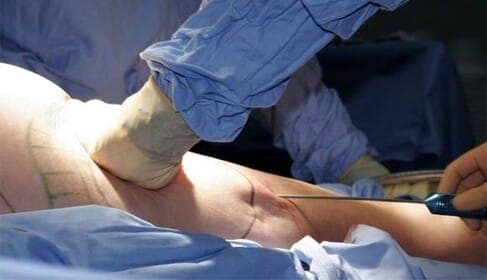
This is the most common type of liposuction. Through a small skin incision, the area is infiltrated with a special solution. This cocktail dissolves and loosens fat and contains sterile saline, a local anesthetic and a solution that reduces bleeding. Its purpose is to reduce sensation during the procedure and to help loosen the fat from its connective tissue capsule so it can be more easily suctioned. Then, through a very small incision, a metal cannula of appropriate size is inserted into the fat tissue; with controlled movements the fat is loosened and removed using surgical vacuum suction.
If a large volume of fat is present, multiple incisions and suction from different directions may be necessary.
Ultrasound-assisted liposuction (UAL)
This type of procedure is sometimes combined with conventional liposuction. In UAL, the surgeon inserts a metal probe that delivers a form of energy under the skin. This energy disrupts the fat cell membranes and liquefies the fat to facilitate removal. A newer version, VASER (vibration amplification of sound energy at resonance)-assisted liposuction, uses a device that may also help improve skin tone.
Laser-assisted liposuction (LAL)
In LAL, the surgeon uses a laser fiber introduced through the incision to break down fat deposits. The fat is then removed using a thin tube.
Power-assisted liposuction (PAL)
In this method a thin tube moves rapidly back and forth. The vibration allows the surgeon to remove dense fat more easily and faster. PAL may sometimes cause less pain and swelling. It can also allow the surgeon to remove fat more precisely, so it is chosen when a lot of fat needs to be removed or when you have had previous liposuction.
All methods, despite their different mechanisms, aim to dislodge fat from the connective tissue framework and remove it using vacuum suction.
Risks of liposuction
Liposuction carries risks, but in the great majority of cases the procedure is uneventful. Risks include bleeding and reactions to anesthesia. Other risks include:
- Contour irregularities: your skin may appear bumpy, wavy or loose due to uneven fat removal, poor skin elasticity or scarring. These changes can be permanent.
- Fluid accumulation: temporary pockets of fluid (seromas) may form under the skin. These may need to be drained with a needle by the surgeon.
- Numbness: you may feel temporary or permanent numbness in the treated areas because nerves in the area can be irritated.
- Infection: skin infection is rare but possible. Severe infection can be life-threatening.
- Internal organ injury: rarely, if the thin tube used during the operation penetrates too deeply, it can puncture an internal organ. Emergency surgery may be required to repair the organ.
- Fat embolism: pieces of loosened fat may break away and become trapped in a blood vessel. They can travel to the lungs or brain. Fat embolism is a medical emergency.
- Kidney and heart problems: when large-volume liposuction is performed, changes in the body’s fluid balance can occur. This can cause life-threatening kidney, heart and lung problems.
- Lidocaine toxicity: lidocaine is a medication used for pain control and is often included in the fluids used during liposuction. Although lidocaine is generally safe, lidocaine toxicity can occur and cause severe cardiac and central nervous system complications.
- Venous and lymphatic problems: liposuction, even when done “gently,” is a destructive procedure. The stronger the suction, the more it damages vessels within the fat tissue, particularly lymphatic vessels. It is quite common for lymphedema to appear years after liposuction as a consequence of this destructive effect; it can even present 10–15 years after the procedure.
- Later complications can include abnormal scar formation, such as hypertrophic scarring or keloid formation. These are also caused by tissue damage.
Because of the risk of early complications (edema, hematoma, postoperative bleeding, significant blood loss, vascular and nerve injury, pulmonary embolism, fat embolism), you will remain at the clinic for a few hours after the operation, or overnight if general anesthesia was used. Later at home, if you notice even the smallest sign of complications, contact your doctor immediately.
The risk of complications increases if the surgeon works on a larger body surface area or performs multiple procedures during the same operative session. Usually a maximum of four areas are addressed at one time, each area roughly the size of a palm. In some areas the skin laxity is already so significant that if fat is removed from beneath it, the skin could not recover its position. In such cases, additional plastic procedures may be considered, such as abdominoplasty or an inner-thigh lift.
After the procedure
Expect some pain, swelling and bruising after the procedure. You may receive medications for pain relief and to reduce the risk of infection.
The incisions may be left open and temporary drains (tubes) may be placed to help fluid escape from the body. While still in the operating room you will be fitted with a special compression garment, which you will need to wear for 6 weeks. This lightweight, elastic, corset-like garment helps the skin re-drape and tighten over the treated area. You may bathe while wearing this garment; after bathing it can be dried in a few minutes with a hairdryer.
If you do not wear the garment, fluid may accumulate between the skin and the muscle where fat was removed, causing the skin to bulge and compromising the result.
At the first follow-up two days later, the doctor will check that everything is fine and remove the dressings. You may then bathe for the first time. Sutures are removed on the 8th day after the procedure, and the six-week checkup will determine whether the skin has properly reattached.
After that, wearing the compression garment can be discontinued. Following liposuction, swelling, bruising and blue discoloration may appear in the treated area and typically resolve in about 10 days. Due to tissue damage, a certain firmness can be felt in the treated area, which will fully soften after about 6 months.
During this time some shape changes are expected, as the remaining fat continuously attempts to find its new position. It can take weeks to months for the swelling to subside and for the final result to become visible.
Only a few millimeter scars remain in the treated area.
These scars will also be checked at the three-month and six-month follow-ups. You will likely feel physical pain during the first week, but this is usually well managed with pain relief. Recovery time depends greatly on the size of the treated area, but after a day or two of rest you can generally return to work. The result is immediately visible, but it can take several months for the final result to develop. You must wait until the liposuction site has fully healed and the body’s final shape has formed.
Within a few months the treated area will usually appear slimmer — and it will remain so unless weight gain continues. But that is another story.

