
Meditation as Medicine: Reduces Pain, Lowers Blood Pressure and Improves Sleep
“Meditation means more than sitting under a tree and daydreaming. Meditation is the highest form of awareness. Meditation means noticing what kinds of thoughts, feelings, concepts, and beliefs touch us, and recognizing that there is a ‘pause,’ a choice, and that we do not have to respond to everything automatically.” Kurt Tepperwein Meditation is a mental state in which [...]

“Meditation means more than just sitting under a tree and daydreaming. Meditation is the highest awareness. Meditation means sensing what kinds of thoughts, feelings, concepts, and beliefs touch us, and recognizing that there is a ‘gap,’ a choice, and that we do not have to react to everything automatically.” Kurt Tepperwein
Meditation is a mental state in which you allow both your body and mind to surrender to calm and turn your focus inward. The goal is to achieve inner peace and tranquility. If during meditation you can fully disengage from your surroundings, the experience can feel like entering an altered state of consciousness.
Meditation has been practiced for a long time in various forms across cultures. There are few well-documented historical traces. Indian writings indicate that meditation techniques date back as far as 5,000 years ago. Researchers speculate that primitive hunter-gatherer cultures discovered and refined meditation—often while staring into the flames of a fire.
Meditation reached Western cultures thousands of years after it was first practiced in the East. In the 1960s and 1970s many researchers began to investigate the effects of meditation on the human mind and body, uncovering its beneficial impacts on health and well-being.
Today meditation and mindfulness practices are widely accepted as parts of a balanced lifestyle, and many believe that meditation’s healing properties have direct effects on sleep, pain management, and even blood pressure.
How to meditate?
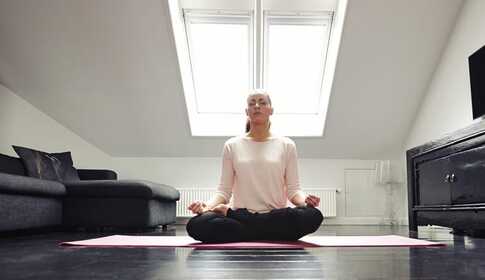
There’s no need to be afraid of meditation. There is no such thing as “I just can’t do it”! Find a quiet, peaceful place. Sit down with a straight back. If you can, sit cross-legged. Don’t lean against a wall or furniture. Rest your arms loosely on your thighs. Close your eyes and let things “happen.”
Choose a soothing focus to concentrate on, for example:
- Your own breathing, feeling the air flow in and out of your lungs
- A sound (a long, resonant “Om”)
- A short prayer
- A positive word such as “rest” or “calm”
- A phrase like “I breathe in peace, I breathe out tension”
If you choose a sound, repeat it silently or whisper it for a while. Focus only on that.
- Relax and let go.
- Don’t worry about how you are doing it.
- If you notice your mind “wandering,” simply take a deep breath and gently bring your attention back to your chosen focus.
- You can repeat this practice as many times as you like—during the day and especially before bedtime!
Meditation — in practice you must neither force anything on your mind nor allow it to wander unchecked. Buddha
Meditation for better sleep
Have you ever gone to bed after a long day and found that a thousand thoughts are still running through your head under the covers? If so, know that these wild, scattered thoughts can ruin your night’s rest. A sleepless, restless night can reduce your next day’s performance, cause daytime sleepiness, and even harm your health.
A 2015 study published in JAMA Internal Medicine suggests that meditation—a calming practice that focuses on breathing and experiencing the present moment—can help end restless nights.
The study group included middle-aged and older adults who suffered from sleep disturbances. Half of the participants took part in a program that introduced them to meditation, while the other half took part in a program that taught sleep hygiene. Both groups met once a week for six weeks. When the results were compared, the meditation group showed marked reductions in insomnia, fatigue, and depression by the sixth session.
Meditation creates a relaxation response that is the opposite of stress. For most people, sleep problems are closely linked to stress. The relaxation response, however, can help alleviate many stress-related conditions.
Meditation against pain
Stress and pain are much more closely related than you might think—the experience of pain causes stress, and stress can cause or worsen pain. Meditation and relaxation can help break this cycle and serve as gentle, holistic pain relief. Meditation-based treatments focus on the connection between mind and body.
Studies show that meditation increases pain tolerance and self-efficacy while reducing anxiety and depression, and can be used as a pain-relieving approach. Mindfulness meditation has been successfully applied to treat pain, including headaches, back pain, chest pain, and gastrointestinal discomfort.
Meditation in managing high blood pressure
“Meditation is not a drug treatment”—this is the prescription Dr. Robert Schneider gives patients who come to him with high blood pressure.
Dr. Schneider is the dean at the Maharishi Vedic Medical School in Fairfield, Iowa. Over recent decades, Schneider has researched the benefits of ancient medical practices, with Transcendental Meditation being a key element. In the past 30 years, roughly 600 studies worldwide have examined the effects of Transcendental Meditation on blood pressure.
“Transcendental Meditation is a simple mind-body technique that allows you to experience a state of restful awareness or alert calm,” says Schneider.
Learning Transcendental Meditation is not difficult, but it is advisable to learn it with the help of a qualified instructor. “You need someone to guide you and provide feedback,” he says. “Otherwise you won’t experience the full effect.”
“Meditation is a leap: first from the head to the heart, then from the heart to being. You go deeper and deeper into yourself, where calculations must be left behind, where all logic loses its meaning.” Osho

