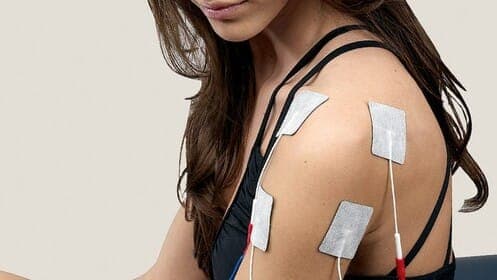

If you don't yet know what TENS is and how it works, it's worth reading the main TENS primer first. If, however, you already own a TENS device and need help navigating the many programs, you've found the right article.
 Key idea
A TENS program is composed from a combination of the four basic parameters (frequency, pulse width, amplitude, waveform). Even a device with 200 programs can essentially be reduced to four main families: conventional, acupuncture-like, burst and modulated. Variety (variation between programs) is the basis for long-term use.
 The four parameters of a TENS impulse
Every TENS program differs by the settings of these four parameters. The 2011 Francis–Marchant–Johnson study (Physiother Theory Pract) also highlighted that parameter choice decisively affects the sensation and duration of the treatment.
Number of pulses per second. The TENS range is 2–150 Hz. Low frequency (2–10 Hz) targets the endogenous opioid system, while high frequency (50–150 Hz) acts on Aβ fibres according to the gate control theory. The 2004 Kararmaz et al. study investigated the clinical effect of frequency choice.
Duration of a single pulse in microseconds. This parameter determines which nerve fibre types are stimulated. Conventional TENS uses a short pulse (typically 50–100 μs) – this reaches only sensory fibres, producing a tingling sensation but not causing muscle contraction. The acupuncture-like / endorphin TENS works with longer pulses (usually 100–400 μs), which can reach motor fibres and produce mild, rhythmic muscle contractions. Burst and modulated programs are combinations of these.
Current strength in milliamperes. TENS range: 10–80 mA. The appropriate level is above the sensation threshold but below the pain threshold: a strong tingle that is not painful. The user can adjust it, and it can be gradually increased during treatment to counter habituation.
Temporal shape of the pulse. Modern TENS devices use a compensated biphasic square wave: the current polarity reverses many times per second, preventing electrochemical buildup under the skin. A precise square wave gives a more pleasant sensation than a distorted waveform. Details: electrode polarity article.
 The four basic program types, technically
Parameters: 50–150 Hz frequency, short (10–80 μs) pulse width, low–medium amplitude (above sensory threshold, below motor threshold; typically 0–30 mA). Mechanism: gate control theory (stimulation of Aβ sensory fibres).
User experience: strong, pleasant tingling, NO muscle contraction (short pulse does not reach motor threshold). Onset: 1–5 minutes. Duration after switch-off: 1–3 hours. The 2021 Ebadi et al. RCT compared conventional TENS with endorphin (acupuncture-like) TENS.
Parameters: 2–10 Hz frequency, longer (100–300 μs) pulse width, amplitude above motor threshold (typically 20–50 mA, depending on device and tolerance). Mechanism: stimulation of motor fibres + may promote release of endogenous opioids (endorphin, enkephalin).
User experience: the longer pulse can reach motor threshold, so it produces rhythmic, mild muscle contractions (a tapping sensation). Onset: 15–30 minutes (slower than conventional). Duration after switch-off: up to 4–8 hours. It can be especially useful for chronic, long-lasting pain.
Parameters: the program emits grouped alternating high (typically 70–100 Hz) and low (2–15 Hz) frequency bursts. The two frequencies are usually alternated in 2–3 second blocks. Pulse width is typically 100–250 μs. In the literature this is known as “Dense–Disperse” or “Han-waveform”; many modern home TENS devices (e.g. Globus, MTR) include this combined program.
Mechanism: the high-frequency phase blocks pain signals via Aβ fibres (gate control), while the low-frequency phase stimulates the endogenous opioid system via Aδ fibres. Thus the program activates both main analgesic mechanisms simultaneously.
User experience: a fluctuating, “pulsing” sensation – fine tingling during the high-frequency phase, mild muscle twitching during the low-frequency phase. Many users find it more pleasant and varied than monotonous conventional or endorphin programs. It is a particularly good choice for chronic, mixed pain patterns (e.g. deep muscle tension plus surface pain).
Parameters: frequency, pulse width and/or amplitude continuously vary (typically within a ±20–50% range). Mechanism: parameter variation helps reduce habituation.
User experience: a “dynamic” sensation, not monotonous. With sustained, multiple daily use the effectiveness tends to remain longer than with fixed-parameter programs. For long-term treatment of chronic pain, the modulated program is particularly recommended.
Technical comparison of the four programs
| Parameter | Conventional | Endorphin | Burst | Modulated |
|---|---|---|---|---|
| Frequency | 50–150 Hz | 2–10 Hz | 2–15 Hz / 70–100 Hz alternating (2–3 sec blocks) | variable |
| Pulse width | 10–80 μs (short) | 100–300 μs (long) | 100–250 μs | variable (±50%) |
| Amplitude (mA) | 0–30 mA (above sensory threshold) | 20–50 mA (above motor threshold) | 15–40 mA | variable |
| Mechanism | Gate control (Aβ fibres) | Endorphin (Aδ + opioid) | Gate control + Endorphin together (Dense–Disperse / Han) | Against habituation |
| Onset | 1–5 minutes | 15–30 minutes | 5–15 minutes | variable |
| Duration | 1–3 hours | 4–8 hours | 2–6 hours | variable |
| Muscle contraction | No (short pulse) | Yes (long pulse) | Fluctuating: tingling + rhythmic twitch | Variable |
| Optimal indication | Acute pain | Chronic deep pain | Mixed complaints | Persistent chronic |
 Avoiding habituation – technical approaches
Habituation is the nervous system's natural response to repeated stimulation: after a strong effect in the first one to two weeks you will notice a gradual decline. This phenomenon does not indicate a faulty device or “worn-out” nerves, but normal neural adaptation. Habituation can be mitigated by several technical strategies:
 Technical strategies against habituation
- Choose a modulated program – variable parameters can reduce habituation. This is the single most direct technical choice to limit tolerance.
- Rotate programs – one day conventional, another day acupuncture-like, a third day burst. The nervous system responds differently to each parameter family.
- Frequency rotation – if your device allows, alternate between 80, 100 and 120 Hz within conventional programs.
- Increase amplitude – gradually raise the current during the session as the nervous system adapts. Always stay in the pleasant "tingling" zone; do not cross the pain threshold.
- Rest day – 1–2 days off per week “re-sensitizes” the nervous system.
- Vary electrode position – don't always place pads on the exact same spot. Shifting by 2–3 cm stimulates different nerve fibres.
 How many programs should your device have?
Market devices come with 4 up to 20+ TENS programs – but not every program differs meaningfully. The four core families are present in every device; the “200 program” label typically represents the same parameter set with 4–8 body-region presets.
| Number of programs | What it offers | Who it's enough for |
|---|---|---|
| 4–8 programs | 4 basic families (conventional, acupuncture, burst, modulated) + 1–4 body-region presets | Entry-level, occasional users (e.g. Dolito) |
| 10–25 programs | Basics + refined parameter variants + EMS programs | Daily use, chronic pain (e.g. Globus Elite SII) |
| 50–100+ programs | Modulated variants, sport protocols, clinical protocols, multifunction (TENS+EMS+MENS+IF) | Chronic, multiple complaints, athletes (e.g. Globus Genesy SII, Genesy 1500) |
| 200+ programs | Clinical protocols, Kotz, iontophoresis, detailed anatomical presets | Sports physiotherapist, rehabilitation center (e.g. Globus Genesy 3000) |
 Quantity vs. quality
The number of programs alone is not a guarantee of effectiveness. A quality 8-program device (accurate square wave, fine intensity control) will often serve a specific indication better than a cheap 100-program device. Detailed buying guide: How to choose a TENS device.
Frequently asked questions
You'll find it in the user manual marked as "modulated", "modulation", "M" or "M-mode". After selecting the program, the constantly changing sensation during treatment indicates modulation: intensity or frequency perceptibly varies. Entry-level devices rarely include modulated programs; mid and premium ranges usually do.
In TENS practice the two labels are equivalent: pps = pulses per second. Hz (Hertz) means the same technically. A 100 Hz conventional TENS and a 100 pps conventional TENS are the same parameter.
Only one program runs per channel at a time. If your device has 2 channels, in THEORY you can run different programs on each channel (e.g. conventional on the lower back, acupuncture-like on the calf), but most home devices output the same program on both channels. Within one session you can, however, switch programs: e.g. 15 minutes conventional, then 15 minutes acupuncture-like.
No. Burst TENS works with grouped pulses aimed at sensory nerves for analgesia. EMS (electrical muscle stimulation) targets motor fibres and produces true muscle contractions for strengthening or regeneration. Detailed differences: TENS, EMS, MENS differences.
Each pulse reverses polarity – a positive and a negative phase form the "pulse." "Compensated" means the net charge of the two phases is balanced, so no electrochemical accumulation (acid/base reactions) occurs under the skin. This ensures safe long-term use. Details on polarity: electrode polarity article.
 Summary
A technical deep-dive into the four basic TENS program families (conventional, acupuncture-like, burst, modulated) and the four main parameters (frequency, pulse width, amplitude, waveform).
TENS users who already know the basics and want to understand what 4–200 programs on their device mean and how to use them optimally.
The four basic programs are present in every device; to avoid habituation use a modulated program or rotate programs. Program count alone does not guarantee effectiveness – parameter quality is equally important.
Read the main TENS primer, or if you're choosing a device: TENS device buying guide. For pad and polarity questions: pads article, polarity article.
Scientific references
- Ebadi S, et al. The effect of acupuncture-like and conventional transcutaneous electrical nerve stimulation on neck pain: a randomized controlled trial – Journal of Bodywork and Movement Therapies, 2021. PubMed: 34776182
- Francis RP, Marchant P, Johnson MI. Comparison of post-treatment effects of conventional and acupuncture-like transcutaneous electrical nerve stimulation – Physiotherapy Theory and Practice, 2011. PubMed: 22007892
- Kararmaz A, et al. The effect of TENS frequency on the success of analgesia – Urological Research, 2004. PubMed: 15243722