
 What does peripheral neuropathy mean?
Peripheral neuropathy is damage to the nerves that carry messages between your brain and the rest of your body — touch, pain, temperature and muscle control. When these “wires” are damaged, the messages get distorted: that’s why you may feel numbness, burning or tingling where there is no obvious cause — or you may not feel what you should.
The most common causes are diabetes, alcohol, certain autoimmune diseases, and chemotherapy or radiation therapy. Some forms are hereditary, and it can also arise after injury.
Depending on which nerves are affected, neuropathy can impair sensation (numbness, burning pain), movement (muscle weakness), and the automatic functions of internal organs (digestion, blood pressure, sweating) — often several at once.
 Key point
I’ll be direct: there is no causal cure for peripheral neuropathy today — it can’t be healed outright. But that doesn’t mean nothing can be done. Symptoms — especially pain — can be meaningfully reduced, and progression can be slowed. And in practice the biggest help rarely comes from the clinic, but from what you do at home, regularly, over the long term. In this article I show you exactly that.
Symptoms of peripheral neuropathy
The most common symptoms that affect most people:
- Burning, tingling pain, numbness, a "stinging" sensation — typically on the feet and hands
- Muscle weakness, cramps, muscle twitching, and over time muscle wasting
- Unsteady balance, a stumbling gait
- Loss of pain sensation — dangerous because you may not notice injuries
- Sleep disturbance, low mood — as a consequence of ongoing pain
If nerves controlling internal organs are involved, less commonly you may see: dizziness on standing, digestive problems (diarrhea, constipation), bladder problems, sweating disorders, difficulty swallowing, irregular heartbeat. These always require medical evaluation.
Who does what in treatment — and what you take on
Because neuropathy symptoms can mimic many other conditions, the first step is always a neurological assessment. The doctor makes the diagnosis, looks for the cause (e.g. uncontrolled diabetes, vitamin deficiency), and tells you what is safe and recommended.
But here’s the point few say out loud: in chronic, slowly progressive conditions — and neuropathy is one of them — most help does not come from the hospital or clinic. There you get the diagnosis and the treatment framework. The result comes from what you do at home every day, for months: regular exercise and home physiotherapy. A monthly clinic visit cannot replace daily home work.
| Helper | What they give | What they don’t give |
|---|---|---|
| Doctor | Diagnosis, treatment of the cause, framing the plan | They don’t carry out the daily treatment for you |
| Physiotherapist, therapist | Teaches the exercises and home device use, monitors progress | Appointments are infrequent and short; the substantive work happens on the intervening days at home |
| Home devices | Enable daily, regular treatment | A single session won’t fix anything — regularity provides the effect |
Prevention — where you can do the most
If you have diabetes, kidney disease or other chronic conditions, you can delay or even prevent neuropathy. The recipe isn’t complicated — it just needs consistency: regular exercise, healthy eating, losing excess weight, stopping alcohol, correcting vitamin deficiencies — and for diabetics, careful blood glucose control.
What you can do at home — six methods, one common rule
Pain medications for neuropathy often only help partially and require trial and error. That’s why you should know the home physiotherapy methods with scientific backing: TENS, microcurrent, softlaser, magnetic therapy (PEMF), BEMER and muscle stimulators — with vibration therapy as a complement.
The common rule for all is the same: use them in courses, regularly, over weeks — don’t expect change from a single session. You don’t need to try every method: usually start with one, and expand with your doctor’s agreement.
 TENS — fast pain relief
A TENS device delivers small electrical impulses through the skin to the painful area and thereby “blocks” pain signals to the brain. Important to know: it’s symptomatic treatment — it doesn’t restore damaged nerves, but it can make daily life much more bearable. Its advantage is that the effect is fast, sometimes within minutes.
“Does it really work, or is it just advertising?”
TENS is one of the most studied methods in this field. International neurological guidelines recognise it for relieving diabetic nerve pain, and independent summaries show users of TENS had significantly greater pain reduction than those receiving sham treatment — and more recently encouraging results have appeared for post-chemotherapy neuropathy.1,2,3,4
How to apply it?
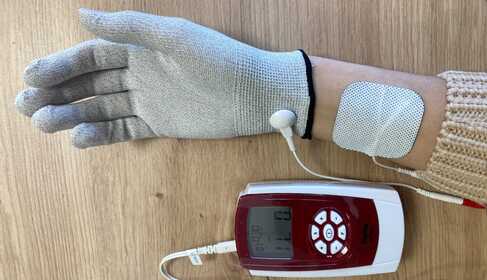
For neuropathy the most comfortable solution is a glove or sock electrode: pull it onto your hand or foot (it conducts better if dampened with lukewarm water). Stick an adhesive electrode above your wrist or ankle, 3–5 cm from the edge of the glove/sock, then connect to the device: the red lead to the glove/sock electrode, the black to the adhesive electrode. Start program 1 and increase intensity gradually.
 Important safety warning
In severe neuropathy, because of damaged nerve endings, you may not feel the pinprick of the current! Therefore never increase intensity based solely on "as long as I feel it": generally 15–25 mA is sufficient. Currents > 50 mA can cause skin burns — which you might not notice because of the neuropathy.
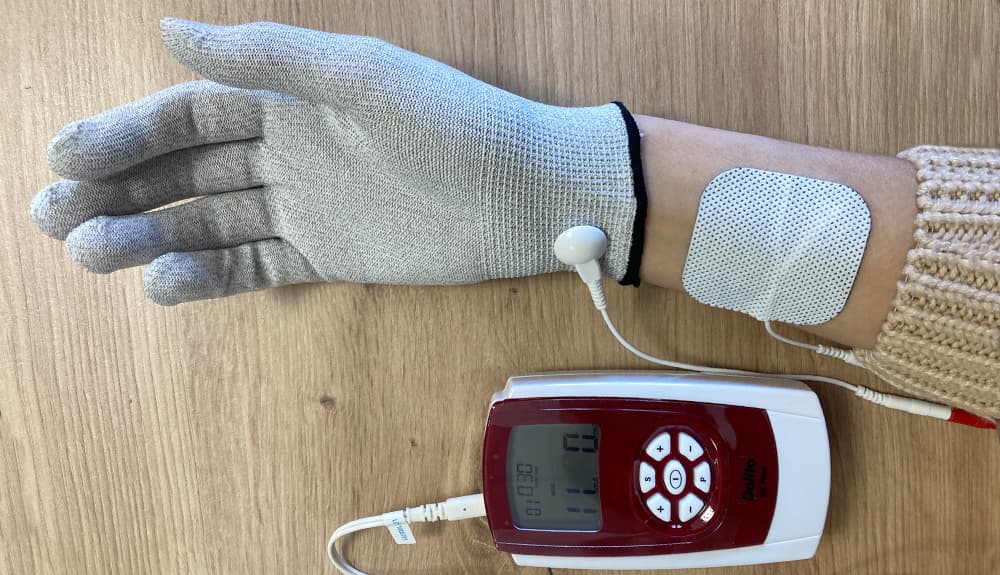
The same application method can help reduce pain from rheumatoid small joint inflammation.
What device do you need?
Good news: for neuropathic pain relief the simplest TENS devices are sufficient — you don’t need an expensive machine.
Dolito TENS device
Simple, reliable entry-level model — the most common choice for home neuropathy treatment.
Myolito TENS/EMS device
TENS + muscle stimulation in one device — choose this if muscle weakness is an issue, because later you can also use it for the 6th method (muscle stimulation).
Required accessories: glove electrode, sock electrode.
Microcurrent — the gentler sibling of TENS
Microcurrent therapy works with electricity like TENS, but at much lower intensities, so you don’t feel the treatment. It doesn’t block pain signals; instead it quietly supports cellular energy production and regeneration.
“When is it a better choice than TENS?”
Two situations: if the tingling of TENS is unpleasant, or if impaired sensation prevents you from safely setting TENS intensity. Because you can’t "overturn" microcurrent, it is the safer option for people with severe neuropathy. Clinical observations report pain reduction and improved sensation — but the research base is currently smaller than for TENS, which is important to know.
How to apply?
Microcurrent devices use adhesive electrodes (glove and sock electrodes cannot be used). Sessions are typically 20–40 minutes, once or twice daily.
Softlaser — light for the cells
Softlaser emits low-energy red or near-infrared light into the tissues. Cells’ small "power plants" (mitochondria) use this light: they produce more energy, inflammation may decrease, and nerve regeneration processes get support. The effect is not immediate — it builds up gradually over weeks.
“Can light help the burning pain in my foot?”
A summary of studies in diabetic neuropathy patients suggests softlaser can reduce pain, improve sensation and quality of life — typically after 4–8 weeks of regular treatment. Researchers note the results are encouraging but larger trials are needed to define optimal protocols. The method is under active scientific investigation and elderly patients have also shown favourable responses.5,6,7
How to apply?
Treat the painful area, moving point by point, once daily. Treatment time depends on device power and area size — follow the device manual.
Personal Laser L400
Ideal for home use — compact, easy-to-use entry model.
Energy Laser L500
Higher power, shorter treatment times — if you plan to treat multiple areas. You don’t need both: one softlaser is enough.
PEMF (pulsed electromagnetic field) therapy — a course for circulation
PEMF therapy’s magnetic pulses pass through skin, muscle and bone. They can help in two ways: improve circulation in the smallest vessels so more oxygen and nutrients reach damaged nerves, and reduce inflammation. A major advantage is convenience: you put the applicator on and the treatment can run while you watch TV or sleep.
“What can I realistically expect?”
I’ll give you an honest picture: results are encouraging but not uniform. In a rigorous nearly 200‑participant trial diabetic patients receiving magnetic therapy had about one-third greater leg pain reduction than those receiving sham treatment, and another study measured improved nerve function. However, some trials found no clear pain difference while showing tissue-level changes. The latest reviews consistently report anti-inflammatory, edema-reducing and circulation-improving effects.8,9,10,11 In short: it can provide meaningful help, but don’t expect miracles — and here too regularity over weeks brings results.
What device do you need?
Choose a PEMF device that has tissue-regeneration or anti-inflammatory programs:
Magnum 2500
Two-channel, 320 Gauss, 52 programs — a good starting point for most home users.
Magnum 3000 Pro
Two-channel, 400 Gauss, 70 programs — worth it if you need stronger field strength or more programs. One device is enough.
BEMER — magnetic therapy tuned to the capillaries
BEMER is a specific form of magnetic therapy focused on microcirculation. In neuropathy this can be a direct hit, because one root problem is slowed blood flow in the tiniest vessels, leaving nerves "hungry".
“What did patients experience?”
In a survey of several hundred patients, six weeks of BEMER use improved sleep, reduced pain and boosted general wellbeing; in a more structured trial, BEMER combined with rehabilitation produced better pain reduction than rehabilitation alone.12,13
 Consideration
BEMER is not a cheap investment. If you can afford it, it may help not only neuropathy symptoms but also any condition caused or worsened by poor circulation.
Muscle stimulation — against muscle loss
Neuropathy is not only painful: over time muscles weaken and waste away, and an unsteady gait increases the risk of falls and fractures. That’s why muscles need special attention. The number one "medicine" here is regular exercise: 30–40 minutes of walking or cycling daily. A muscle stimulator comes into play when movement is impossible due to illness, pain or weakness.
“Can muscle be preserved if I can’t move?”
Yes — muscle stimulation is among the best-supported methods for this. Reviews show neuromuscular electrical stimulation can substantially slow or prevent muscle loss in people who are temporarily or permanently unable to exercise. In one experiment, during five days of forced immobility the stimulated group virtually did not lose muscle mass while the control group did.14,15,16
Important order: muscle stimulation does not replace movement — it supplements or temporarily substitutes it. In my article on strengthening the thigh muscles I show a specific program and devices; the full range is in the muscle stimulator category.
Vibration therapy — for balance
One of the most frightening symptoms of neuropathy is not the pain but the loss of balance. People who don’t "feel" their feet’s position stumble, fear stairs, and are afraid to go out alone. Vibration therapy uses a gently vibrating platform: the vibration stimulates sensory nerve endings in the sole, lower leg and knee — helping the body relearn position sense. Research shows a few weeks of regular use can measurably improve balance in people with diabetic neuropathy. This is a complementary method — use it alongside the above, not instead of them. Avoid after recent fractures or surgical wounds.
Other supportive methods
Relaxation, meditation, yoga: for people with chronic pain, stress management is an important part of treatment — tension amplifies pain perception.
Infrared heat therapy: neuropathy is often accompanied by cold, poorly perfused feet. An infrared lamp or infrared sauna provides deep warming that can improve peripheral blood flow and relieve the sensation of cold feet — as a complement to the methods above.
 Before you start treatment
For safe use it is important to know the contraindications. In the following conditions none of the presented methods should be used without consulting your physician.
Contraindications applicable to everyone
- Implanted pacemaker or defibrillator — TENS, PEMF, BEMER and muscle stimulators are all prohibited
- Insulin pump or other active electrical implant
- Pregnancy (especially over the abdominal area)
- Active bleeding or severe clotting disorder
- Active malignant disease in the treatment area
- Severe cardiac arrhythmia
- Active thrombosis
- Acute febrile infection
- Epilepsy
Modality-specific additional warnings
| Method | Additional warning |
|---|---|
| TENS, muscle stimulator | Never place electrodes on the head, the front of the neck (carotid) or directly over the heart |
| Softlaser | Direct irradiation into the eyes is prohibited — eye protection is required |
| PEMF / BEMER | For old (more than 10 years) ferromagnetic metal implants consult your physician |
| Microcurrent | Same contraindications as for TENS |
| Vibration therapy | Avoid after fresh bone fracture or recent surgical wound |
Detailed information on softlaser contraindications: Softlaser therapy contraindications
Possible side effects
The therapies presented are generally well tolerated. Rare side effects may include: skin irritation under electrodes or muscle-fatigue-like sensation (TENS, muscle stimulator), mild warming or temporary skin redness (softlaser), mild headache or dizziness (PEMF, BEMER), temporary numbness in the sole (vibration therapy). Microcurrent typically has no perceptible side effects — that’s one of its advantages. If you experience persistent or unusual symptoms, stop the treatment and consult your physician!
Further reading
Softlaser therapy can support the treatment of many other conditions — an overview of home application areas is in the Softlaser therapy at home article. If you are new to the method, start with the comprehensive softlaser guide.
 Summary — Quick overview
- TENS: fast pain relief
- Microcurrent: imperceptible, safe cellular support
- Softlaser: light-assisted nerve regeneration
- PEMF / BEMER: circulation improvement, inflammation reduction
- Muscle stimulator: slowing muscle loss
- Vibration therapy: relearning balance
Frequently asked questions
TENS usually has the fastest effect (can be felt within minutes). Softlaser, PEMF and BEMER effects emerge gradually and become tangible after 4–8 weeks of regular treatment. Microcurrent also works longer-term — but is safer than TENS in severe neuropathy.
Yes — in fact the most effective approach is often a combination. For example: TENS during the day for pain, softlaser in the evening for the affected area, overnight PEMF/BEMER for the whole body. Don’t use multiple devices at exactly the same time — leave 1–2 hours between them.
TENS effects are almost immediate but symptomatic — the pain may return some time after treatment. Other methods (laser, PEMF, BEMER, microcurrent, vibration) tend to produce gradual and more lasting effects, usually after 4–8 weeks of regular use. Be patient — nerve regeneration is a slow process.
Yes. These physiotherapy methods are intended to complement pharmacological treatment, not replace it. Monitor blood glucose regularly and consult your treating physician.
Unfortunately TENS, muscle stimulators, PEMF and BEMER are all contraindicated with a pacemaker. One safe home option that remains is softlaser. Vibration therapy and infrared heat may also be options, but consult your cardiologist first.
Current medical opinion is that neuropathy is not fully reversible — but progression can be slowed, symptoms can be meaningfully relieved, and in some cases (e.g., neuropathy due to vitamin deficiency or alcohol) partial improvement can be expected after treating the underlying cause.
Sources
- Assessment: Efficacy of TENS in neurologic disorders. Neurology (2010). PubMed: 20018714
- TENS for symptomatic diabetic peripheral neuropathy: meta-analysis (2010). PubMed: 20510476
- Wireless TENS for chemotherapy-induced peripheral neuropathy: randomized controlled trial (2023/2024). PubMed: 37993030
- Cochrane Review: TENS for neuropathic pain in adults (2017). PubMed: 28944453
- Low-level laser therapy for painful diabetic neuropathy: systematic review. Diabetes & Metabolic Syndrome (2019). PubMed: 31405692
- LLLT for diabetic peripheral neuropathy: protocol for systematic review and meta-analysis. BMJ Open (2022). PubMed: 36104132
- Low-level laser therapy case report in an 81-year-old male with diabetic neuropathy (2025). Parker Journal
- PEMF for painful diabetic symmetric peripheral neuropathy: double-blind RCT. Journal of Diabetes Science and Technology (2023). PubMed: 37542366
- PEMF for diabetic neuropathic pain: 225-patient randomized trial (2009). PubMed: 19577022
- PEMF in management of diabetic polyneuropathy (Musaev et al.). PMC2812751
- PEMF and LIPUS in peripheral nerve regeneration — review. MDPI (2025). MDPI 26/19/9311
- BEMER therapy effects on sleep, pain and quality of life. Journal of Complementary and Integrative Medicine (2013). PubMed: 23940071
- BEMER for CRPS-I: randomized controlled pilot trial (2018). PubMed: 29985719
- NMES for muscle impairment: critical review (2017). PMC5683854
- NMES prevents muscle disuse atrophy. Acta Physiologica (2014). PubMed: 24251881
- NMES for physical activity benefits. Frontiers in Sports and Active Living (2024). Frontiers 2024