Peyronie's Disease Attacks "Manhood"
Peyronie's disease is a disorder affecting the penis. Hard nodules form in the penis, causing an increasing curvature. In some cases it is painful and in advanced stages can make sexual intercourse impossible. Nevertheless, only a small proportion of those affected see a doctor because of embarrassment. If you notice such symptoms, consult a physician – a urologist or andrologist is appropriate. The sooner you start treatment, the greater your chance of stopping its progression or eliminating the complaint. Read the details!
What is Peyronie's disease?
Erection of the penis occurs when sexual stimulation causes blood to flow into the spongy, so-called cavernous bodies that run along the length of the penis. The cavernous bodies expand, pressure rises and they become firmer. Peyronie's disease is a nodule that appears in the connective tissue layer covering the cavernous body. The number of elastic fibers decreases while fibrin and collagen increase and calcium is deposited between them. As a result, the nodule becomes cartilage-/bone-hard – this is called a "plaque."
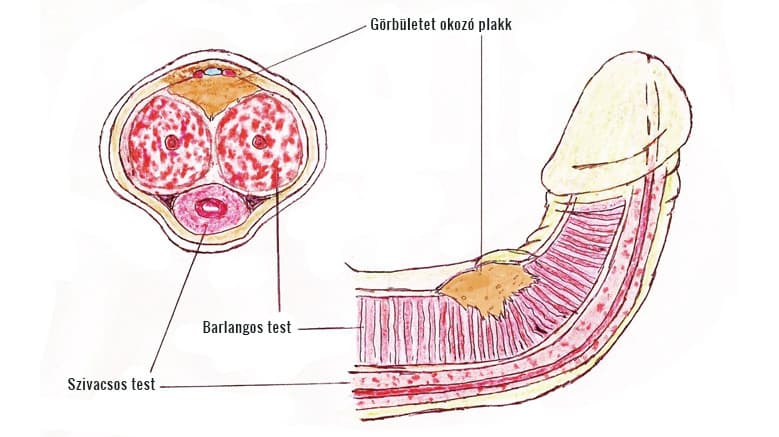
The curvature is mainly visible in the erect state (in severe cases even at rest), because the plaque prevents the tunica of the cavernous bodies from following the increase in size during erection. The side toward the plaque therefore does not expand, its shape distorts and it bends. This can cause pain, erectile dysfunction and even impotence.
As the curvature worsens, the problem also intensifies:
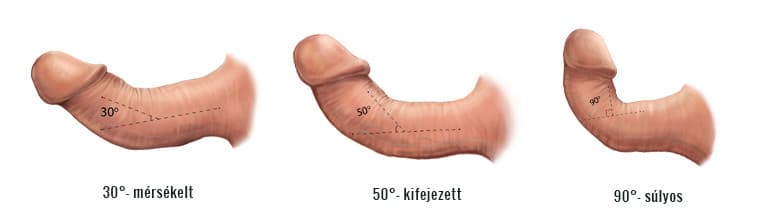
- with curvature between 5–20° intercourse is still possible,
- with curvature between 20–45° it becomes difficult,
- with curvature over 45° intercourse is impossible.
The exact cause of Peyronie's disease is not yet fully known. The fibrin protein is responsible for the formation of the penile plaque. This protein plays an important role in maintaining healthy tissues (including blood clotting and scar tissue formation). If there is too much fibrin, it can also lead to clot formation, causing heart attack, stroke or pulmonary embolism.
In Peyronie's disease, microscopic injury to the penis (or other causes) allows fibrin from the circulation to enter and deposit in the penis. This forms the basis for plaque formation.
The following also play a role in the development of Peyronie's disease:
- diabetes and smoking, which increase fibrin levels,
- chronic prostatitis,
- chronic changes of the glands around the urethra,
- markedly increased sexual activity.
When should you see a doctor?
AS A GENERAL RULE: the earlier the treatment begins, the greater the chance of success. If you delay treatment for months, you may "run out" of the time when the process is still reversible.
In some cases (unfortunately rarer) the problem resolves spontaneously. More often, it will not go away without treatment.
If the shape of your penis has changed recently, has become curved, or you can feel a nodule in it, see a specialist as soon as possible in a urology or andrology (men's health) clinic. Peyronie's disease in its early stage can be treated with certain medications; as time passes, the chance for successful treatment decreases.
How can Peyronie's disease be treated?
Treatment of Peyronie's disease (PD) is a therapeutic dilemma for physicians and there is no "gold standard"—currently no treatment guarantees success.
Some treatments can only be performed in a medical office, but there are also home treatments that you can use under your doctor's guidance.
Medications
The aim of oral medications is to reduce plaque size, penile pain and curvature. A major drawback of oral drugs is that much of the active substance is broken down in the digestive tract and only a very small portion reaches the target: the penis.
Intralesional injection
A drug is injected into the area around the plaque. Yes, the needle is inserted directly into the penis… This can only be performed by a knowledgeable physician under the highest standards of sterility, and even then it is not a pleasant method.
Cavernous body training
The aim of this treatment is rehabilitation rather than sexual pleasure. Physical "training" of the cavernous bodies that give the penis its elasticity can be performed very effectively using a vacuum penis pump.
The vacuum created in the tube placed over the penis induces an erection within 60–90 seconds, which should be maintained for 2–3 minutes. After releasing the vacuum the erection subsides. The exercise should then be repeated 4–5 times daily.
It effectively improves arterial blood supply to the penis and surrounding tissues and thereby increases the body's self-healing processes. Some opinions suggest that macrophage cells (a type of white blood cell) are activated and begin to break down excess fibrinous material, leading to loosening of the plaque.
Click here to find vacuum penis pumps. The device most suitable for this purpose is the Rehabi PVT; it is specifically designed as a medical device for "training." Other devices in the product group can also be used for this, although erection-assist devices are primarily intended for erectile dysfunction.
Ultrasound treatment
In this case one of the effects of ultrasound, called "phonophoresis," is exploited. Ultrasound is applied so that the vibrations help drive the active substance through the skin into the cavernous bodies.
The medication in cream or gel form is applied to the skin over the plaque, then ultrasound at low intensity is moved slowly in circular motions over the plaque for 2–3 minutes.
Ultrasound phonophoresis is usually performed in a physiotherapy clinic, but with a home therapeutic ultrasound device and proper instruction the simple treatment technique can also be performed safely at home.
An appropriate device for this is the M-Sonic 950, which you can purchase via the link.
Iontophoresis
This method uses a weak and safe electric current.
Ionic active substances (charged molecules) move between the two poles of the electric current. A great advantage is that the active ingredient reaches directly and in high concentration where it is needed—directly into the plaque. And all this without needle puncture. Iontophoresis treatment can also be given in a physiotherapy clinic, but with appropriate instruction it can be performed at home using an iontophoresis device. For example, the Genesy SII device may be suitable and can be purchased via the link.
The selection and prescription of drugs to be used for iontophoresis is the responsibility of the treating physician. Iontophoresis requires water-soluble active substances, such as injectable solutions. The most commonly used agents are verapamil, lidocaine and dexamethasone or a "cocktail" of these.
Studies suggest that verapamil treatment should be started in the early stage, when the curvature is still less than 30° and the plaque has not yet begun to calcify. Those whose plaques did not respond to 3 months of verapamil treatment were more likely to require surgery later.
Soft laser
Soft laser treatment effectively reduces plaque size. This requires at least 3 months of daily (i.e. persistent) treatment. It is important to know that treatment should not be stopped completely afterwards, but can be reduced to 2–3 times per week.
One study showed that after successful 3-month therapy, the beneficial effect had worn off 9 months after complete discontinuation. Therefore it is important to treat continuously and regularly.
It can also be said that verapamil injections into the penis followed by long-term soft laser combination showed stronger effects than soft laser treatment alone.
Soft laser is a safe treatment method that may help with long-term use.
The Personal Laser L400 device may be suitable for plaque treatment, with 5–8 Joules (20 seconds/point) application. You can find the Personal Laser L400 in the online store via this link.
Surgical intervention
Surgery should be considered only after at least 3 months of stable condition. At that time either the plaque is excised or the connective tissue on the opposite side is shortened. Partial success with residual symptoms, e.g. incontinence or impotence, is common… surgery should be considered only as a last resort…
I already mentioned that you should consult a specialist immediately at the first signs of the problem, because Peyronie's disease may be treatable in the early stage! If iontophoresis or ultrasound is recommended, you can have it done in physiotherapy or, if you are bothered by lack of privacy, you can obtain a home ultrasound and/or iontophoresis device and treat yourself safely. Use only agents recommended by your doctor for treatment!