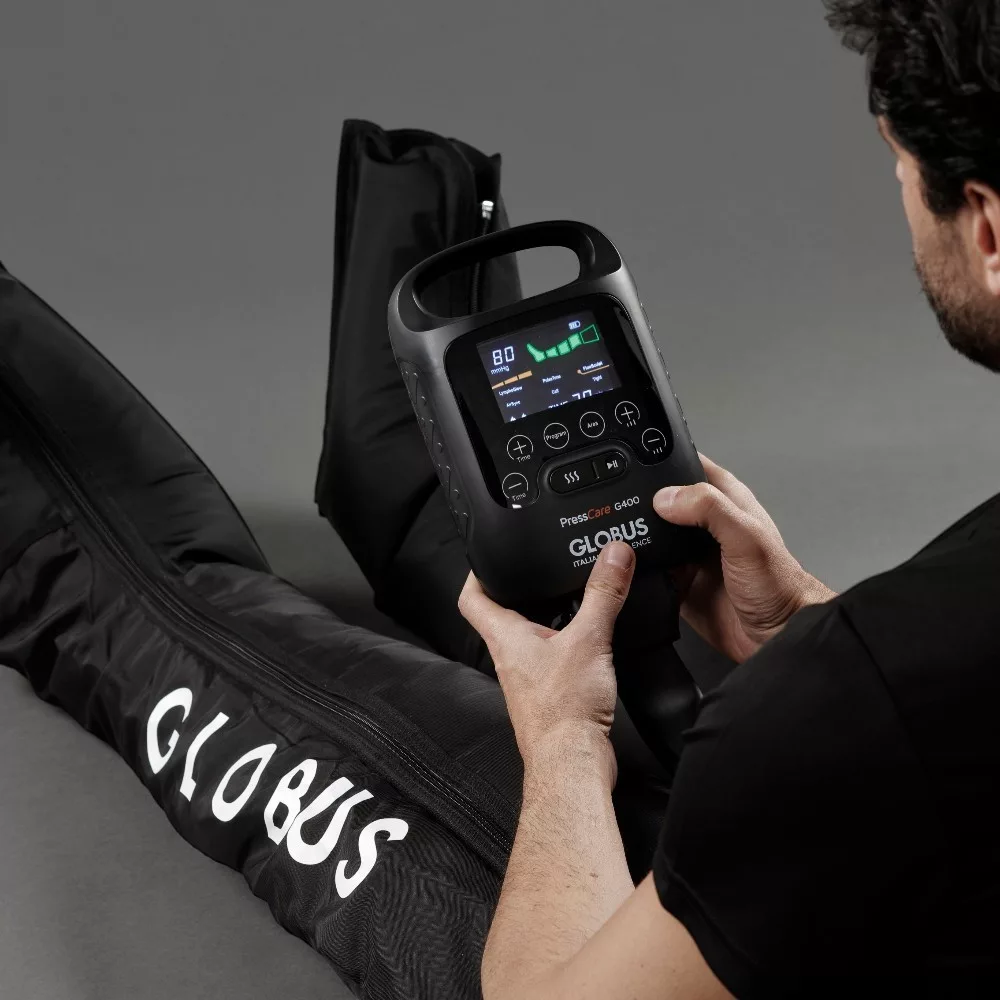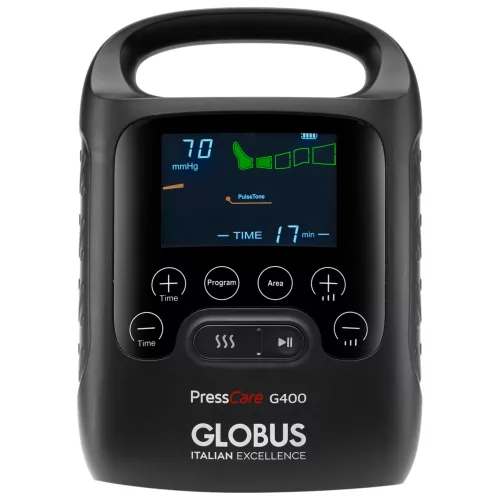
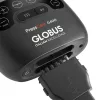
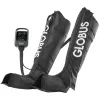
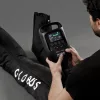
Who is the PressCare G400 for?
Marathons, ultras, multi-day cycling tours, triathlon, high weekly mileage: where the load is serious, muscle recovery is very important. The G400 timer can run for 60 minutes, while the six programmes allow you to choose a treatment that matches your current needs – you need something different immediately after reaching the finish line and on the morning of the third day when your muscles are sore.
An important detail that many people overlook: little effect can be expected from a single treatment – regular use is what makes the difference. In a study examining plyometric loading, the greatest difference appeared 48–72 hours after training, where treatment was carried out regularly and consistently. After a hard training session, it is therefore worth treating the legs not once, but three or four times.
The six programmes are designed for different purposes. LymphoFlow is the longest and slowest sequence, designed to move fluid. PulseTone has a more pulsating, invigorating rhythm. FlowSculpt and AirSync use different wave patterns over the whole leg. The calf and thigh programmes focus on one section each – and the Smart Area function adds 14 chamber combinations.
I write in detail about the relationship between compression and muscle recovery in a separate article, and about use by athletes here.
Office work, hours spent behind a counter, a teaching day or a hairdressing shift: all have one thing in common. The leg muscles hardly pump at all, and fluid collects downwards. This is the most common cause behind heavy-leg sensations, tight ankles and evening leg swelling. The G400 targets this mechanical pooling: the air chambers move upwards from below, directing fluid towards the torso.
A hot summer day, a long flight or extensive driving – after these, the ankle and foot often become swollen. If the symptom keeps returning or affects one side only, always have it investigated first, because persistent leg swelling may have a venous, cardiac, renal or thyroid-related cause. With investigated swelling linked to exertion, however, pressotherapy may be a pleasant evening routine.
When walking is limited, the muscle pump also works less. The longer, low-pressure programme together with foot heating provides a pleasant daily routine – but with venous insufficiency or lymphoedema, leave the heating switched off. The six programmes also mean more menu options than on the entry-level model: if the simplest operation matters most, the G250's two buttons are easier to follow. If you have a chronic illness or take regular medication, it is worth discussing use with your doctor before starting.
The G400 can also be used at home for lymphoedema, and within the PressCare family it is the most suitable model for this purpose: the 60-minute timer covers the longer treatment times described for lymphatic drainage, the LymphoFlow programme provides a specifically slower, longer sequence, and the 19 levels allow finer pressure adjustment. The lower levels, between 40–60 Hgmm, are exactly within the range described as effective for lymphatic drainage.
One request if you use it for lymphoedema or venous insufficiency: leave the foot heating switched off. Heat dilates the blood vessels and may thereby increase swelling – it is useful during recovery and wellness use, but specifically undesirable in the conditions mentioned above. Compression works in exactly the same way without heating.
For arm lymphoedema, do not choose this model, because a cuff for the arm is not currently available for the PressCare device family.
If you are specifically looking for a device for lymphoedema, the Power Q-1000 Premium may be the more capable choice: with a 5–60-minute timer, leg, arm, torso and trouser cuffs, chamber-by-chamber fine adjustment and protocol memory. You can find all the options among the lymphatic drainage devices.
How does intermittent pneumatic compression work?
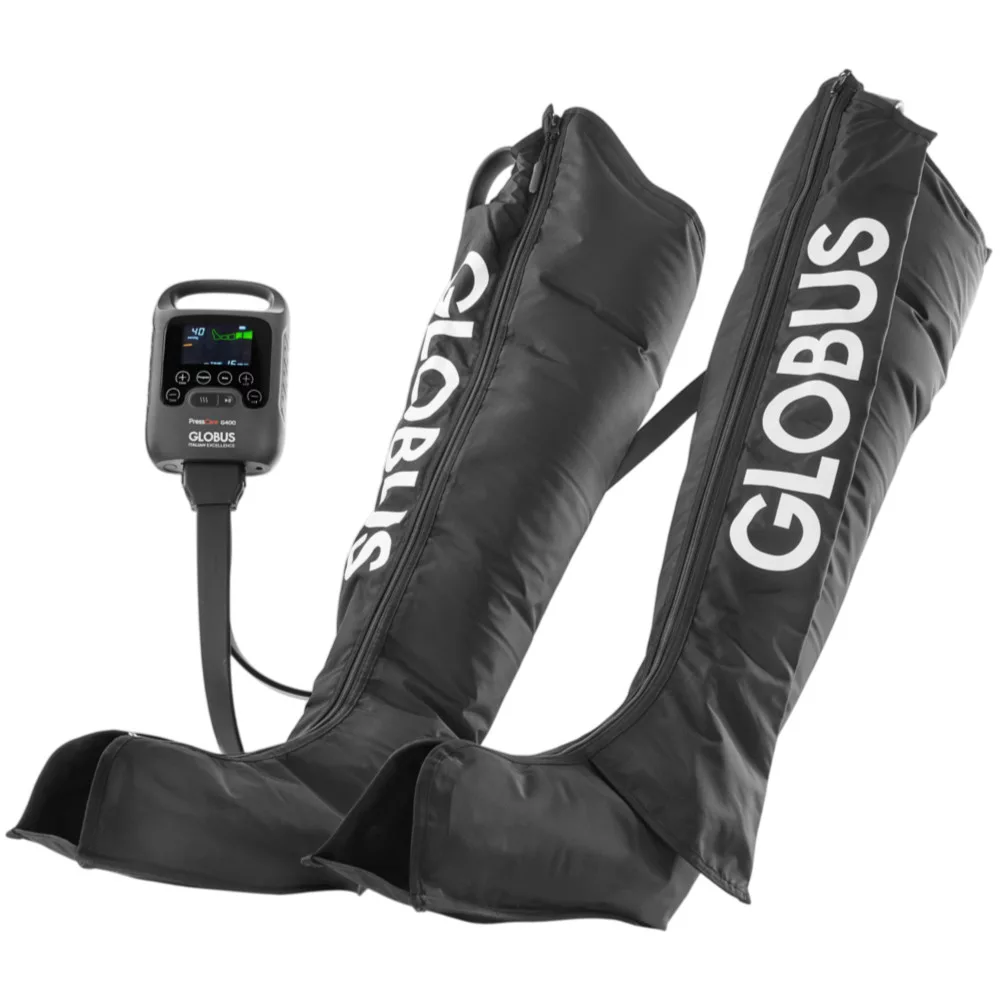
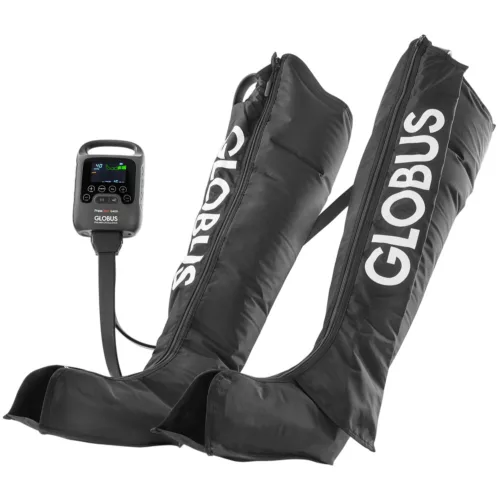
The principle of pressotherapy is simple mechanics. The leg cuff contains five air chambers one above another – in the G400, they have an overlapping design, so the boundaries between neighbouring chambers do not leave an untreated strip. The device does not inflate them all at once. It inflates them in sequence, from the bottom upwards: first at the foot and ankle, then on the lower leg and finally on the thigh. This upward-moving wave directs venous blood and excess fluid between the tissues towards the torso, after which the area refills as the cuff deflates.
In everyday life, this work is done by the leg muscle pump: with every step, the calf contraction pushes blood upwards. After training, while you are resting, and during a whole day of sitting or standing, this pump hardly works – this is where the heavy-leg sensation comes from. The device replaces this missing movement mechanically, in a few tens of minutes.
This is not only a theoretical effect. In a measurement-based study, more blood flowed measurably through the calf during sequential compression, and the proportion of oxygen-rich blood was also higher than without treatment. Increased local circulation is the physical basis on which recovery use is built.
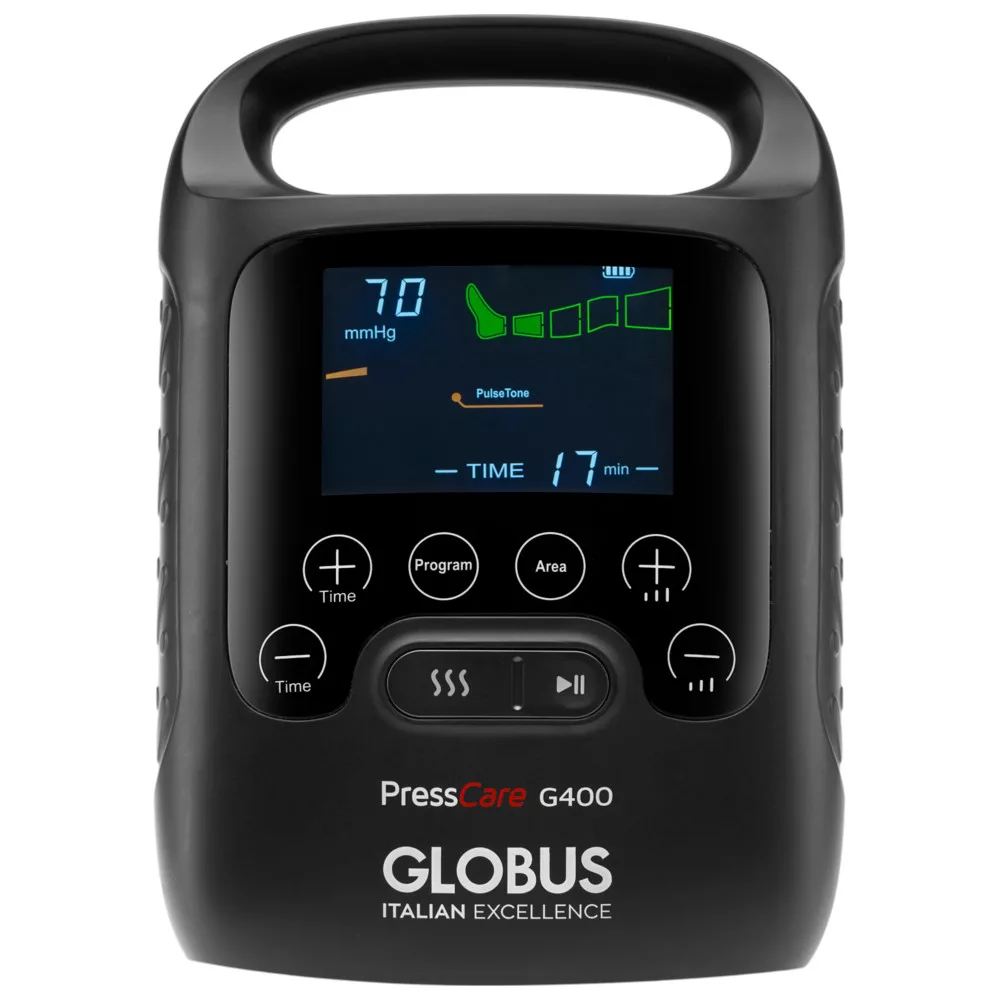
The G400's six programmes vary the same basic principle through different wave patterns, rhythms and pause lengths. LymphoFlow is the slowest and longest, for moving fluid; PulseTone is more pulsating; FlowSculpt and AirSync run different sequences over the whole leg; the calf and thigh programmes focus on one section each. Pressure can be adjusted between 40 and 220 Hgmm in 10 Hgmm steps, across 19 levels, while the Smart Area function lets you choose from 14 chamber combinations.
Foot heating can be switched on at two levels. In a cool home, after winter training or with chronically cold feet, it makes a longer treatment noticeably more comfortable, so it is particularly useful for recovery and wellness use. It is not recommended for lymphoedema or venous insufficiency: heat dilates the blood vessels and may thereby increase the amount of fluid leaving the vessels and entering the tissues, which may worsen swelling. In these conditions, switch the heating off and use the device with compression only.
One important misconception is worth clearing up: higher pressure does not mean better treatment. In sports recovery studies, the most frequently used setting is around 80 Hgmm, while research on lymphatic drainage describes the lower range of around 30–60 Hgmm as effective. 220 Hgmm is the device's upper limit, not the target – the G400's real advantages are its programme selection, longer treatment time and finer 19-level adjustment.
What does pressotherapy provide after training – and what does it not?
The “recovery boot” has come down from elite sport to recreational athletes in recent years. It is worth being clear about what research shows, because this helps you set realistic expectations – and adjust the device parameters accordingly.
1
The most consistent finding: less muscle soreness and tightness
According to the latest analysis summarising 17 studies, intermittent pneumatic compression applied to the legs produced the clearest measurable effect in reducing the feeling of pain and muscle soreness. This is the effect that brings athletes back to it: movement is easier to start the next day, and stairs hurt less.
2
A smaller but measurable effect on muscle function
The same review found a small but measurable advantage for the treated groups in the return of muscle performance. It is not a dramatic difference – but where there is little time between two training sessions or races, even a small difference matters.
3
The established protocol is 20–30 minutes at around 80 Hgmm
The recovery-optimised setting used most often in studies is approximately 20–30 minutes at a pressure of around 80 Hgmm. With the G400, this is well within the lower-middle part of the range: the 60-minute timer adds the option of running slower, longer programmes – such as LymphoFlow – all the way through when you need that on a particular day.
4
The peak effect does not occur on the day of training
In a study examining jumping exercise, the greatest difference between treated and untreated groups appeared 48 to 72 hours after training, where treatment continued on the following days. The practical conclusion is this: after a hard training session or competition, do not use the device only once, but also over the next two or three days – and the six programmes mean you do not have to repeat the same one.
5
What it does not provide: it does not speed up muscle repair itself
We need to be honest here. Studies have produced mixed results for blood markers of muscle damage, and several studies found no difference. So pressotherapy may make you feel better and ready to perform sooner, but it does not speed up the actual repair of muscle fibres. That does not make it worthless – it simply puts it in the right place: an additional tool, not magic.
6
And what nothing can replace
The three pillars of recovery are sleep, nutrition and fluid replacement, and carefully planned training load. Pressotherapy comes fourth, alongside these, and adds most when the other three are also in order. No device can make up for the difference in an athlete who sleeps poorly or is undernourished.
How should you use it? – In 6 steps
1
Choose the size
The G400 comes with three leg cuff sizes (S, M and L), and you order the package with the selected size. Attention: the G400 size chart differs from those of the two smaller models in the range, so use the table in the Configurator section, not the G250/G280 values. If your thigh is close to the upper limit, request an extension: the S/M/L extension adds 7 centimetres at the ankle and 9 centimetres at the thigh.
2
Charge it before taking it on the road
The G400 works from mains power and its built-in lithium-ion battery, and the package also includes a carry case. Charge it before leaving for a competition or training camp – you will not need to look for a socket at the venue. At home, mains operation is simpler, especially for the longer 45–60-minute programmes.
3
Put on the leg cuff and connect it
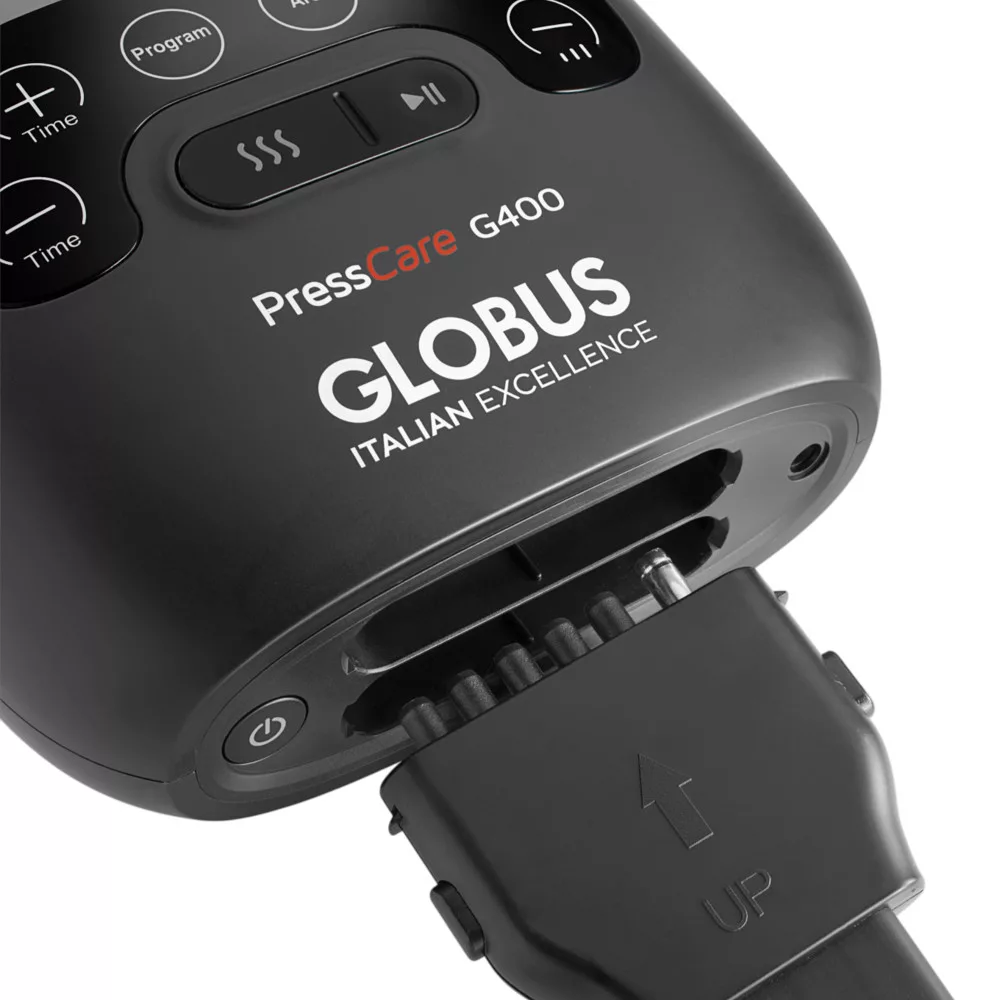
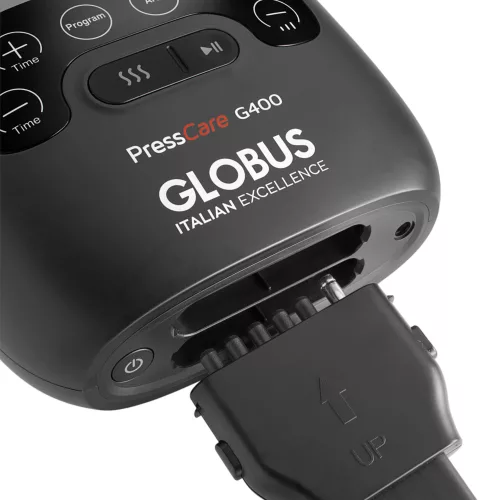
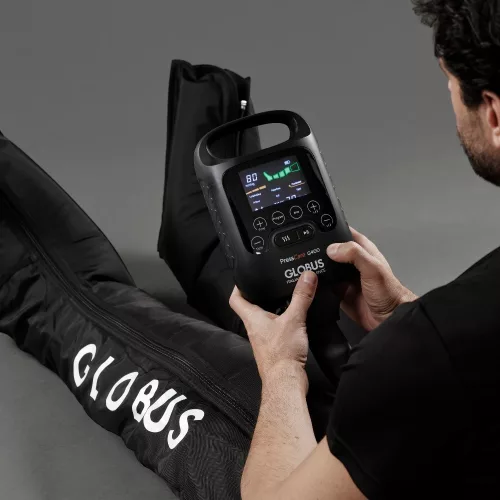
It is easiest to do this sitting or semi-reclined: open the zip, step inside, pull the cuff up to the top of the thigh and close it again. Thin sports trousers or long socks underneath make the treatment more comfortable and also protect the cuff. The cuff should lie smoothly on the leg without creasing. Then insert the air hoses into the device connectors.
4
Choose the programme, area, pressure and heating
Start with a gentler programme and the lowest 40 Hgmm level. If it feels comfortable, increase it step by step. For recovery, around 80 Hgmm is the established setting. If you want to treat only one section, use the Smart Area function to select the chamber combination. Foot heating has two levels – it feels good in a cool room or after winter training, but it is not an essential part of treatment; leave it switched off for lymphoedema and venous insufficiency. If you experience numbness, a stabbing sensation or pain, always reduce the pressure.
5
Set the timer and raise your legs
The timer can be set between 10 and 60 minutes in 5-minute steps. For sports recovery, the established range is 20–30 minutes; with longer, slower programmes – such as LymphoFlow – 45–60 minutes may be appropriate. Keep your legs slightly raised during treatment – even a cushion under the calves makes a difference. The device switches off automatically when the time has elapsed.
6
Use it regularly
A single treatment feels pleasant, but regular use is what makes the difference. For athletes: after hard training or competition, include it on the following two or three days as well, because the peak effect occurs around 48–72 hours – and make use of the fact that you do not have to repeat the same programme. For heavy legs: after daily or every-other-day use, assess the situation after a few weeks. After treatment, put on your compression stocking if you wear one, and take a short walk.
Frequently asked questions about the PressCare G400
The device must not be used in acute deep vein thrombosis or suspected deep vein thrombosis – compression may be dangerous in this situation. After a thrombosis has resolved and been treated, use may begin after approximately 3 months, with the treating doctor's approval. There is no single answer for varicose veins either: it depends on the stage and complications, so a prior vascular surgeon's or GP's opinion is required. I write more about the background of varicose veins here.
In a complicated pregnancy (for example, pregnancy-related varicose veins), only with the treating doctor's approval. With severe heart failure, this device and two cuffs must not be used simultaneously, because the returned fluid volume places strain on the circulation. With untreated high blood pressure, the first step before use is to bring the blood pressure under control.
Both have a place. A gentler treatment immediately after training (mode A) is part of the cool-down and feels good for warm muscles. Research shows, however, that the difference is greatest in the 48–72-hour window – in other words, treatment on the following and third day is at least as important as treatment on the day of training. After a heavy load, you get the most from it by spending 20–30 minutes on it for three or four consecutive days.
No, and that is not what it is for. Pressotherapy targets circulation and the return of fluid, stretching targets range of movement, easy jogging during the cool-down targets metabolism, and massage acts locally on the soft tissues. They complement one another. The sequence that works well in practice is: cool-down → shower → pressotherapy → relaxed stretching.
Definitely not instead of warming up – warming up prepares the nervous system and muscles, which passive treatment cannot do. In the hours before a competition, while sitting and waiting, many people do use it to feel lighter, typically with a shorter, lower-pressure setting. Do not try something new for the first time on competition day: fine-tune the setting during training days.
Do not use it during the acute phase of a recent muscle injury, strain, sprain or knock – swelling is part of the healing process at this stage, and compression may worsen the situation, especially if bleeding is also present. After an injury, the treating doctor or physiotherapist should determine how and when to return to use. Muscle soreness is not an injury: it is a normal response to loading, and the device may be used for it.
No. There are two separate situations in which it must be omitted.
With lymphoedema and venous insufficiency, heating is not recommended. Heat dilates the blood vessels and may thereby increase the amount of fluid entering the tissues – in other words, it may worsen swelling. This is not a problem during recovery and wellness use; in fact, warmth is particularly pleasant there. In these conditions, however, it is undesirable.
For safety reasons, it must also not be used if sensation in the skin of the foot is reduced or absent – this is common in diabetes and advanced neuropathy – because the skin cannot signal in time if it becomes too hot. It should likewise be avoided over inflamed, damaged or recently scarred skin.
If you are unsure, use the device without heating: compression will still work in exactly the same way.
Yes, it can be used for this, and within the PressCare family it is the most suitable model for this purpose: 60-minute timer, LymphoFlow programme and 19 pressure levels. It may be suitable for mild and moderate forms. One important detail: leave the foot heating switched off, because the vasodilating effect of heat may worsen swelling. The Power Q-1000 Premium offers more in this respect: pressure starting at 30 Hgmm (the G400's lower limit is 40), a 5–60-minute timer for longer lymphatic drainage programmes, separately adjustable pressure for each chamber, stored protocols, and arm, torso and trouser cuffs – an arm cuff is not available for the PressCare range. I write in detail about the conditions on the lymphoedema and lipoedema pages.
Measure three things: the circumference at the thickest part of the thigh, the ankle circumference and the length from the groin to the heel. The G400 leg cuffs are 76 cm long in size S (76 cm thigh, 47 cm ankle), 87 cm in size M (80 / 47 cm), and 96 cm in size L (86 / 50 cm). These values are not the same as the G250 and G280 sizes, so use the G400's own table. If any of your measurements is close to the upper limit, choose the larger size or the extension – a tight cuff is uncomfortable and is not more effective.
Start at the lowest level, 40 Hgmm, and increase step by step from there. For sports recovery, the setting most often used in studies is around 80 Hgmm; for lymphatic drainage, research describes the 30–60 Hgmm range as effective. 220 Hgmm is the device's upper limit, not a recommendation – the real benefit of the 19 levels is the fine increments, not the maximum value. The correct setting is firm but comfortable throughout – if you become numb, feel a stabbing sensation or pressure marks remain, reduce it.
It is worth it if you will use the extra features: 60-minute treatment, six programmes to switch between, foot heating and 19-level fine adjustment. If your routine is 20–30 minutes a day at one setting, the G250 or G280 provides the same basic function in a smaller and lighter body – the G400 weighs 1.2 kg, compared with 645 and 745 grams. You can find the full comparison in the Comparison section.
Yes. It has a built-in lithium-ion battery, and the carry case is included – it is the only model in the range where this is standard equipment. The control unit weighs 1.2 kg and measures 228 × 155 × 87.5 mm, so it is a deliberate item to allow for in your bag, not an incidental one. The device must not be used while driving – it may be used as a passenger, in a stationary vehicle or while resting.
Yes. A separate 5-chamber abdominal belt can be ordered for this purpose (125 × 35 cm), with a 40 × 35 cm extension, and it connects to the same control unit. There is no arm cuff in the PressCare range. The leg cuff contains air chambers and hose connectors, so it must not be put in a washing machine: wipe it with a slightly damp cloth and let it dry completely before the next use.
This is how your device is configured
You order the PressCare G400 together with the leg cuff size: the package contains the control unit, two leg cuffs of the same size and a carry case. Three steps and your configuration is complete.
1
Measure your leg
You need three measurements: the circumference at the thickest part of the thigh, the ankle circumference and the length measured from the groin to the heel. Keep the tape measure smooth without pulling it tight. The result may differ in the morning and evening – use the larger measurement.
2
Use the G400's own table
The G400 leg cuff sizes differ from the G250 and G280 values – especially the thigh circumference for size L (86 cm instead of 84) and at the ankle. The stated values are the cuff's upper limits. If any measurement is close to the limit, move up to the next size. If the length and circumference indicate two different sizes, the circumference is decisive.
3
Request an extension if needed
If your thigh or ankle exceeds even the largest size, the S/M/L extension provides 7 cm of extra circumference at the ankle and 9 cm at the thigh. If you also want to treat the abdomen, hips or buttocks, the separately orderable 5-chamber abdominal belt connects to the same device.
| Size | Length (groin–heel) | Thigh circumference | Ankle circumference |
| S | 76 cm | up to 76 cm | up to 47 cm |
| M | 87 cm | up to 80 cm | up to 47 cm |
| L | 96 cm | up to 86 cm | up to 50 cm |
| Extension (S/M/L) | – | +9 cm | +7 cm |
| Abdominal belt (5 chambers) | 125 × 35 cm | extension: 40 × 35 cm | |
What does the package contain?
The PressCare G400 arrives as a ready-to-use system: the leg cuffs and carry case are included. You only need to choose the size.
- 1 pc PressCare G400 control unit (5 overlapping air chambers, 6 programmes, Smart Area, heated foot section, built-in lithium-ion battery)
- 2 pcs leg cuffs of the same size (S, M or L, according to the version ordered)
- 1 pc carry case
- 1 pc mains power supply (100–240 V AC, 50/60 Hz)
- 1 pc user manual
Separately orderable accessories: extension (S/M/L, +7 cm at the ankle and +9 cm at the thigh) and 5-chamber abdominal belt (125 × 35 cm) for the abdomen, hips and buttocks, with its own 40 × 35 cm extension.
Switch off the control unit and disconnect it from the mains before cleaning. Do not use thinner, petrol, alcohol or aggressive chemicals. The leg cuff contains air chambers and hose connectors, so it is not washable and must not be put in a washing machine: wipe it with a slightly damp cloth and let it dry completely before the next use.
This is particularly important after training: a cuff put on sweaty skin develops odours more quickly. Thin sports trousers or long socks underneath solve this problem and also help the cuff last longer. Let the heated section cool completely before cleaning. Release the air before storage and avoid sharp folds. Do not leave the lithium-ion battery completely discharged for months, and avoid prolonged exposure to heat – do not leave the device in a car in summer.
Use the device only with the supplied Globus-brand cuffs and power supply – cuffs from other manufacturers may have a different number of chambers and different connectors. Repairs and battery replacement may be carried out only by a professional or authorised service centre.
Do not leave the device within reach of children or people with limited abilities without supervision. During treatment, the cuff must not cover an open wound, recent scar or skin lesion, and there must be no jewellery or tight strap on the leg beneath which pressure could become trapped. Use foot heating only when skin sensation is intact; with lymphoedema and venous insufficiency, leave it switched off. The device must not be used while driving – it may be used as a passenger, in a stationary vehicle or while resting.
PressCare G250, G280 or G400 – which one is right for you?
All three models work with five air chambers, so the basic principle of compression is the same. The difference is not the number of chambers, but the range of programmes, the precision of adjustment, the maximum treatment time and whether the device can be taken somewhere without a socket.
| PressCare G250 | PressCare G280 | PressCare G400 | |
| Number of air chambers | 5 | 5 | 5 (overlapping design) |
| Pressure range | 40–160 Hgmm | 40–180 Hgmm | 40–220 Hgmm |
| Intensity levels | 13 | 15 | 19 |
| Modes | 2 (gentle activation, deep massage) | 3 (+ combined sequence) | 6 (LymphoFlow, PulseTone, FlowSculpt, AirSync, calf, thigh) |
| Smart Area chamber selection | none | 14 combinations | 14 combinations |
| Heating | no | no | 2 levels |
| Timer | 10–30 minutes | 10–30 minutes | 10–60 minutes |
| Power supply | mains | mains + Li-ion battery | mains + Li-ion battery |
| Control unit weight | 645 g | 745 g | 1.2 kg |
| Control unit dimensions | 172 × 133 × 71 mm | 172 × 133 × 71 mm | 228 × 155 × 87.5 mm |
| Carry case included | no | no | yes |
| Leg cuff sizes | S / M / L | S / M / L | S / M / L |
| Abdominal belt (available separately) | yes | yes | yes |
| Arm cuff | none | none | none |
The G250 is enough if the device will stay at home in one place and the aim is post-training recovery or relief from evening heavy-leg sensations. It fully covers the basic recovery protocol – 20–30 minutes at around 80 Hgmm – and is the lightest and simplest model to operate in the range.
The G280 is worth considering if you want to use it without a socket: in a training bag, changing room, competition venue or hotel. In addition, you get a third combined mode and Smart Area chamber selection, allowing you to target the calf or thigh separately.
The G400 is for people who need longer and more varied treatment: a 60-minute timer, six programmes (including the longer, slower LymphoFlow), heated foot section and the finest 19-level adjustment. Heating is useful for recovery and wellness; with lymphoedema and venous insufficiency, use it switched off. In return, the device is larger and heavier – with a carry case.
It is worth being clear, however: a higher maximum pressure is not an advantage in itself. In practice, few people use 220 Hgmm, while the established setting in sports recovery studies is around 80 Hgmm. The real differences between the models are the programme range, treatment time and portability – not which one presses harder.
If you are specifically looking for a device for lymphoedema, all three PressCare models can be used for it, but the Power Q-1000 Premium is the more capable choice for this purpose: lower starting pressure, 60-minute programmes, chamber-by-chamber fine adjustment, protocol memory, and arm, torso and trouser cuffs.
Technical data
| Product name | PressCare G400 pressotherapy device |
| Number of air chambers | 5, with overlapping design (sequential inflation from the bottom upwards) |
| Pressure range | 40–220 Hgmm, in 10 Hgmm steps |
| Intensity levels | 19 |
| Programmes | 6 preset programmes: LymphoFlow, PulseTone, FlowSculpt, AirSync, calf, thigh |
| Smart Area chamber selection | 14 chamber combinations |
| Foot heating | 2 levels |
| Timer | 10–60 minutes, in 5-minute steps |
| Power supply | mains, 100–240 V AC, 50/60 Hz, and built-in lithium-ion battery |
| Control unit dimensions | 228 × 155 × 87.5 mm |
| Control unit weight | 1.2 kg |
| Leg cuff sizes | S: 76 cm length / 76 cm thigh / 47 cm ankle · M: 87 / 80 / 47 cm · L: 96 / 86 / 50 cm |
| Extension (available separately) | S/M/L – +7 cm at the ankle, +9 cm at the thigh |
| Abdominal belt (available separately) | 5 chambers, 125 × 35 cm; extension: 40 × 35 cm |
 When must you NOT use the device?
Pneumatic compression directs fluid towards the torso, so in the following conditions treatment must not be used, or may be started only with the treating doctor's approval:
- Acute deep vein thrombosis or suspected deep vein thrombosis
- Severe heart failure
- Active skin infection in the treated area (erysipelas, cellulitis)
- Severe peripheral arterial disease (arterial narrowing in the limb)
- Untreated high blood pressure
- Active malignant tumour
- The period immediately following surgery
- The first trimester of pregnancy and complicated pregnancy
- Open wound, leg ulcer or recent scar in the treated area
- Acute phase of a recent muscle or ligament injury in the treated limb
- Absent skin sensation in the treated limb (for example, advanced diabetic neuropathy) – foot heating should also be avoided in this situation
- Lymphoedema and venous insufficiency – compression may be used, but the foot heating function is not recommended because the vasodilating effect of heat may worsen swelling
Not sure? Consult your treating doctor before use.
 Important information
The PressCare G400 is a pressotherapy (intermittent pneumatic compression) device intended for home use. The manufacturer intends it to support circulation, recovery after physical exertion and relief of heavy-leg sensations. The device bears the CE conformity marking. This description is not medical advice, and the device does not replace investigation of leg swelling or circulatory symptoms, diagnosis or treatment recommended by a doctor.
Persistent, recurring or one-sided leg swelling must always be investigated: it may have a venous, cardiac, renal or thyroid-related cause. If swelling develops suddenly and is accompanied by pain, warmth or redness, urgent medical assessment is required. If you have a chronic illness, take regular medication, or have had thrombosis or vascular surgery, discuss use of the device with your doctor beforehand. Use foot heating only when skin sensation is intact; heating is not recommended with lymphoedema or venous insufficiency because the vasodilating effect of heat may worsen swelling – compression treatment can be carried out without heating in these conditions. The treating doctor or physiotherapist should determine how to return after a sports injury. Only a doctor may change existing treatment.
This description is for information only and is not medical advice. Pressotherapy is an additional procedure and does not replace treatment recommended by your doctor; results may vary between individuals and become assessable with regular use.