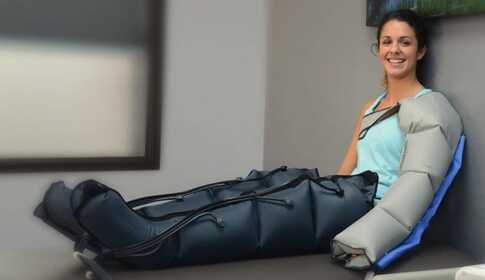

 What is pneumatic compression?
In competitive sports every second, even every hundredth of a second, counts. Many athletes train hard and prepare for competitions. During training, metabolic processes that provide the energy for muscle work produce many breakdown products (metabolites) – especially when training is performed at high intensity, near the aerobic–anaerobic threshold. One of the best‑known of these substances is lactic acid: when it accumulates in the muscles it causes fatigue and stiffness – and in untrained people it causes delayed onset muscle soreness (DOMS).
In this state you must reduce intensity at the next session, otherwise an injury may occur. If you lower intensity, performance improvement may not happen – which could mean saying goodbye to good results. Supporting recovery is therefore not a luxury, but an integral part of athletic performance.
You don’t have to be an athlete to wake up the day after physical activity with unpleasant heaviness in your limbs. After age 35, especially if you exercise irregularly, you may notice that after a friendly soccer game or basketball, or a bit of cycling, even walking feels uncomfortable; your thigh may feel uncomfortably tight going down stairs, almost painful. You can thank the metabolites left in your muscles for this. For symptomatic differential diagnosis the leg swelling triage article – sport section is useful.
 Key point
Pneumatic compression (IPC) "massages" the limb or trunk with segmented cuffs and rhythmic pressure. By supporting venous return and lymphatic circulation it can favorably influence muscle fatigue, lactic acid accumulation and DOMS. A typical protocol after training is 20–30 minutes at 80–100 mmHg. The pillar (general sports compression): compression therapy for athletes.
The importance of muscle recovery
Athletes have long known how important it is to eliminate metabolites. The traditional “cool‑down” after training is an old method that consists of lower‑intensity movements – slow jogging followed by stretching and relaxation exercises focused on the muscles most worked during the session.
Katinka Hosszú's cold‑water baths also serve recovery. Nowadays, alongside or partly replacing traditional methods, instrument‑based recovery techniques are becoming more widespread: muscle stimulation, compression (pressure) therapy, and cold‑compression.
Faster muscle recovery is crucial in sport. Those who recover faster can sustain high‑intensity training for longer. Since muscle strength and performance increase mostly at high intensity, it’s obvious that you should use every tool available to speed recovery.
Another important role of recovery is reducing the incidence of injuries: stiff, fatigued muscles are more prone to injury. Recovery procedures should therefore be started immediately after activity, but within a maximum of 90 minutes.
 Pneumatic compression – how does it work?
You can connect cuffs that treat the legs, trunk and arms to the compression device. Which cuffs you use depends on what you trained: if you worked the upper body, you would naturally use arm and trunk cuffs afterward.
The cuffs are made up of multiple segments, so‑called air chambers. The device inflates these one by one or in groups, in a preset sequence, to the set pressure. This compresses the muscles and the vessels within them. By adjusting the inflation sequence you can direct and channel the fluid in the tissues as well as the blood in capillaries and veins.
The treatment loosens stiff muscles, removes excess blood and fluid, while also "carrying away" and squeezing metabolites and lactic acid out of the muscles.
When should you use it?
It is worth using pneumatic compression after every training session on the muscles most heavily used. There are cuffs for the legs, arms and trunk, so you can treat practically any area. It can always be used after an injury once the acute phase has passed (48–72 hours of cold‑compression), because it passively mobilizes the muscles, favorably affects microcirculation and can support healing.
It is a useful aid not only after training but also during competitions that include repeated efforts – for example between consecutive bouts for fencers or between matches in combat sports. As a complement to massage and other techniques, it can enable more optimal recovery.
On long competition trips (flights or car journeys over 4 hours) IPC helps not only recovery but also prevents venous stasis – this is especially important because athletes are also at risk of travel‑related thrombosis during travel.
In the United States it is already so popular that not only sports clubs use it: at gyms you can choose so‑called Recovery services after training (massage, sauna, muscle stimulation, pneumatic compression, ice bath).
IPC sports recovery protocol
| Parameter | Recommendation |
|---|---|
| Timing | Immediately after training or within max. 90 minutes |
| Duration | 20–30 minutes |
| Pressure | 80–100 mmHg (clinical studies have used the 100–200 mmHg range) |
| Position | Legs elevated (on a couch or bed, slight elevation) |
| Frequency | After every intensive training, and between competition matches |
| Combination | With static compression socks (especially recommended for athletes with venous complaints), massage, adequate sleep and hydration |
 Power Q-1000 Premium – detailed video demonstration
I made a detailed video in which I demonstrate compression recovery using the Power Q-1000 Premium pneumatic compression (also known as a lymphatic‑massage) device:
Devices recommended for athlete recovery
Power Q-1000 Premium lymphatic‑massage device
An advanced home device with multiple programs and higher comfort – one of the best choices for sport recovery (video demo above).
Power Q-8060 lymphatic‑massage device
Professional‑level 6‑chamber device with a higher pressure range – for competitive athletes and dense training cycles.
Power Q-2200 lymphatic‑massage device
Mid‑level 4‑air‑chamber device – an entry choice for athlete recovery at an affordable price.
More Power Q models and the full buying guide: lymphatic‑massage device category – sport section and technical buying guide.
 Before you start – contraindications
- Acute deep vein thrombosis or suspicion of it
- Severe, decompensated heart failure
- Acute skin infection or open wound on the treatment area
- Active malignant tumor in the treatment area without physician approval
- Fresh acute muscle injury in the first 48–72 hours – use cold compression first
 Acute injury – cold‑compression first
If you have an acute muscle injury (sprain, strain, traumatic DOMS), cold‑compression is recommended in the first 48–72 hours – not IPC. Details: ice massage / cold‑compression therapy.
 Scientific background
Maia 2024 – meta‑analysis
Based on 17 studies and 319 participants, lower‑limb IPC may modestly reduce muscle pain and perceived fatigue after exercise.1
Martin 2017 – muscle damage markers
Concurrent IPC treatment alongside HIIT reduced markers of proteolysis (protein breakdown) in skeletal muscle, which is a sign of more favorable recovery.2
Stedge 2021 – endurance athletes
A critically appraised review suggests IPC may beneficially influence exercise‑induced muscle damage in endurance athletes; faster recovery may lead to indirect performance benefits.3
Fernández‑Lázaro 2020 – multisport tournament
The combination of IPC and cold water immersion favorably supported physiological and perceptual recovery in athletes at an international multisport competition.4
Further guides on sport and compression topics
Besides IPC, several home modalities and clinical contexts can support sport recovery and the treatment of related conditions:
Sport recovery pillar and parallel modalities
- Compression therapy for athletes – pillar article on all recovery modalities
- Ice massage / cold‑compression – parallel modality (RICE, acute injury)
- Muscle stimulators (EMS) devices – support for muscle tone after recovery
Related venous and symptomatic conditions
- Home treatment of varicose veins – athlete varicose vein considerations
- Thrombosis – when your vein clots – pillar article
- Travel‑related thrombosis – for athletes on competition trips
- Leg swelling triage – sport section – when recovery is appropriate and when to seek medical care?
Home device categories
Frequently asked questions
Optimally within 30–90 minutes – at this time the recovery window is still open. In shorter breaks between competition bouts (30–60 minutes) it can also be effective.
No, it complements it. Manual massage acts locally (soft‑tissue release, trigger points), while IPC provides more systemic circulatory support. The two together have a stronger effect.
In the first 48–72 hours after an acute muscle injury, cold‑compression is the choice (inflammatory phase). For “mild” DOMS (non‑traumatic), IPC can be applied as early as 1 day after training.
A minimum of 4 air chambers is recommended for sports recovery so that the wave motion is finer and more effective. The Power Q-8060 (6 chambers) and the Power Q-1000 Premium meet this; the 4‑chamber Power Q-2200 is an entry‑level option.
 Summary
Sources
- Maia F et al. (2024). Effects of lower-limb intermittent pneumatic compression on sports recovery: A systematic review and meta-analysis. Biology of Sport. PubMed: 39416507
- Martin JS et al. (2017). Concomitant external pneumatic compression treatment with consecutive days of high intensity interval training reduces markers of proteolysis. European Journal of Applied Physiology. PubMed: 29075862
- Stedge HL, Armstrong K. (2021). The Effects of Intermittent Pneumatic Compression on the Reduction of Exercise-Induced Muscle Damage in Endurance Athletes: A Critically Appraised Topic. Journal of Sport Rehabilitation. PubMed: 33418535
- Fernández-Lázaro D et al. (2020). Intermittent Pneumatic Compression and Cold Water Immersion Effects on Physiological and Perceptual Recovery during Multi-Sports International Championship. International Journal of Environmental Research and Public Health. PubMed: 33467261