
From Robber to Cop – Angi Nimród
In the series about professionals, I now introduce physiotherapy specialist, personal trainer and spinal expert Angi Nimród, who after a severe car accident — having been declared disabled — worked on her own rehabilitation for five years. That experience inspired her to help others as well. She has earned respect in the profession and is a member of the board of the Massage Therapists Association. She mainly treats spinal patients, but because of her reputation athletes also line up with various complaints.
Dr. Zátrok Zsolt (ZZs): Let's recall the event that set you on your career path! It happened back in 1996: you, your wife and your little girl were driving home and you were in a serious accident.
Angi Nimród (AN): I still remember the details exactly. In the moments after the collision my whole life flashed before my eyes. I thought I was going to the beyond. A few seconds later, however, I heard my wife's voice, my daughter's crying, and I was overwhelmed with joy.
Then I noticed my right leg was on the passenger seat and it was spurting blood. Perhaps divine providence helped: there was a belt in the glove compartment with which I tied off the bleeding. While they were cutting us out of the wrecked car, almost unconscious, I was picking up "stones" I found in the leg of my trousers and putting them in my pocket. They took us to a nearby hospital and immediately began a reconstructive operation. The "stones" were actually pieces of my bone; they were reattached to my leg.
The ordeal didn't end there; in fact it got worse... the epidural anesthesia was performed poorly and other surgical errors were made. It turned out that at the operation they had fixed my shinbone with a metal fixation wire that was too long. It protruded above and below, and when they first tested my movements, it tore and damaged my ankle and knee... Six surgeries were needed to partially repair the damage. My rehabilitation lasted five years and during that time I was declared 67 percent disabled.
ZZs: From robber to the best cop?
AN: Your analogy limps, because I wasn’t on the wrong side even before... but yes, I see what you mean!
I know what those who come to me are going through. I managed to learn the long, arduous path of recovery by my own efforts. Pain coupled with despair is unpleasant company! But it taught me to rebuild both body and soul. There is a way out even from very deep places, if you are persistent.
With my help you don't have to spend five years searching for the way. I direct what and how you should do it and within a few weeks or a couple of months you can reach a state from which you can manage on your own.
ZZs: What does a spinal specialist personal trainer do?
AN: First I perform a thorough assessment of the condition. I also review any medical records brought in. Afterwards I try to ease the physical complaint with a therapeutic treatment, continuing this until the patient can go to the gym symptom-free after the treatment. There we carefully and gradually begin the training.
This is a two-person training. Just you and me. That way I focus only on you and your problem, I help you. I prepare you to get back on your feet from the illness as soon as possible. I lead and direct you, you execute the movements, I correct your movements and improve your posture. In a few weeks I'll get you to a point where your complaints disappear or diminish and you can even continue your rehabilitation without me.
Because rehabilitation typically lasts months. There is no method where you take a pill and everything is fixed by tomorrow. You have to work hard for recovery.
ZZs: What are your methods?
AN: I combine the strengths of several methods to aid recovery. They act differently but all in the same direction: toward your healing. It includes manual therapy, fascia work, taping, massage, electrotherapy, etc. And of course movement therapy, i.e. training — with exercises that your condition allows. That is important — knowing what you can tolerate and how much load you can handle. That is what makes it "personal" rather than "mass-produced".
ZZs: Your client base is quite diverse. You train professional and amateur athletes as well as average people. Why do they come to you?
AN: I work with extremes. Mostly very ill, badly conditioned people or elite athletes stuck on the way to performance improvement come to me.
For the average person it also matters how mobile and fit for work they are. Those who neglect rehabilitation can easily become unable to work. If they can't work, they become financially destitute because they have no income. They become vulnerable and need support and help. That's why it's important to regain mobility and the ability to work.
The situation is different with athletes. Professionals need to return as soon as possible because only then do they receive pay or prize money — they can only win if they are healthy. Amateur athletes are not motivated by money; they come for reasons more similar to the average person.
ZZs: Today's musculoskeletal rehabilitation is supported by a range of modern devices. Do you use any? Which is your favorite?
AN: I consider electrotherapy the most effective tool in my work. The combination of therapeutic currents is like a good pharmacy — it provides remedies for almost everything. Interference therapy helps effectively with pain relief and reducing edema, and EMS (muscle stimulation) helps effectively with muscle relaxation and restoring strength.
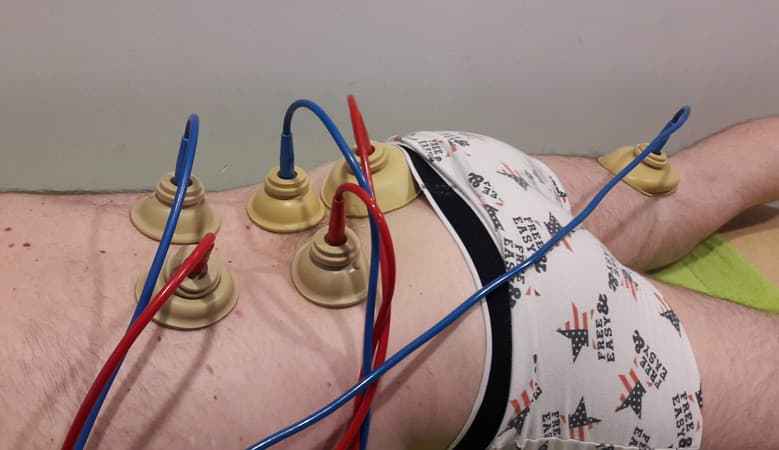
The electrotherapy is extremely versatile and effective — that is, in skilled hands! Here a sciatica treatment is being performed with vacuum electrodes.
It pains me that electrotherapy is applied at an unjustifiably low level here at home. It is hardly used, even though it greatly aids, supports and improves the rehabilitation results of the work of masseurs and physiotherapists. Neither athletes nor patients are familiar with it. That's why I often recommend your blog to my clients, since you write a lot of useful things about it.
ZZs: What are the typical cases that can come to you?
AN: Generally, people come with herniated discs and other musculoskeletal problems and pains.
ZZs: What was your most difficult case? Besides your own "self-rehabilitation," of course.
AN: Every case is a separate miracle, because the more knowledge we have the deeper connections we uncover, even in what seems to be a simple shoulder pain. It turned out that endometriosis-related bowel complaints were behind one case.
Long-standing pains often bring big surprises, for example childhood mother-child relationships causing adult body asymmetry, etc.
The most difficult case is the uncooperative patient who expects me to do it for them... but of course that's not possible.
ZZs: What are you proud of?
AN: My father always taught me one thing, and that is THINKING. That we can solve it if we understand it. This drives me tirelessly and I cannot give up searching for the solution...
ZZs: How can someone make an appointment with you?
AN: You can book online via my Facebook page.
My motto: "Training is an art, a painting on the canvas of health..."
ZZs: We agree on that as well. I wish you successful rehabilitation work!
AN: Thank you very much for the interview!

