
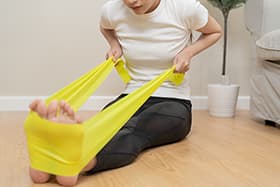
Strengthening Resistance Band - the Simplest Tool for Rehabilitation
If you need physiotherapy, you will almost certainly encounter these colorful, elastic bands. But do you know how this simple little tool can become one of the key pillars of your lasting recovery? In this article I will show you why it's worth taking resistance bands seriously and how you can use them effectively and flexibly at home.
A change of perspective in treating chronic conditions
In recent decades a fundamental shift has been taking place in medicine!
It has become clear that chronic conditions—whether joint problems, spinal disorders, muscle weakness or post-operative rehabilitation—cannot be solved with a single medication or a few days of hospital treatment.
These conditions require long-term, consistent attention, and here an important insight comes into play: the patient cannot be a passive participant in their own recovery.
Modern medicine increasingly recognizes that traditional therapeutic tools—the drug, the injection, the infusion or a few days of institutional physiotherapy—are not sufficient on their own. These treatments are valuable and necessary, but they only bring lasting results when complemented by something you can do for your own body at home, day after day.
This is how the concept of the fourth pillar of therapy is born. Alongside medication, medical interventions and institutional treatments, a new element enters: self-directed therapy using home medical devices.
This does not mean that the role of the doctor or therapist diminishes, but that it changes. The professional's task is to teach you the correct technique, to compile a personalized exercise program, and to monitor your progress.
But the daily work, the regular practice, and the gradual strengthening of the muscles will be your responsibility.
Why is the resistance band useful?
Among home rehabilitation tools, the resistive elastic band holds a special place. It is no coincidence that physiotherapists, physical therapists and athletes worldwide use it. But what makes this seemingly simple tool so special?
The training principle of the band is resistance. When you stretch the band, it resists your movement, and that resistance places a load on your muscles. The difference compared to traditional weights is that the resistance band provides continuous, even loading throughout the entire range of motion. While with a weight the direction of load is determined by gravity, with band exercises you decide the direction from which you want to load your muscles.
This joint-friendly property is especially important during rehabilitation. After an injury or surgery, joints and surrounding tissues are particularly sensitive, and sudden, large loads can do more harm than good. The resistance band is ideal for physiotherapy because you control the amount of load millimeter by millimeter. If you stretch it less, the resistance is lower. If you pull harder, it increases. That way you can apply precisely the load indicated by your body's feedback—enough to develop strength, but not to cause damage.
The Moves band: premium quality serving rehabilitation
There are many resistance band brands on the market, but it matters what tool you work with. The Moves Band has been specifically made to meet the needs of professionals in physiotherapy, rehabilitation and fitness, and that professional background shows in every detail of the product.
One of the Moves band's most important features is the Snap-Stop technology. This patented solution prevents the band from snapping suddenly even if it sustains some damage. This is important not only for your safety, but also because during rehabilitation your muscles may not always function as they should, and an unexpected break could cause a more serious injury.
The Moves Band has outstanding elasticity and can stretch up to three hundred percent. This high elongation capability allows you to work across a wide range of motion without the band overstretching or losing its resistance. Linear resistance means that the load increases evenly during stretching, so you can precisely calculate how much force you're working against.
The Moves band is dust-free and latex-based. Latex is a naturally derived material with excellent elasticity, and with proper care it ensures long service life. The dust-free finish is particularly important for those sensitive to materials or who simply prefer a cleaner, more comfortable feel during exercises.
Colors and resistances: how to choose the right one?
In the world of resistance bands, different colors indicate different resistance levels. This color coding helps you quickly and clearly identify how strong a band is and which one suits your current condition. The same system applies to the Moves band.
The yellow band provides the lightest resistance. This variant corresponds roughly to a load of 1.0–2.3 kilograms depending on the degree of stretch. This band is recommended primarily in the early stages of rehabilitation, after a severe injury or surgery when the muscles are still very weak and the goal is slow, gradual strengthening. It is ideal for older adults, children, and anyone just starting home exercise who does not yet have sufficient muscle strength.
The red resistance band offers somewhat greater resistance (1.5–3.7 kg). This level typically becomes relevant in the middle phase of rehabilitation, when the muscles are beginning to strengthen but are not yet ready for full load. The red band is excellent for general conditioning, lighter strengthening exercises and increasing range of motion.
The green Moves band belongs to the strong category, providing about 1.5–4 kilograms of resistance. This variant is aimed at those who have passed the initial phase of rehabilitation and are looking for more substantial muscle strengthening. The green band is also popular for fitness purposes, as it offers a suitable challenge for most recreationally active adults.
The blue and black colors represent even higher resistance. These bands are intended for more trained users who already have basic muscle strength and aim for further development or enhanced sports performance.
The black and silver variants are made specifically for athletes and elite sportspeople.
The importance of length
When choosing a band, not only the amount of resistance matters but also the length. The Moves band is typically available in a 1.5 meter version, which is an ideal length for most exercises. The general rule is that the band should be at least as long as the body part on which you perform the exercise. If the band is too short, you cannot stretch it properly and the effectiveness of the exercises decreases.
A longer band allows for more variations. Wrapped around your leg, or grasped by your hand, you can adjust the grip width and thus modify the amount of load. Shorter variants are used for specific exercises, but for home rehabilitation and strength recovery routines the 1.5 meter length is the ideal choice.
Which conditions can the resistance band help treat?
Band exercises are applicable across a very wide range. Let's start with the most common uses.
Post-operative rehabilitation often makes the resistance band an indispensable tool for physiotherapy. After knee or hip replacement, shoulder surgery, or spinal surgery, muscles become significantly weakened. Hospital treatment and institutional physiotherapy lay the foundations, but real strength recovery happens at home over months with regular practice. The band enables precisely this gradual, safe strengthening.
Joint diseases, especially osteoarthritis and arthritis, require regular movement. Strengthening the muscles around the affected joint reduces the load on the joint, alleviates pain, and slows down degenerative wear. Because band training is joint-friendly, it is an excellent choice for these conditions, as it avoids overloading already vulnerable joints.
For spinal problems, whether after a herniated disc, degenerative changes or simple back pain, strengthening trunk muscles is key. The resistance band allows you to strengthen the back and abdominal muscles with controlled, safe movements, which over time stabilizes your spine and reduces pain.
Age-related muscle loss, or atrophy, can be fought effectively with regular resistance exercises. Muscle strength and mass decline with age, which not only affects mobility but also increases the risk of falls. Band exercises help maintain and regain muscle strength, improve balance, and contribute to preserving independent living.
How to start home band exercises?
The first and most important step is to consult a professional. A physiotherapist, physical therapist or movement therapist can assess your condition and compile a personalized exercise program for you.
Remember: home therapy complements medical treatment, it does not replace it.
When training with bands always start with the lower resistance. Even if you feel stronger, gradual progression is one of the most important principles in rehabilitation. The yellow or red band is a perfect starting point, and as you build strength you can gradually switch to stronger bands.
During exercises pay attention to correct posture and controlled movement. The essence of band training is not how quickly you perform the movements, but feeling your muscles working and consciously directing the movement. Both pulling the band and returning it require effort, so your muscles work in both directions.
Begin with six to eight different exercises, performing ten to fifteen repetitions each. If you complete these easily, increase the number of repetitions or switch to a stronger band. The key is regularity: it's better to do ten to fifteen minutes every day than one hour once a week.
The resistance band as a tool for self-managed health
One of the greatest challenges in treating chronic conditions is long-term commitment. Taking medication is relatively simple, but regular exercise, lifestyle changes and active participation in your own recovery require much greater effort. And yet, this active approach produces the greatest results.
From this perspective the resistance band is a special tool. It does not require expensive equipment or a gym—you can use it anywhere, anytime. It fits in your bag, you can take it on holiday, and you can get an effective workout even in a small room. This accessibility makes it possible to truly integrate exercise into your daily life so it becomes part of your routine rather than an occasional activity.
Home medical devices—whether a strengthening band, a compression therapy unit or any other therapeutic aid—do not replace the doctor, but complement their work. They can reduce the need for medication because regular movement has a natural pain-relieving effect. They offer causal treatment because they address the underlying problems, such as muscle weakness or limited range of motion, not just the symptoms.
And perhaps most importantly: they return control over your own body to you.
Summary
The resistive band is not just a simple fitness tool. It has become a fundamental item in modern rehabilitation and prevention, helping put your recovery into your own hands. The Moves band’s premium quality, safety features and professional background guarantee that you will find a reliable companion for home exercise.
Remember: treating chronic conditions is not a sprint but a marathon. Lasting results require sustained effort, and band exercises make that daily, regular work easier, safer and more effective.
Start today and experience how much this small tool can contribute to achieving big goals.

