
Causes, Symptoms and How to Eliminate Tech‑back
With the spread of technology, health problems that were previously rare are appearing and can make your everyday life quite miserable. Lately a characteristically curved back is increasingly noticeable among young people. The condition even has a name: "tech‑back." English speakers know how catchy that name is; in Hungarian you might call it a programmer's back or an administrator's back. The phenomenon is caused by poor workplace posture, constant computer use and fiddling with mobile phones, and the complaints it causes can be very unpleasant.
Tech‑back symptoms
One of the most common reasons people in the developed world visit a doctor today is severe neck and back pain.
At first only tension appears in the neck and shoulder area. Usually there is little or no pain in the morning, but it gradually intensifies during the day and is worst in the evening. Over time the pain does not disappear and becomes constant.
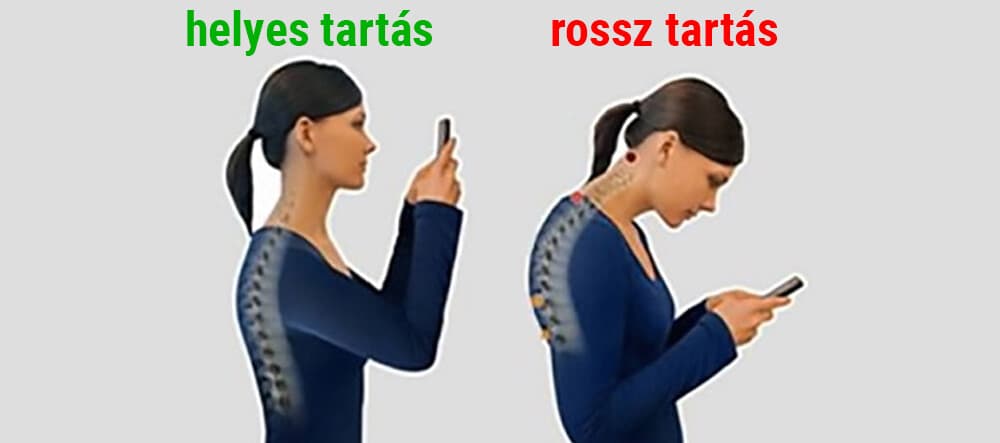
The natural curves of the cervical and thoracic spine slowly change, deform, and the characteristic "dowager's hump" develops.
Causes of tech‑back
The deformation of the spine is, of course, not the work of a moment — it takes time.
The cause is the modern lifestyle. You spend the whole day in front of a screen and constantly use your mobile phone. Your posture is far from natural. You don't exercise (going from home to school or work is not exercise).
Your body strives for balance and adapts its functioning to what you do. If you sit all day, it thinks: "Look! This is not using its muscles! If it doesn't need them, why should I maintain them?" And it starts to break them down, to make them smaller.
If you don't use something regularly, the body "pulls it out of focus." If you don't use your muscles, the body won't spend energy on building and maintaining them.
So the development of the so‑called Facebook back (tech‑back) is caused by weakened muscles and the constant posture of watching a screen.
The neck muscles, the trapezius and the muscles of the upper back weaken. In contrast, the muscles on the chest side become stiffer.
The stiff muscles pull the head and shoulders forward and down — the weak neck and back muscles cannot resist. The tight pains you feel are primarily due to overstrain of the neck muscles.
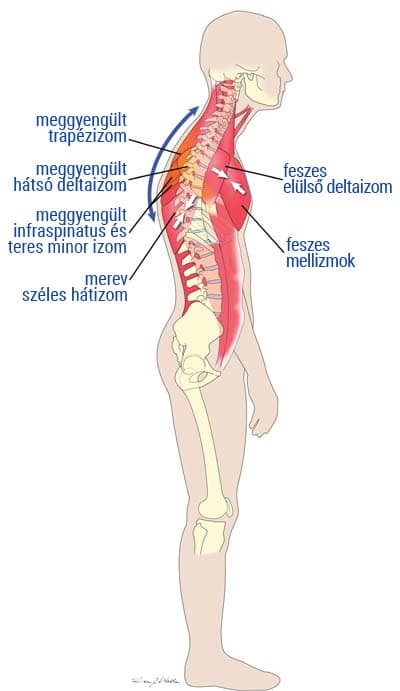
If you don't change, within a few months your cervical curve will straighten, the thoracic curve will increase and the characteristic dowager's hump will appear.
What can you do about it?
The first and most important thing: move more!
This means regular daily exercise. Preferably spend 40–50 minutes or more on maintaining or restoring your body's health.
The best prevention methods are various forms of exercise. Yoga can be good, bodyweight exercises, or even gym workouts. Also don't neglect your cardiovascular health. If you can, walk instead of using public transport. Take the stairs instead of the elevator. At least go for regular walks, run, or cycle.
As a result of exercise your body will think: "Look! This one uses its body! I must strengthen its muscles!".
With exercise and targeted training the tightness of the chest muscles decreases, your back muscles strengthen and pull your shoulders back into place. Your spine regains its natural curvature and your complaints disappear.
Of course, this takes time and regular exercise. Doing five push‑ups once will not bring any improvement.
When should you use a muscle stimulator?
If you've neglected exercise for a long time and your complaints are severe, suddenly starting exercise can actually increase the pain.
If you've gotten this far, use a muscle stimulator for a few weeks. This will not worsen your complaints; it is, however, very effective for strengthening your muscles!
Different treatment is needed for the front and the back! You must use programs that relieve stiffness on the chest muscles and muscle‑strengthening stimulation on the neck, trapezius and upper back muscles.
You will feel the beneficial effect as early as the third week, and in 2–3 months you can reach a level where you can start exercising without pain and risk.
Then the exercises should take over the role from the device.
If you don't use the device and you don't improve your muscle strength with training either, then what do you expect will change? From pills? Well... if you take some pills there will be a change — because soon you'll also be tormented by drug side effects. But since no medication strengthens your muscles, your complaints won't improve!
Appropriate devices
Choose a device that provides medical muscle stimulation. One that includes programs both for relieving muscle stiffness and for restoring muscle strength.
The simplest such device is the Rehalito multifunctional device. This is an entry‑level, affordably priced device. It is 2‑channel, so you can treat only your neck at a time. Then you need to treat the upper back, and finally the chest muscles. Separately treating the three areas takes nearly 2 hours daily.
With a 4‑channel device you can treat a larger area, so the treatment time can be reduced to about 35–40 minutes. Examples of such devices are the MyoBravo and the Elite multifunctional devices.
Just as you don't become strong from a single workout, you won't from a single stimulation session either!
As you know, regular training will surely strengthen a muscle. Likewise, your device will only help with regular and persistent use — but if you use it, it will certainly work.

