
TENS pad or TENS electrode
The TENS electrode (commonly referred to as a TENS pad) is a fundamentally important accessory for at-home electrotherapy treatments (for example TENS – nerve stimulation, pain relief; EMS – muscle stimulation; Microcurrent – pain-relieving, healing-stimulating treatment; denervated – treatment of peripheral paralysis) because the impulse reaches your body from the device through the TENS pad placed on the skin. Without it there is no treatment and no effect. In this article I summarize the most important information to help you make the right choice.
Main characteristics of the TENS electrode
- application method (self-adhesive, carbon-silicone (also called rubber electrode))
- connector type (pin, snap, clamp, other)
- size and shape (square, rectangular, round, oval, other)
- layers (cover, gel, conductive layer, adhesive)
- conductivity quality.
By application type
Self-adhesive
Manufacturers always supply self-adhesive electrodes with electrotherapy devices intended for home use.
They are the easiest to apply because one side is adhesive and they can be placed on the skin in a single motion and remain there. These electrodes are gelled, so you don’t need to wet them separately or use contact gel.
Self-adhesive electrodes allow the most effective treatment (because they are evenly gelled, adhere over a large surface, and can be placed tightly on the skin).
The adhesive layer wears off with use and adheres less and less. After a while they no longer stay in place – then they must be replaced. In other words, the self-adhesive electrode is a consumable that must be replaced regularly.
Carbon-silicone, i.e. rubber electrode
If you use the device often and want to avoid recurring costs, you can choose rubber electrodes instead of self-adhesive ones.
However, there are disadvantages. They are not easy to apply because they have no adhesive surface. You must secure them in place with an external strap. For this reason rubber electrodes are easy to use on limbs, but fixing them on other parts of the body such as the back, shoulders, neck, chest/abdomen is quite difficult.
Rubber electrodes are “dry”, so they do not conduct electricity well. They require moistening. You can buy a separate sponge cover to wet, or you need to apply contact gel to the skin-facing side of the electrode.
Rubber electrodes cannot provide as accurate and precise a treatment as self-adhesive electrodes, but they can be a good compromise. They may be suitable for pain relief and general muscle stimulation treatments. They are not suitable for precision treatments such as treating a denervated (paralyzed) muscle.
Microcurrent treatments cannot be performed with rubber electrodes.
Connector type
Electrotherapy device cables are usually fitted with
- pin (PIN) or
- snap (SNAP) or
- other, non-standard connectors.
Higher-quality, medical-grade manufacturers generally use standard PIN or SNAP connectors, so you can connect any PIN or SNAP electrode to them. You just need to check what termination your device cables have.
Some consumer wellness manufacturers (e.g., Omron, Beurer, Vivamax) use non-standard connectors on their devices. Standard electrodes will not “fit” these.
This is a marketing trick: you buy the device cheaply and later realize that a replacement electrode costs HUF 8–9 thousand. If you have to use the device regularly, the cost multiplies.
Size and shape
You can find a wide variety of sizes and shapes on the market. The most common shapes and sizes are
- square (4×4 or 5×5 cm)
- rectangular (5×9 or 5×10 cm)
- round (diameters 2.3, 3, 5 cm)
- oval (3×5, 7.5×13 cm)
- butterfly and other shapes.
Consider the area to be treated when choosing size!
Obviously a 7.5×13 cm oval electrode pair will not fit on your face; 2.5–3 cm diameter round electrodes are appropriate there.
For your calf, on the other hand, a larger 7.5×13 cm oval electrode is a good choice.
For general pain relief (TENS or MENS) a 4–5 cm square electrode is appropriate. I also recommend these for neck, shoulders, and arm muscle stimulation, and for the motor point of larger muscles (thigh, abdomen, chest, back).
I recommend 5×9 or 5×10 cm electrodes as the more distant electrode in muscle stimulation treatments.
Keep in mind that for stimulation it is generally recommended to apply about 2 mA/cm². So a 5×5 electrode is 25 cm², meaning the recommended maximum current is about 50 mA.
The smaller the electrode, the more the current concentrates on a smaller area. Higher current intensity produces a more unpleasant sensation.
Layers and materials of the self-adhesive TENS pad
The electrode materials and thickness determine the electrode’s flexibility. The thicker and stiffer an electrode, the less it conforms to body contours.
Cheap electrodes generally consist of three layers: adhesive, gel and cover. The current is led into the gel layer and spreads there.
Higher-quality electrodes (types: PALS, UltraStim, ValueTrode) contain two gel layers, adhesive, a conductive layer and a cover. The dual gel layer provides more even current distribution, which reduces the unpleasant stinging sensation during treatment.
The cover layer is usually textile, foam, paper or a special material.
Thicker and stiffer electrodes fit well on larger muscles—thighs, back, abdomen, buttocks. However, they are not suitable for thin areas like the wrist or neck because they do not conform well to pronounced folds.
Cheap (often Chinese) electrodes are stiff and their edges curl up in folds. This concentrates current delivery onto a small area and creates an unpleasant treatment experience.
PALS electrodes represent the highest level. They contain a stainless steel mesh, are extremely thin and flexible. The full-surface mesh provides perfect current distribution across the entire surface.
UltraStim electrodes use a silver-thread mesh as the conductive layer. They also provide excellent current distribution but are somewhat stiffer.
General-purpose ValueTrode electrodes have no separate conductive thread. The current is led into the dual gel layer, which provides good distribution, but the electrode is stiffer.
How to choose a self-adhesive TENS electrode?
The electrical impulse triggers the desired response in your body if its intensity (current strength) is adequate. However, the higher the intensity, the more uncomfortable the sensation during treatment. Above a certain current the pain prevents continuing the session.
If the electrode is of poor quality its conductivity is poor. You must set a high current on the device to achieve an effect, which increases discomfort. If the impulse isn’t strong enough, you get no effect.
A better-conducting electrode delivers an adequate impulse to your body at a lower current. This enables more effective treatment.
Buy a cheap Chinese electrode only if you want to train to be a fakir. Poor-quality electrodes guarantee an unpleasant and ineffective treatment.
General rule: if you can afford it, choose the best quality — that is the PALS electrode. If price matters, proceed as follows.
For pain relief (TENS and Microcurrent) treatments
ValueTrode electrodes are generally sufficient. For TENS and Microcurrent treatments, 40–50 mm diameter electrodes are suitable. Stick them around the painful area and perform the stimulation that way.
For Bell-type facial paralysis and cosmetic facial treatments
Small-diameter electrodes (25–30 mm) are required for face and neck because the muscles are small and there is limited space so larger electrodes cannot be placed with several centimeters distance between them.
I recommend 32 mm ValueTrode Round or 25 mm PALS Round electrodes for the face.
For denervated (paralyzed muscle) treatments
The injured nerve is sensitive. The better the quality of the electrode you use, the gentler you are on the nerve. Therefore it is worth using PALS or UltraStim electrodes.
Depending on the muscle to be treated you can use 25–32 mm round electrodes (e.g., facial nerve palsy) or 5×5 and 5×9 cm electrodes (e.g., peroneal palsy), etc.
For muscle stimulation treatments
In muscle stimulation there are two schools of thought about what size TENS pads to use. Some recommend as large an electrode surface as possible, while others suggest using different-sized electrodes.
Proponents of larger electrodes argue that the larger the electrode, the easier it is to spread the current through the muscle, the higher the comfort level, the higher current intensity is achievable, and the stronger the muscle contraction.
Supporters of different sizes say that the smaller electrode should be placed on the muscle belly (the most prominent part). With a smaller electrode, higher current density concentrates on the motor endplate (motor nerve), which is located near the center of the muscle. They also believe this reaches deeper parts of the muscle before the nearby electrode is encountered.
I recommend trying both variations and decide based on your experience which you find more effective.
| PALS | UltraStim | ValueTrode | Cheap-generic | |
| Number of uses | 15–20 | 20–25 | 15–20 | 5–10 |
| Gel layers | double | double | double | single |
| Conductive thread | stainless steel mesh | silver-thread mesh | none | none |
| For TENS | Excellent | Excellent | Excellent | Adequate |
| For MENS | Excellent | Excellent | Adequate | Poor |
| For muscle stimulation | Excellent | Excellent | Adequate | Adequate |
| For denervated treatment | Excellent | Excellent | Adequate | Not suitable |
| For facial nerve palsy | Excellent | Excellent | Adequate | Not suitable |
| Conformability | Flexible | Stiffer | Stiff | Stiff |
You can extend the life of self-adhesive TENS pads with careful use
The electrodes supplied with your device — depending on quality — can be reused from a few treatments up to 20–30 treatments. Eventually they will no longer stick, they dry out and no longer transmit the impulse properly. Then you must buy new electrodes, which — if you use the device often — becomes a recurring expense.
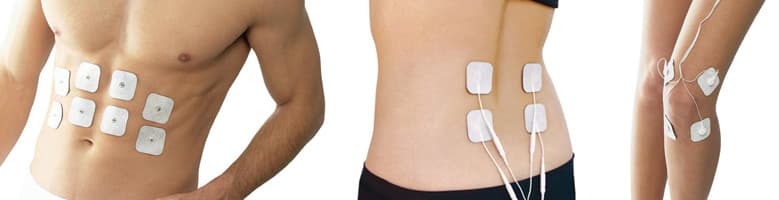
- Electrodes are shipped adhered to a plastic sheet.
- Carefully peel them off the sheet. Do not touch the adhesive, as this reduces adhesion.
- Make sure the adhesive side does not touch the floor or stick to clothing, because dirt quickly reduces adhesion.
- Before applying the electrode to your skin, wash the treatment area with warm soapy water (to degrease) and dry thoroughly. Only stick electrodes onto completely dry skin.
- After use, pull the electrode off the skin in one motion and immediately stick it back to the plastic sheet for storage. Do not pull by the cable, as the cable can tear out!
- Keep the TENS pad in the refrigerator! Not in the freezer, but in a normal refrigerator. This increases its lifespan.
- If the electrode surface looks dry, put a drop of water on the electrode to gain a few extra uses.
- After a while the electrode will not stick at all. At that point its life can be extended with contact gel and adhesive tape.
- Don’t rely on this for too long, because a dry electrode does not transmit the impulse and the treatment’s effectiveness decreases or is lost.
- A time will come when you must replace the self-adhesive electrode with a new one.
If you follow and apply the above, you can maximize the life of TENS pads and the effectiveness of the treatment while optimizing your costs.
The TENS electrode is a consumable that wears out after a number of treatments and must be replaced! (like fuel in a car — the more you use the car, the sooner the tank needs refilling). The TENS electrode is a hygiene item, so an opened package cannot be returned (just as an opened tissue packet cannot be returned).
I made a video about self-adhesive TENS electrodes. Watch my film by clicking the play button. If you prefer to read, scroll down!
Subscribe to my YouTube channel! Don’t forget to click the small bell icon so you are notified about the next episode!
Can self-adhesive electrodes be replaced?
If you want to avoid recurring costs, you can use “permanent” electrodes. These are usually made of rubber-carbon-silicone materials, meaning they are almost indestructible and can be used for years. They are not adhesive and are not gelled. You need a Velcro elastic strap or adhesive tape (e.g., leukoplast) to fix them in place. These cannot be used dry — you must use contact gel to transmit the impulse to the skin (without gel the treatment will burn or sting).
- For abdomen-buttocks-thigh treatments you can choose specially designed large-surface electrodes (FastPads, Flexible electrode).
- You can simplify waist and abdominal muscle treatment with an electrotherapy belt (FastBand belt, UltraStim Belt).
- For muscle stimulation you can use silicone-carbon electrodes.
- Incontinence can be treated with probes that are placed in the vagina or the rectum.
- Iontophoresis uses sponge-covered carbon electrodes.
Rubber electrode and its use
In this film I show a solution that can replace self-adhesive electrodes. The rubber (carbon-silicone) electrode does not wear out and can be used for years — but it has limitations.
For example, it cannot be fixed everywhere (torso, back) — but it is excellent for limb treatments. It is great for general pain relief and muscle stimulation, but I do not recommend it for nerve injury, paralysis, or specialized sports muscle development — for these choose the highest quality electrode!
You can obtain rubber electrodes by clicking here.

