
Watch out! You're being deceived! LED lamp or diode laser — what's the difference?
Many companies shamelessly lie about products recommended for health purposes. Mercantile companies push devices on unsuspecting buyers with ruthless ad campaigns that are not suited for the uses they advertise. Nowadays, softlaser devices are increasingly popular due to their effectiveness. However, their price is relatively high. That's when the opportunists appear, selling colorful LED lamps as "lasers." You might think light is light... but a LED and a diode LASER are about as similar as a pedal-powered plastic toy car and a Mercedes. I'll explain.
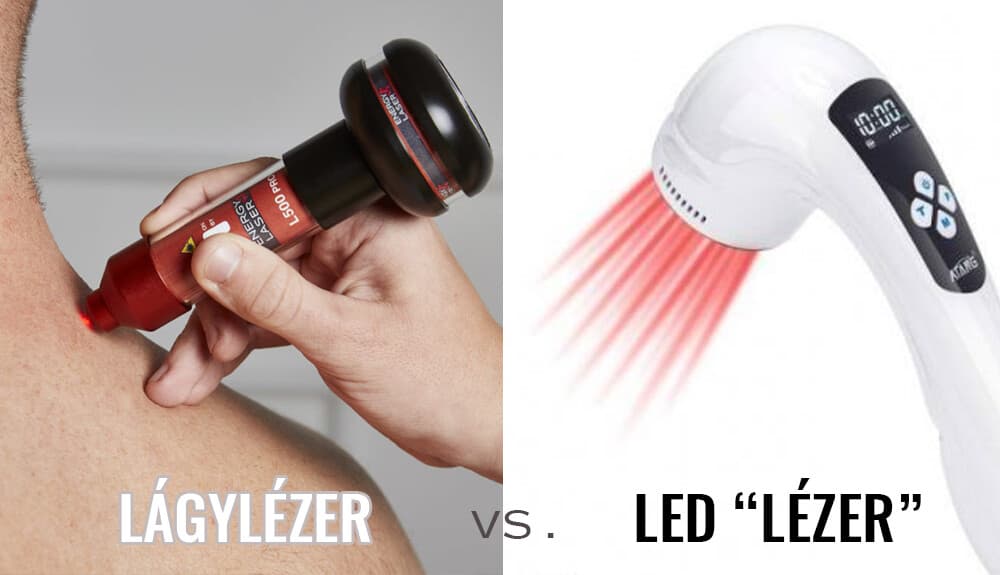
Let's start by running through the main technical facts. Differences between LED and LASER
| LED | LASER | |
| Light source | small in size, requires little energy to emit light. | larger in size, requires more energy to emit light than an LED. |
| Mode of action | heats the tissues, slightly improves superficial blood circulation. Cannot penetrate deeply. | acts at the cellular level, influencing cells in many ways by stimulating cellular ATP production. No warming effect. Can penetrate several centimeters into tissues. |
| Health effect | none or negligible | medically proven effects in many conditions. |
| Beam | LED emission is not coherent (waves are not in the same phase), not collimated (divergent) and generates a wider wavelength range (i.e. not monochromatic). | Laser light is coherent (photons move in the same wave phase), collimated (rays are parallel, do not spread) and monochromatic (contains a single wavelength). |
| Output power | Output peak power is measured in milliwatts. | Peak power is measured in watts (i.e. a thousand times stronger). |
| Operating principle | Works on the principle of electroluminescence, i.e. light emission occurs via charges/electrons. | Works on the principle of stimulated emission. |
| Color | LED-emitted light consists of multiple colors (even if one dominates). | Emitted light consists of a single color. |
| Types | Surface emitter and edge emitter | Semiconductor laser and gas laser. |
| Response | LEDs respond quickly. | Lasers respond faster than LEDs. |
| Drive current | LEDs require a drive current between 50–100 mA. | Lasers require a drive current between 5 and 40 mA. |
| Bandwidth | LEDs have moderate bandwidth. | Lasers have greater bandwidth. |
| Feedback | LEDs do not require feedback. | Proper feedback in a laser is essential for it to be treated as an optical source. |
| Price | Cheap | Not cheap |
From this alone it may still not be clear what the difference really means. Let's go over the most important parameters!
Wavelength (i.e. the color of the light)
Medical studies show that the ability of light to penetrate the body depends on wavelength. That is, light at 650 nm penetrates less deeply into the body than, for example, 808 nm. In medical softlaser (softlaser) applications these two wavelengths are used most often.
650 nm lasers are used for treating the skin, since this beam can penetrate the body maximally about 1–2 cm.
The 808 nm, depending on the device's energy, can reach about 2–4 cm.
Many manufacturers claim that the beam penetrates 10 cm — this is misleading. Light certainly cannot reach such depths (no device can). The effect of a laser — if the power is sufficiently high — can reach structures at 8–10 cm depth.
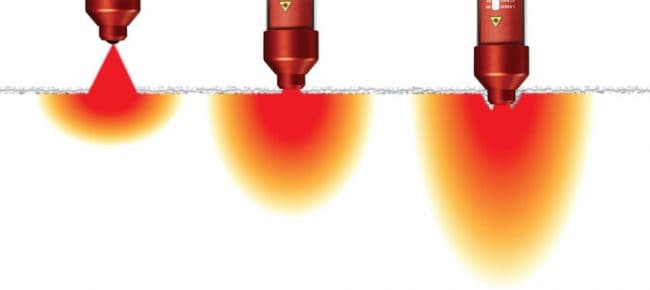
Diode lasers contain very precisely only a single wavelength, so the expected penetration depth can be precisely determined and dosing can be calculated accurately.
LEDs cannot emit as precise a wavelength as a laser; their light emits a range, not just 660 nm. Therefore you cannot accurately know how deep they will penetrate and the dose cannot be calculated precisely. Yet every therapeutic treatment should be based on knowing exactly what dose is being delivered.
Beam divergence
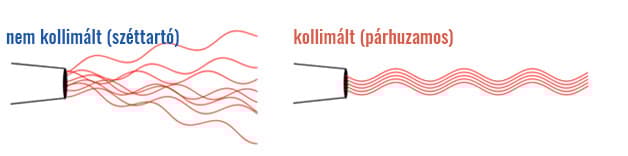
The main strength of a diode laser is its beam made of virtually parallel waves with no divergence. A large amount of energy can be concentrated on a given area. Because there is no divergence, when the source is held perpendicular to the surface, reflection loss is also minimal. Knowing the emitted energy and the beam diameter, the necessary dose can be calculated very precisely.
An LED source emits an uneven, divergent beam. Therefore it cannot be focused onto a small area. Part of the light can be applied perpendicularly to the surface, but due to divergence reflection losses are high and the dose cannot be calculated with acceptable accuracy.
Beam incoherence
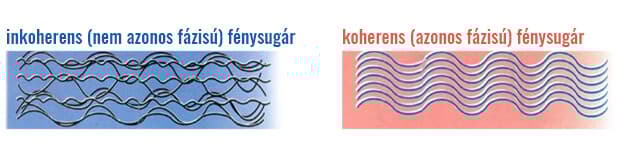
In a diode laser beam the photons move in the same wave, which allows the energy to be concentrated on a specific area.
Photons emitted by an LED source are not synchronized with each other.
 Output power
Because an LED beam is divergent, not in the same phase and not monochromatic, its energy output is significantly lower than that of diode lasers.
Generally an LED outputs 1–5 mW, while a diode laser outputs 200–500 mW.
The essence of laser treatment is delivering a specified amount of energy to the treated area. Depending on the condition this energy is typically 3–5 Joules, but in some cases much higher. For cartilage regeneration usually about 20 Joules, while for tinnitus (ringing in the ears) delivering about 200 Joules may be necessary.
So let's see what treatment times are required to deliver these doses.
Output power
Because an LED beam is divergent, not in the same phase and not monochromatic, its energy output is significantly lower than that of diode lasers.
Generally an LED outputs 1–5 mW, while a diode laser outputs 200–500 mW.
The essence of laser treatment is delivering a specified amount of energy to the treated area. Depending on the condition this energy is typically 3–5 Joules, but in some cases much higher. For cartilage regeneration usually about 20 Joules, while for tinnitus (ringing in the ears) delivering about 200 Joules may be necessary.
So let's see what treatment times are required to deliver these doses.
| 1 mW LED | 5 mW LED | 200 mW laser | 500 mW laser | |
| 5 Joules | 5000 s / 83 min | 1000 s / 16.5 min | 25 s | 10 s |
| 20 Joules | 20,000 s / 333 min / 6.5 h | 4,000 s / 66 min | 100 s / 1.5 min | 40 s |
These treatment times apply to a single point and not, for example, to an entire knee.
With an LED device, for unilateral knee pain you must treat at least 5 points, so those times must be multiplied by 5! For example, with a 5 mW LED device, to treat one-sided knee arthritis you need 5 × 16.5 minutes, i.e. 82.5 minutes (almost one and a half hours). In contrast, with a 500 mW laser it takes at most 2–3 minutes. I therefore recommend buying an LED device only if you have a lot of time. But even if you hold the LED device for an hour and a half, you will not get the same effect, because the LED beam does not contain only the effective wavelength, it scatters due to divergence and its incoherence results in lower energy density — it penetrates less deeply and delivers less energy overall.
How to protect yourself from being "misled"?
Ask the distributor whether the device is LED or a diode laser! Check the technical specifications. If the laser power is below 200 mW, it is very likely you are dealing with LEDs! Some companies trick you with this too. There are devices shaped like a shower head (commonly called "shower lasers") that contain 5–10 or even more LEDs. They typically list the power per LED as e.g. 5 mW/LED. The distributor then multiplies the power by the number of LEDs and lists a so-called "total power." This is misleading, because putting several LEDs side by side does not reduce the treatment time; it only reduces the number of positions you need to treat!
Request the device's medical conformity certificate! The medical device manufacturer must prove that the specific model complies with Council Directive 93/42/EEC on medical devices. The distributor (retailer) may only sell you a device that has such certification. It is important that the so-called declaration of conformity (EC declaration of conformity) must include the exact model name of the device! It is not sufficient to state just "softlaser" — the certificate must specify, for example, B-Cure Classic or Personal Laser L200. Directive 93/42/EEC will soon be replaced by a new and much stricter regulation, Regulation (EU) 2017/745 of the European Parliament and of the Council, commonly called MDR (Medical Device Regulation).
During the transition it is still acceptable if the device is provided with certification under Directive 93/42/EEC. The EC declaration has an expiration date — make sure it is still valid! If the device's certification already complies with MDR, it means the device's medical effects have been verified! Manufacturers of LED devices prefer to use many small light emitters because devices with output below 5 mW do not need to be certified as medical devices.
Summary
I consider LED "lasers" sold on eBay, Amazon and Alibaba to be a waste of money, because their effects are not equivalent to those of diode lasers. Distributors list everything next to LEDs that can be attributed to lasers — but that's just marketing. Paper will accept any lie. I advise extreme caution with all devices that look like shower heads. Many light sources in such devices are very likely LEDs, not lasers. Their effects are not the same as those of real lasers. If you want a device that has a real health effect, choose B-Cure, SafeLaser, Personal-Laser or Energy-Laser devices. These are diode lasers and you can expect from them the medical effects that a laser should provide.

