
Weight loss – more effective with diet or exercise?
Weight loss… a difficult question. Pounds come on much more easily than they can be shed. Let’s examine some concepts related to weight loss and their meanings. Understanding these can help you more purposefully get rid of excess weight. I will also review the data of two diet-related studies that show what the optimal method might be.
Our bodies continuously use energy for their functioning, which we replenish through food. To simplify a bit: our foods are ultimately “fuels” whose burning powers the machinery of our bodies.
The energy intake–expenditure balance can be in three states.
- If intake and expenditure are roughly equal, body weight remains stable. This is the natural state and the most favorable for long-term health.
- If you consistently take in less energy than you need, your body uses reserves and your body weight decreases.
- If you consistently take in more energy than you need, your body begins to store reserves and your body weight increases.
Physics is ruthless
One of the basic laws of physics is the conservation of energy: energy is not lost, only transformed.
From this follows the ruthless fact: if your body weight increases, then you are eating more than is necessary to sustain your life.
The accumulated calories are then painfully hard to shed – but they must be shed, otherwise over time you will almost certainly pull dozens of diseases on yourself along with the kilos. Diabetes, high blood pressure, atherosclerosis, joint problems, breathing difficulties, etc., etc.
Obesity is one of the most dangerous diseases – and if you catch it in time, it is still treatable! If complications have already appeared, you are a little late, but even then you can still improve your condition a lot. So start no later than NOW!
Weight loss by calorie deficit
Calorie deficit means: the amount of energy consumed is less than what you use through basal metabolism and daily physical activity.
Fat equivalent
One kilogram of stored fat contains about 7,700 kcal (kilocalories), so you can calculate that if you consume 500 kcal less per day (than your needs), you can lose at most about 2 kg in a month. So to lose 5 kg of excess weight you would have to starve yourself on a diet for 2–3 months.
It is much more effective to incorporate physical activity into your everyday life. During exercise you can burn about 500 kcal in roughly 40–50 minutes.
But let’s not get ahead of ourselves: let’s see what two studies found.
500 calorie deficit
Ninety obese study participants followed a diet with a 500-calorie deficit for 48 weeks, about 11 months. [1]
On average they lost 8.5 kg +/- 7.8 kg of fat, the least was 0.7 kg and the most 16.3 kg.
It can be said that fat and muscle loss occurred in a 4:1 ratio, so with a 10 kg weight loss, 8 kg came from body fat and 2 kg from muscle and water.
Extreme: only 1,000 calories per day
This study went to the extremes, allowing only 1,000 calories per day and including exercise. All this led to a huge calorie deficit.
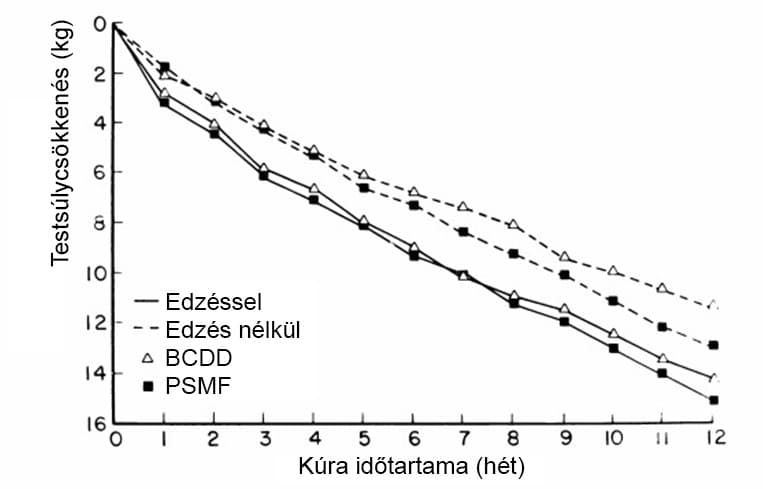
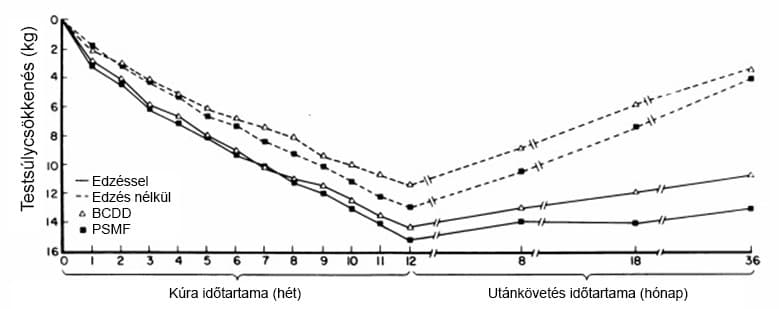
The results were also extreme: the PSMF group (1,000 calories, daily meat, fish and poultry and nothing else) combined with exercise lost 15 kg within 12 weeks, 1.25 kg per week, that is more than 5 kg per month.
The same diet without exercise resulted in a 13 kg loss within 12 weeks.
The second group, the BCDD (1,000 calories from balanced foods) combined with exercise lost 14 kg within 12 weeks, almost the same result as the previous group.
There were two additional groups whose members consumed 420 and 800 calories respectively.
The 420-calorie group lost 13 kg in 8 weeks, that is 1.6 kg per week, and 7 kg per month. But such very low caloric intake is not safe and requires medical supervision. We will not go into further details about those groups.
Given the large calorie deficits of the groups, all received daily multivitamins. The group that consumed only protein achieved great results, better than the 420-calorie group, but this extreme diet can lead to nutrient deficiencies, so consuming vegetables also appears indispensable.
"Rebound"
There is one last conclusion worth noting. The groups who exercised were able to maintain their weight, while those who only dieted regained the excess weight: almost back to their starting weight.
So exercise is clearly beneficial because it becomes part of the lifestyle. In the end, the groups that also exercised lost more weight than the others.
The groups whose members also exercised reported increasing strength over the 12 weeks, while those who only dieted lost strength.
Conclusions, recommendations
There are no miracle cures, so no matter how much weight-loss pills lie to you, it’s not true. Taking a capsule does not bring meaningful change – especially if you continue snacking and neglect movement.
Rapid weight loss is possible, but you must eat very few calories per day. This method takes a toll on your body and requires great willpower to endure long enough. Meanwhile you must pay attention not to deprive yourself of essential nutrients, minerals and vitamins, because if you completely upset your body’s balance, it can create a severe condition.
That is why you are better off aiming for slower and sustainable weight loss. Start exercising and carefully monitor how many calories you eat. You don’t have to run a marathon immediately! Start with 10–15 minutes of walking. Increase your daily activity time by 1 minute and raise the intensity weekly. If your weight causes joint pain while walking, then cycle instead! This reduces the load on your joints. Once you’ve started exercising, don’t stop for the rest of your life!
Ideal weight loss is between 0.5–1 kg per week, that is about 2–3 kg per month, while you fundamentally reorganize your lifestyle. This does not endanger your health in any way; on the contrary…!
Such weight reduction can then be maintained and you won’t be ping-ponging back and forth.
In the beginning you will of course need strong self-control to limit your calorie intake and to exercise even when you don’t feel like it.
Sources:
- Effect of Energy-Reduced Diets High in Dairy Products and Fiber on Weight Loss in Obese Adults. Warren G. Thompson, Nicole Rostad Holdman, Denise J. Janzow, Jeffrey M. Slezak, Kristin L. Morris, Michael B. Zemel
- Exercise as an adjunct to weight loss and maintenance in moderately obese subjects. Konstantin N Pavlou, Suzanna Krev, and William P Steffee

