
What to know about persistent pain
When we talk about pain, it's important to use the right words. In medical jargon you often see the term “chronic,” but that can be misleading. “Chronic” may imply that your pain will last forever, which usually isn't the case. Even healthcare professionals don't always agree on its precise meaning – is pain chronic after three months? Or does it require six months? For this reason it's better to use the terms “persistent” or “peristent” (persistent is preferable). These describe your situation more accurately: your pain has been present for a longer time, but that doesn't mean it must remain so forever.

The maze of seeking a diagnosis
You have likely consulted numerous professionals about your pain. You've seen your GP, an orthopaedic specialist, a chiropractor, a physiotherapist, an osteopath or an acupuncturist.
Each of them may have offered a different explanation for the origin of your pain. One might have said it's a bone problem, another mentioned muscle tension or poor posture. Some may even have questioned whether your pain is real, which can be hard to accept.
Different treatments may have provided temporary relief, but the pain returned.
How does pain work?
Fundamentally there are two types of pain: nociceptive and central pain.
Nociceptive pain
Nociceptive pain usually appears in acute situations and is linked to some tissue damage. Examples include pain from a bone fracture, a ligament tear or a herniated disc.
This type of pain has a defined healing time. A fracture typically heals in about 8–14 weeks, a ligament injury can cause symptoms for 60–90 days, and a herniated disc may take up to 6 months. Injuries ultimately heal.
Central pain
Central pain is associated with hypersensitivity of the nervous system.
This occurs very often in cases of persistent pain.
It's like an overly sensitive alarm system: small signals trigger strong responses.
One of the clearest examples is phantom pain, when people feel pain in an amputated limb. In that case it is physically impossible for danger signals to reach the brain from a limb that no longer exists, yet real pain occurs.
The brain's role in producing pain
When you get injured, danger signals travel to your brain from the site of injury. But your brain does not automatically turn that into pain – it considers many factors.
If you prick yourself with a needle while sewing, you hiss and perceive it as an unpleasant pain. When you fall off your bike and a branch sticks into your thigh, you jump up and only notice the wooden splinter in your leg minutes later.
The tissue damage is larger, yet the brain ignores it.
That's because your brain can modify the danger signal – it can amplify or dampen it. This is part of the escape instinct.
Is the pain real?
The fact that your pain originates in your brain does not mean it's not real.
In persistent pain the pain is often less tied to a specific tissue injury and more related to hypersensitivity of your nervous system.
To understand this, imagine you have an old knee injury. Originally it was a strain from skiing that has physically healed long ago. The tissues have regenerated and medical examinations show no abnormalities. Yet when you approach a flight of stairs you already feel the old pain. Sometimes merely thinking about the stairs can bring on the unpleasant sensation.
Think, for example, of the first time you burn yourself on a hot pan. The next time you even reach towards a pan – even a cold one – your body prepares in advance: your muscles tense and you may withdraw your hand. Your nervous system seeks to protect you and tends to “overreact.”
The same happens in persistent pain, only on a larger scale: the nervous system has become so sensitive that it responds with pain to even the smallest stimulus, even when there's no real danger or injury.
This also explains why treatment methods that don't directly target the supposed physical source of the pain can still work.
When you learn relaxation techniques or gradually return to movement, you are effectively “reprogramming” your nervous system. New connections and new “memories” form that can gradually overwrite some of the old ones.
Just as a pianist can correct a wrongly practiced melody, your nervous system can learn new, less painful responses to various situations.
The good news is that because your nervous system "learned" this hypersensitivity, you can also "relearn" appropriate responses.
This is a gradual process that takes time and patience, but change is possible. Just as you would not expect to master a new song instantly, retraining pain responses requires progressive improvement.
Modern methods of pain relief
There have been major advances in persistent pain treatment with drug-free physical pain relief methods. These therapies not only provide symptomatic relief but also support your body's natural healing processes and generally have no side effects.
TENS (Transcutaneous Electrical Nerve Stimulation) treatment
Small electrical impulses are applied through your skin.
This method can block pain signals traveling along your nerves to the brain. It also stimulates endorphin production, your body's natural painkiller.
The advantage of TENS is that it can be used at home and it does not cause dependence, unlike many pain medications.
Microcurrent (MENS – Microcurrent Electrical Neuromuscular Stimulation) therapy
MENS works with even smaller currents than TENS. This treatment acts at the cellular level: it improves cellular energy production and supports natural regeneration.
Microcurrent can be particularly effective for nerve pain and slow-healing injuries.
The treatment is usually pleasant and you often don't even feel the current.
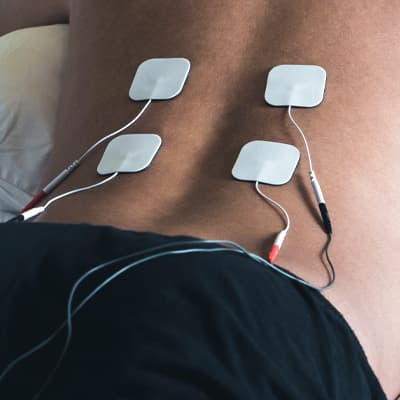
Product recommendation: microcurrent therapy devices
Microcurrent therapy is a form of electrical treatment and one of the newest pain-relief (MENS) and anti-inflammatory (MCR) procedures.
Interference therapy
It uses two currents of different frequencies that meet and exert their effects in the deeper layers of your body.
This method is excellent for treating deep muscle pain. Interference can improve circulation, reduce inflammation and relax tense muscles.
During the treatment you may experience a pleasant tingling sensation.
Softlaser therapy
A specially produced beam of light is used to treat the painful areas.
The laser light penetrates the tissues where it stimulates cellular function, endorphin production and natural healing processes.
This method can be especially effective for joint problems, wound healing and nerve pain.
Softlaser treatment is completely painless and has no known side effects.
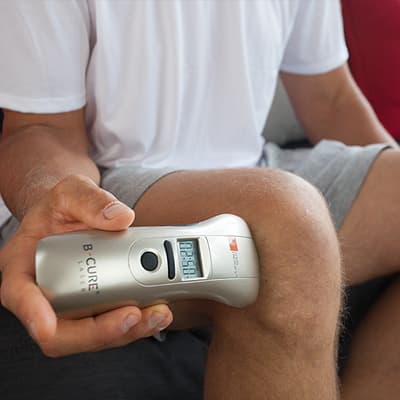
Product recommendation: our softlaser devices
The primary effect of softlaser devices is to support cell regeneration processes and thus speed up healing, and through stimulating endorphin production they also provide pain relief.
The advantages of physiotherapy methods over drug treatments
The pain-relief methods mentioned above have many advantages compared to traditional drug treatments.
There is no risk of developing dependence, which is especially important in persistent pain.
They do not burden the liver and kidneys, so they can be used safely in the long term.
Physiotherapeutic methods do not only treat symptoms but also support your body's natural healing processes.
Treatments can be combined with each other and with other therapeutic methods, allowing a personalized, complex treatment plan to be created for you.
They help reduce the amount of medication needed and can sometimes replace drugs altogether. This can be particularly important if you are sensitive to certain medications or want to avoid the long-term side effects of drugs.
Practical aspects of treatments
It is important that physiotherapy is assembled for you by the therapist. Every case and every pain is unique, so treatment must be individualized.
Most physiotherapeutic methods require regular application to achieve lasting effects.
The frequency and duration of treatments are determined by the professional based on your condition and progress.
The methods mentioned above are also suitable for home use. They should preferably be used after proper instruction, although with a little learning the basic rules can be understood.
Home-use medical devices increase treatment flexibility and can reduce long-term costs.
The importance of a holistic approach
Physiotherapy is most effective when used as part of a comprehensive treatment plan.
Never expect a miracle from a single method; instead combine gradually increasing exercise, relaxation techniques and, when necessary, psychological support.
Pain is not merely a physical phenomenon; it affects your emotional state and many aspects of your quality of life.
The key to success in treating persistent pain
The key to successful persistent pain treatment is patience and consistency. The effects of physical therapies often build up gradually over weeks, and the pace of improvement varies between individuals.
It's important to set realistic expectations and not give up if you don't experience immediate, dramatic improvement. Regular treatments and consistent adherence to the therapeutic plan can bring significant long-term improvements in your condition.
Understanding and treating persistent pain is a complex process in which modern physical pain-relief methods can play a major role. These therapies offer a safe and effective alternative to, or complement for, traditional drug treatments.
TENS, microcurrent, interference and softlaser treatments each affect pain in different ways and are often used to complement one another.
Successful treatment requires professional application and patience, and it is important to carry out therapy as part of a comprehensive treatment plan.
Remember: treating your pain is a process in which you are an active participant, and there are many tools and methods available to help you on the road to recovery.