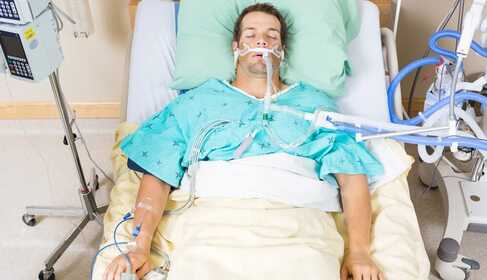
Should you really go to the hospital with COVID only when you're already short of breath?
Today a desperate woman wrote asking: “My partner and I are infected with COVID; I'm already better — I 'only' cough. But my partner has back and chest pain. His blood oxygen level is a bit lower every day, now 92–93. The GP said on the phone that if he started to have trouble breathing, then we should go to the hospital. What should we do?”

I wrote this article because I was angered by the GP's attitude and recommendation. Even using plain common sense, he is not right! Let's analyze the matter a bit!
1. My partner's back and chest hurt
Everyone knows that a healthy person does NOT have back or chest pain. If it hurts, that's already a problem the doctor should hear about.
In this case the COVID infection is known. For many it's only accompanied by cold-like symptoms. Chest pain appears only in severe cases, when pneumonia is suspected.
So if the chest hurts, the doctor should suspect that a "simple" COVID may be progressing into pneumonia.
There is nothing to wait for! The larger the area that becomes inflamed, the harder it is to recover. You can't stomp out a fire when the whole forest is already burning!
2. Oxygen saturation of 92–93
An oxygen saturation value of 92–93 measured by a pulse oximeter is the lower limit of healthy. On its own this wouldn't be a problem.
That the normal 95–99% oxygen saturation slowly decreases day by day is very concerning. Together with the other reported complaints (the chest and back pain), the decrease indicates that lung function is gradually deteriorating, that it can take up less and less oxygen (which is an indirect sign that pneumonia is slowly but surely spreading).
If your device is otherwise reliable, then in the case of a known COVID infection deteriorating values indicate a worsening lung condition.
Again, we come to the conclusion that there is no reason to wait any longer.
3. If he's short of breath, then go to the hospital.
That's what angered me and prompted me to write this article.
The GP is wrong to say you should wait until breathlessness appears! That's already too late! The feeling of suffocation appears only in advanced cases, when it can only be treated with great difficulty.
You must not wait until the whole house is on fire; fires are best put out when you stamp out the first flames.
Pneumonia can also be treated when treatment is started in time and not when it has "consumed" the entire lung.
4. The doctor left the rest to the patient's decision
I understand that the GP doesn't like seeing COVID patients either. However, if he is consulting by phone, he should at least pay attention to what his patient tells him.
It is already very problematic that he did not recognize that his COVID patient's condition was turning for the worse, that the symptoms were moving toward deterioration. He did not recognize what it could mean if a COVID patient starts to have chest pain. He did not understand what a decreasing blood oxygen level in a COVID patient means. In my view this is a serious professional problem that calls his competence into question. As a result, he gave completely wrong advice: he told his patient to wait until they were almost beyond saving (until breathlessness appears).
More serious than the professional error, however, is that he abandoned his patient to their fate. “Let the patient decide himself…” he washed his hands, like Pilate.
A doctor can never leave it to the patient to decide at which stage of an illness they should go to the hospital, or when they should seek treatment. Moreover, he gave neither a referral nor any other guidance.
Thus in reality the patient's life depends on the decision and, where necessary, the assertiveness of themselves and their relatives — namely whether they will be admitted to the emergency department without a referral. Hospitals, after all, "do not like" those who come on their own and are not sent by a doctor! The patient who falls between these two fires pays the price.
IN SUMMARY
If you have COVID, are coughing, feel lousy, but your chest does not hurt, your pulse oximeter shows 95–99% (and is not falling), and you have no fever, then DON'T PANIC! Rest, take the medications prescribed by your doctor, eat light foods, drink herbal tea. Measure your saturation and your temperature 2–3 times a day.
If your chest begins to hurt (especially if on both sides, front and back), your general state worsens (increasing weakness, loss of appetite), your pulse oximeter readings decrease day by day, and you have a high fever, then IMMEDIATELY SEEK EXAMINATION and care!
Until a chest X-ray is performed and pneumonia is ruled out, do not let them brush you off.