Arthritis (joint inflammation) and soft laser
Arthritis, that is joint inflammation, is one of the most common musculoskeletal diseases. The term “arthritis” is a “collective category” that includes more than 100 different conditions. The best known are osteoarthritis and rheumatoid arthritis, but it also includes gouty and psoriatic arthritis, systemic lupus erythematosus, and even fibromyalgia. Nowadays soft laser represents one of the most effective physiotherapy methods to alleviate symptoms.
From the above it follows that in certain forms of arthritis the joint inflammation is a consequence of an underlying disease. In cases of gout, rheumatism, or lupus, treating the underlying disease is paramount.
The main symptoms of joint inflammation are pain, joint stiffness, and swelling. Soft laser treatment can reduce or eliminate inflammation. Since most anti-inflammatory drugs cause numerous side effects, it is important to know that soft laser is completely drug-free and therefore free of side effects. Its use can at least be expected to reduce the need for anti-inflammatory medication.
Soft laser studies
The healing effect of laser is being investigated by many today. Several research groups have confirmed its anti-inflammatory effect and its effectiveness in treating arthritis.
Molina and colleagues divided arthritic patients into two groups. One group received only a non-steroidal anti-inflammatory drug, while the others received soft laser treatment in addition to the medication. The group receiving both laser and medication showed better recovery outcomes.
Soriano treated 938 osteoarthritis patients with soft laser and found that soft laser is more effective in acute (recent inflammatory) conditions than in chronic ones.
Antipa and colleagues also found that the group receiving both medication and soft laser achieved better results than those treated with anti-inflammatory therapy alone.
Glazewski treated 224 patients with rheumatoid arthritis with soft laser, which resulted in a reduced need for anti-inflammatory and pain-relief medications.
Soft laser treatment for arthritis
Effective soft lasers have only become available for home use in the past approximately 10 years. Previously only clinical application was possible.
Home-use, low-energy so-called softlaser devices are designed so they cannot “harm”. However, it is important to know how to use them, because if you do not use them properly you will not achieve the expected effect.
For joint treatment, buy a device that emits a wavelength of 808 nanometers. Attention! Devices of 650–660 nm are cheaper but ineffective for joints (knee, wrist, hip, spine, shoulder, elbow).
You can buy a softlaser device by clicking here.
The essence of soft laser treatment is to deliver a certain amount of energy to the affected area. The required amount depends on the disease, but is generally 5–7 Joules. How long it takes to deliver this energy depends on the laser output of the device. A lower-power device delivers the same amount of energy with longer treatment times.
The laser works only within a certain dose! If you apply less than the recommended time, it is not enough to initiate the beneficial effects; giving more than recommended is not good for the cells and can stop the healing. Therefore it is not good to arbitrarily double the treatment times; this will not improve the effect! Treat only for the recommended duration.
It's also important to check the treatment head area. The smaller the head, the more time you will need because you have to treat more points. If arthritis affects a small joint, for example a finger joint, a single 5–8 minute treatment may be sufficient. However, if you were to treat, for example, your knee, you will need to treat it from several directions (3–4 points).
The laser must be applied directly to the skin. Laser light does not penetrate clothing or dressings, so the treatment will be ineffective!
Soft laser treatment is generally not perceptible. The effects occur deep in the tissues, at the cellular level, and do not appear immediately. Although pain may decrease after the first treatment, it is more likely that 10–12 days are needed for symptom relief, during which the area should be treated several times a day. Stop treatments only after full recovery has been achieved.
Soft laser treatment points for arthritis
Each tissue, joint, and pain has its own irradiation time. That is, it matters how long you hold the device in place. Some tissues are more sensitive and require less energy, while others need longer exposure (more energy delivered). The device manuals provide detailed treatment recommendations—treatment times, intensity, etc., appropriate for different conditions.
For pain of arthritic origin, start treatments as soon as possible after symptoms appear. Deliver 5–7 Joules of energy to each treatment point. For example, if a device delivers 1 Joule/cm2, then 5 minutes of treatment are required to deliver 5 Joules. In acute inflammation, treat the area hourly. For chronic complaints, 2–3 treatments are sufficient.
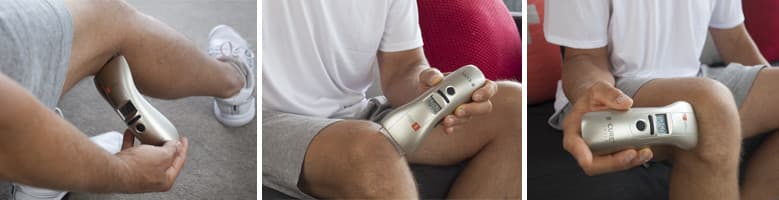
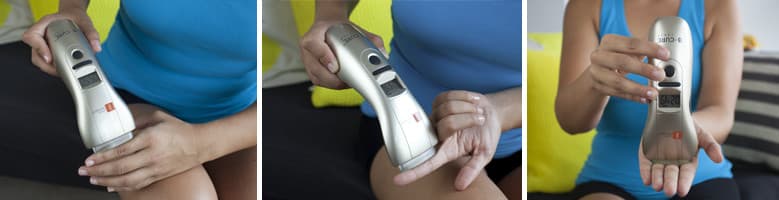
The following images and videos show the points where you should treat (the B-Cure softlaser device is shown in the footage).
Shoulder arthritis
The shoulder joint area and the outer part of the upper arm.

Finger joint pain, rheumatoid arthritis
The right and left sides of the finger (each finger individually), the palm and the crease between the fingers.
Knee arthritis, knee pain, knee injury, after knee surgery
The back of the knee, the popliteal fossa, the right and left sides of the knee (possibly under the kneecap).