Who is it for?
Weakness of the sphincter muscles causes leakage with physical strain (coughing, laughing, lifting). Biolito program 01 targets phasic muscle fibres with higher frequency (35–100 Hz). This is the most common form of incontinence and may respond well to electrostimulation muscle training.
Caused by overactive bladder muscle: a sudden need to pass urine you cannot hold. Biolito program 02 uses low frequency (5–20 Hz) to reduce involuntary bladder contractions.
Programs 03–04 are for combined treatment of mixed and faecal incontinence. With an anal probe (PeriProbe Analis) targeted training of the anal sphincter is also possible.
Biolito program 05 is designed for pelvic pain relief. For vaginismus, gradual treatment with a vaginal probe and slowly increasing intensity can help relax muscle spasm.
For targeted training of weakened pelvic floor muscles after childbirth, Biolito is an affordable entry option. Treatment may begin after the 6–8 week postpartum medical check. If prolapse is present, read my article on prolapse and its management.
How electrostimulation works
Biolito emits low-intensity, safe electrical impulses that stimulate the pelvic floor muscle groups and nerve endings. In response, muscles contract and relax – this cyclic training can help restore muscle tone.
Perineal electrostimulation effectiveness relies on excitomotor effects: it may help increase muscle tone and favourably affect local circulation. In stress incontinence, stimulation can contribute to increased urethral closure pressure, while in urge-type problems it can reduce bladder muscle overactivity.
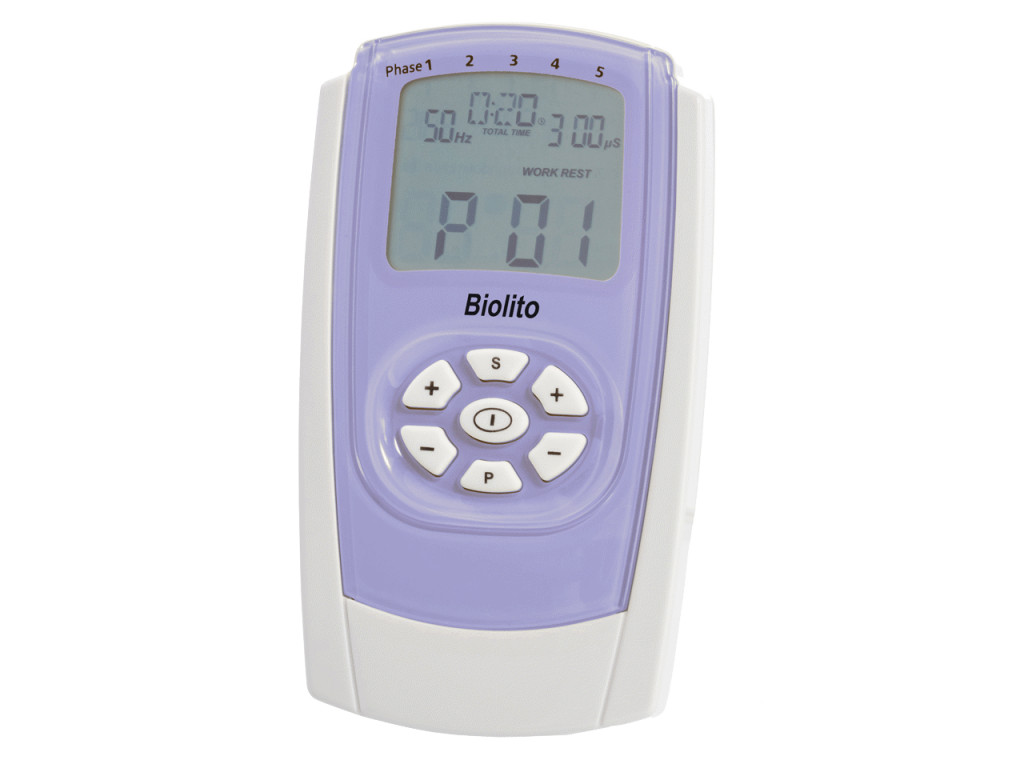
Biolito operates on the principle of functional electrical stimulation (FES) and does not include a biofeedback function. That means the device does not measure muscle activity, but the pre-programmed impulse patterns effectively guide muscle training. If you need objective feedback, consider the evoStim P (pressure biofeedback) or the evoStim E (EMG biofeedback).
Frequently asked questions
No. You will feel mild tingling and clear muscle contractions. If you experience pain, reduce the intensity. Treatment should never be painful – if it is, check electrode/probe positioning.
No. Electrostimulation devices must not be used during pregnancy. Use during menstruation only under medical supervision. Treatment may begin after the 6–8 week postpartum medical check.
The Biolito is an entry-level, two-channel electrostimulator with 6 programs and no biofeedback. The evoStim P adds pressure biofeedback, and the evoStim E adds EMG biofeedback and an ETS assist function. If you need objective feedback on training effectiveness, evoStim devices offer more – but if you want a simple, reliable stimulator, Biolito may be suitable.
Yes. The package contains 4 self-adhesive electrodes for surface treatment, but no vaginal or anal probe. For probe-based treatment (recommended for incontinence) see the compatible probes on our category page.
With regular use you may notice the first improvements after 2–4 weeks. The intensive treatment phase is 8–12 weeks, followed by maintenance (1–2 sessions per week) to preserve results.
Program choice depends on incontinence type: P01 stress, P02 urge, P03–P04 faecal/mixed, P05 pain relief. If unsure, consult your treating physician.
How to use the Biolito?
1
Select the program
Use the control buttons to choose one of the 6 programs: stress (P01), urge (P02), faecal/mixed (P03–P04), pain relief (P05), or the user-programmable P06.
2
Attach electrodes or insert the probe
For vaginal use, moisten the probe with contact gel before insertion. For surface treatment, stick the self-adhesive electrodes to the target area. The two-channel system allows use of two electrode pairs simultaneously.
3
Set the intensity
Gradually increase intensity until you feel a clear but comfortable muscle contraction. The two channels are adjustable independently (0–80 mA). The treatment should not be painful.
4
Run the session
The program automatically controls pulse rhythm – alternating contraction and relaxation. One session lasts 20–30 minutes. The device safety lock prevents accidental intensity increase.
5
Regular use
Treatment is recommended for 20–30 minutes daily for at least 8–12 weeks. After the intensive phase, maintenance treatment (1–2 times weekly) helps preserve results.
Package contents
Biolito arrives with the following accessories:
- 1 pc Biolito device
- 2 pcs MTR stimulation cable
- 4 pcs self-adhesive electrodes (40×40 mm)
- 1 pc 9V battery
- 1 pc user manual
Important: The package does not include a treatment probe – this must be purchased separately for the chosen application.
Biolito is compatible with several probes: vaginal probes (PeriSphera-O, PeriSphera-U, PeriSphera AT) and anal probes (PeriProbe Analis, PeriSphera A). The electrode surfaces have a smoke-gold plating, so they can be used in metal allergy. Probes are for personal hygienic use. Spare probes, electrodes and contact gel are available on the category page.
Technical specifications
| Channels | 2× stimulation (independent, separately adjustable) |
| Waveform | Biphasic symmetric |
| Stimulation output | 0–80 mA (adjustable per channel) |
| Frequency | 1–150 Hz |
| Pulse width | 50–450 µs |
| Session time | 20–30 minutes (program dependent) |
| Programs | 6 (5 predefined + 1 user-programmable) |
| Biofeedback | Not included |
| User interface | Push-button |
| Power supply | 1× 9V battery |
| Manufacturer | MTR+ Vertriebs GmbH |
| Certification | CE medical device (MDR) |
 When NOT to use the device?
- Pacemaker or implanted defibrillator
- Myocardial damage or cardiac arrhythmia
- Pregnancy
- Untreated epilepsy
- Acute inflammation or infection in the pelvic area (vagina, rectum, urinary tract)
- Mechanical intestinal obstruction
- Febrile or infectious disease
Unsure? Consult your treating physician before use!
 Important information
Biolito is a CE-marked medical device (MDR classification) designed as an adjunct to medical treatment. A medical assessment is required before starting treatment to determine the type of incontinence, as different types need different treatment protocols.
Electrostimulation can be an effective adjunct to pelvic floor muscle training (PFMT). The Cochrane review from 2022 found high-level evidence supporting PFMT effectiveness in treating incontinence.1
Information on this site is for guidance only. Home therapy devices are intended to complement medical treatment, not replace it. Consult your treating physician if you have symptoms.
Scientific background
There is high-level clinical evidence supporting pelvic floor muscle training supplemented with electrostimulation:
- Todhunter-Brown A, Hazelton C, Campbell P, et al. (2022). Conservative interventions for treating urinary incontinence in women: an Overview of Cochrane systematic reviews. Cochrane Database Syst Rev. 9(9):CD012337. PubMed
- Ghaderi F, Mohammadi Oskouei A, et al. (2023). Effects of pelvic floor muscle exercise on stress urinary incontinence. Int Urogynecol J. 34(5):1137-1147. PubMed
 Incontinence treatment – full guide →
 Treatment in practice – step by step →
 Urinary incontinence and its management →
 Faecal incontinence and its management →
 Pelvic floor exercise guide →
 evoStim P – pressure biofeedback device →
 All incontinence devices →