 TENS, EMS, microcurrent, vagus, CES… – which one fits YOUR complaint?
In this article I will help you with that. I do not proceed by methods – but by complaints and treatment goals. Find the situation that best describes you in the list below, and from there you will be guided to the method (and article) that contains detailed information relevant to you.
 Key idea
There is no "universally best" electrotherapy – each method is suited to different tasks. The choice is based on your complaint, your goal and the condition of your body. Home electrical devices are adjunct modalities: they complement your usual medical care, medications and physiotherapy, not replace them. For new, worsening or unknown complaints, start with a medical consultation before choosing a device.
 Find your complaint – this is where the choice begins
The list below shows 8 common application areas. For each you’ll find the recommended method, the corresponding home device family and the detailed article where you can read more.
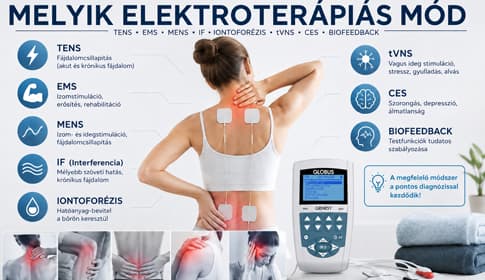
https://www.medimarket.com/shop_ordered/21500/pic/blog-feat-image/melyik-elektroterapias-mod.png
Recommended method: TENS (or IF if the pain is deeper).
If you have low back, neck, shoulder or muscle pain and you want immediate, noticeable relief, TENS is the classic choice. The transcutaneous impulses reduce the sensation of pain during the treatment. If the pain originates deeper (deep muscles, joints), interferential (IF) current can reach deeper and works with a more pleasant, less sharp sensation.
Read more: TENS pain relief | IF (interferential) treatment
Home devices: TensCare UniPro, Dolito, Globus Genesy 300 Pro.
Recommended method: EMS (electrical muscle stimulation).
If your muscles have become noticeably weaker after surgery, immobilization in a cast, hospitalization or lack of movement – difficulty climbing stairs, weaker grip, easy fatigue – EMS treatment actively exercises your muscles, even when you cannot move at full strength because of pain. It is also used by athletes to support recovery and strengthening.
Read more: About EMS | EMS for rehabilitation | EMS for athletes
Home devices: Globus Premium 400, Globus Elite SII, the Myolito and Rehalito series.
Recommended method: microcurrent (MENS) – under specialist supervision.
If you have a wound that hasn’t closed for months – leg ulcer, chronic heel wound, diabetic foot ulcer – microcurrent treatment can speed up healing alongside standard wound care. The method is so gentle that you do not feel it – which makes it suitable around sensitive, inflamed skin. Important: wound care is a specialist task; always discuss it with your GP or wound care professional.
Read more: Microcurrent (MENS) | Treating leg ulcers
Home devices: Premium 400, Globus Genesy 1500, TensCare UniPro.
Recommended method: combination of microcurrent + TENS.
If you struggle with acute or chronic knee pain – due to injury or degeneration (osteoarthritis) – microcurrent treatment can bring meaningful relief after 3–4 weeks of regular use. TENS provides quick relief for acute pain spikes. What to know: the main pillars of osteoarthritis management are exercise programs, weight control and medications – electrical treatment is complementary to these.
Read more: Microcurrent and joint inflammation | TENS
Home devices: Globus Genesy 300 Pro, Premium 400.
Recommended method: acetic acid iontophoresis (part of a complex package).
If you feel a sharp pain in your heel on the first step after getting up, it’s likely heel spur or plantar fasciitis. Acetic acid iontophoresis can provide meaningful relief after 4–6 weeks of regular treatment – especially when combined with stretching exercises, orthotic insoles and athletic footwear. What to know: the aim of treatment is to reduce pain, not to "remove" the spur.
Read more: Acetic acid iontophoresis for heel spur | Iontophoresis main principles
Home devices: IontoBravo, Globus Genesy 3000.
Recommended method: iontophoresis (tap water or gel).
If your palms or soles sweat so much that it disrupts daily life – slipping on the steering wheel, blotches on paper, avoiding handshakes – iontophoresis is one of the best proven solutions. Medication is not always necessary here – simple tap water can be effective. Sweating volume can decrease significantly within a few weeks.
Read more: Iontophoresis main principles | Excessive sweating
Home devices: DermaDry (specifically designed for this) / IontoBravo.
Recommended method: vagus stimulation (tVNS) or CES.
If you’ve been tense for months, can’t switch off, sleep poorly or suffer from anxiety, your body’s brake/accelerator balance has shifted. Transauricular vagus stimulation (tVNS) or cranial electrical stimulation (CES) gently activates the "brake" (parasympathetic system), supporting relaxation and sleep. What to know: these are adjunct tools – they do not replace sleep hygiene, exercise, meditation or prescribed psychiatric medications.
Read more: Autonomic nervous system and vagus stimulation | CES (cranial stimulation)
Home devices: Nurosym (tVNS), Zenowell Vita (sleep/stress), TensCare Somnus (CES).
Recommended method: migraine-specific neuromodulation.
If recurrent migraine attacks trouble you – hours-long pain, sensitivity to light and sound, nausea – a neuromodulation device applied to the forehead may help relieve attacks and prevent them. What to know: migraine treatment is a neurologist’s responsibility; always coordinate device use with your treating physician.
Read more: CES and neuromodulation
Home devices: Mynd Migraine Relief.
 The 8 methods in one table
If you want a quick overview, this table shows the methods in one view:
| Method | What will you feel? | What is it for? | When to choose? |
|---|---|---|---|
| TENS | distinct tingling | pain relief | for acute, noticeable pain immediately |
| EMS | muscle twitching | muscle activation, strengthening | post-surgery rehab, sports, muscle weakness |
| MENS (microcurrent) | typically nothing | cellular regeneration, wound healing | poorly healing wound, joint inflammation |
| IF (interferential) | finer, deeper tingling | deeper muscle/joint pain | chronic low back, neck or joint complaints |
| Iontophoresis | light tickling | delivering active substance under the skin | excessive sweating, heel spur, tennis elbow |
| Vagus stimulation (tVNS) | mild tingling in your ear | autonomic balance, activating the "brake" | chronic stress, sleep disorder, POTS |
| CES (cranial stimulation) | typically nothing | anxiety, sleep, mood | insomnia associated with anxiety |
| Biofeedback | does not stimulate – provides a measurement signal | conscious muscle or nerve learning | pelvic floor rehab, post-stroke muscle re-training |
The detailed methodological comparison can be read in the electrotherapy methods main pillar, and the TENS/EMS/MENS triple comparison in the TENS, EMS and MENS article.
4 questions to ask yourself before buying
Before you click on a specific device, it’s worth answering these questions clearly:
- What is my main goal? Pain relief? Muscle strengthening? Improving sleep? Wound healing? If you have multiple goals, consider choosing a multifunction device (e.g. Globus Genesy series – TENS + EMS + MENS + IF together).
- Do I already have medical diagnoses and medications? Electrotherapy devices are complements – they do not replace prescribed medications. With a pacemaker, implanted nerve stimulator or other implant, cardiologist approval is required.
- How much will I use it? If you will use it daily, choose a battery-powered, lightweight and comfortable device. If only occasionally, a simpler model may suffice.
- Have I discussed it with my treating physician or physiotherapist? For new, worsening or unknown complaints, specialist consultation is required first – only then start home electrotherapy.
 When NOT to start home electrotherapy – general rules
The rules below apply to all electrical treatments. Details are in the electrical treatment contraindications and electrical treatment and implants articles.
- You have a pacemaker, ICD, implanted nerve stimulator, hearing implant – only with cardiologist / arrhythmologist approval.
- You are pregnant – for general safety most methods should be avoided.
- The treatment would involve a cancerous area – electrodes must not be placed there.
- You have a blood clot in the treatment area – forbidden due to the risk of embolization.
- Your complaint is accompanied by fever or has unknown origin – medical evaluation first.
- Fresh wound, eczema or skin infection at the electrode site – wait until it heals (unless using it specifically for wound healing under specialist supervision).
- You cannot feel hot/cold on the affected skin – hard to set safely.
- You are in an acute psychiatric crisis (suicidal thoughts, severe panic) – seek specialist / emergency care first.
For new, worsening or unknown complaints always see a doctor first, only then choose a device.
Frequently asked questions about device selection
If you have multiple goals (e.g. pain relief + muscle strengthening + regeneration), it’s worth choosing a multifunction device – e.g. the Globus Genesy series includes TENS, EMS, MENS and IF. If you have only one specific goal (e.g. only hyperhidrosis or only migraine), a targeted device can be simpler and cheaper.
Yes, but in separate sessions. You cannot combine programs simultaneously on the same channel. You can use multiple types in one day – for example EMS training in the morning, TENS pain relief or MENS regeneration in the evening. Vagus stimulation (tVNS) and CES are typically most effective in the evening before bed.
It varies by method. TENS: immediate pain relief during the session. EMS: after 4–6 weeks of regular training. MENS: meaningful change after 2–4 weeks. IF: after 3–4 weeks. Iontophoresis: 4–6 weeks. Vagus / CES: 4–12 weeks. Chronic complaints require patience – it’s not as fast as a pill.
No. All electrotherapy methods are adjunct modalities – they do not replace prescribed medications. Only your treating physician can decide on stopping analgesics, antiarrhythmics, antidepressants or any other drugs. Never discontinue your medications on your own to replace them with a device.
In general electrotherapy is to be avoided with active implants (pacemaker, ICD, nerve stimulator, hearing implant). It may be initiated only with cardiologist / arrhythmologist approval – they can assess whether your specific device and the chosen electrotherapy combination are safe. Details in the electrical treatment and implants article.
Do not continue on a “maybe it will work” basis. See a doctor or physiotherapist – the underlying problem may require a different approach, or the chosen method may not be the most effective for your specific situation. Electrotherapy does not help everyone equally – individual results may vary.
 Summary – decision-support in a nutshell
What you need to know as a patient
- For acute, noticeable pain: TENS (or IF for deeper complaints).
- Muscle strength loss, rehab, sport: EMS.
- Poorly healing wound, joint inflammation: microcurrent (MENS).
- Excessive sweating, heel spur, tennis elbow: iontophoresis.
- Chronic stress, sleep, feeling "overdriven": vagus stimulation (tVNS) or CES.
- Recurrent migraine: migraine-specific neuromodulation (Mynd).
- Pelvic floor rehab, post-stroke muscle re-training: biofeedback (Biofeedback main article).
- All methods are adjunctive – they do not replace medical care, medications or physiotherapy.
- For new complaints see a doctor first, only then choose a device.
- If there’s no meaningful change after 6–8 weeks, a specialist consultation is needed.
Further information
- Overview of electrotherapy methods – all methods in one article.
- TENS – pain relief without medication
- EMS – electrical muscle stimulation
- Microcurrent (MENS)
- Interferential treatment (IF)
- Iontophoresis
- Autonomic nervous system and vagus stimulation (tVNS)
- CES – cranial stimulation
- Biofeedback
- TENS, EMS, MENS – comparison
- General contraindications
- Electrical treatment and implants
This article is for general information only and does not replace personal medical consultation. The methods and devices presented are CE-certified medical devices, adjunct treatments – they do not replace specialist diagnosis, prescribed medications or multidisciplinary care. Contraindications (pacemaker, implanted devices, pregnancy, tumor, acute fever, blood clot) must be strictly observed. For new, worsening or unknown-origin complaints consult your treating physician or physiotherapist. Results may vary between individuals.