Who is it recommended for?
Do you leak when coughing, sneezing, laughing or lifting? The STRE program group (35–100 Hz) targets fast-twitch muscle fibres responsible for reflex sphincter closure. Typical treatment is about 20 minutes daily; improvements are often noticed after 4–6 weeks. For women use a vaginal probe (PeriSphera O or H), for men use an anal probe (PeriSphera A). In women, uterine or bladder prolapse can underlie stress incontinence – read more in my article on prolapse treatment.
Sudden, uncontrollable urges to urinate that can’t be postponed? The URGE program group (5–10 Hz) targets bladder muscle overactivity: low-frequency stimulation can help reduce involuntary bladder contractions. The recommended protocol is once daily in the first week, then 2–3 times weekly thereafter.
The combined presence of stress and urge components is the most common form. The MIX program group addresses both components: within one session it alternates high- and low-frequency stimulation. The two channels allow targeting different muscle groups in parallel.
Fecal incontinence is treated with an anal probe (PeriSphera A or PeriProbe Analis). Stimulation can promote contraction of the pelvic floor and anal sphincter. With two-channel probes, evoStim UG can stimulate internal and external sphincters simultaneously – it is the only device in our range specifically suitable for this.
The PAIN program group is intended for chronic pelvic pain; the RELX program promotes pelvic floor muscle relaxation. For vaginismus, the PeriSphera AT probe is specifically designed for a narrow vaginal canal – gradual, gentle stimulation can help release muscle spasm. Use after medical consultation.
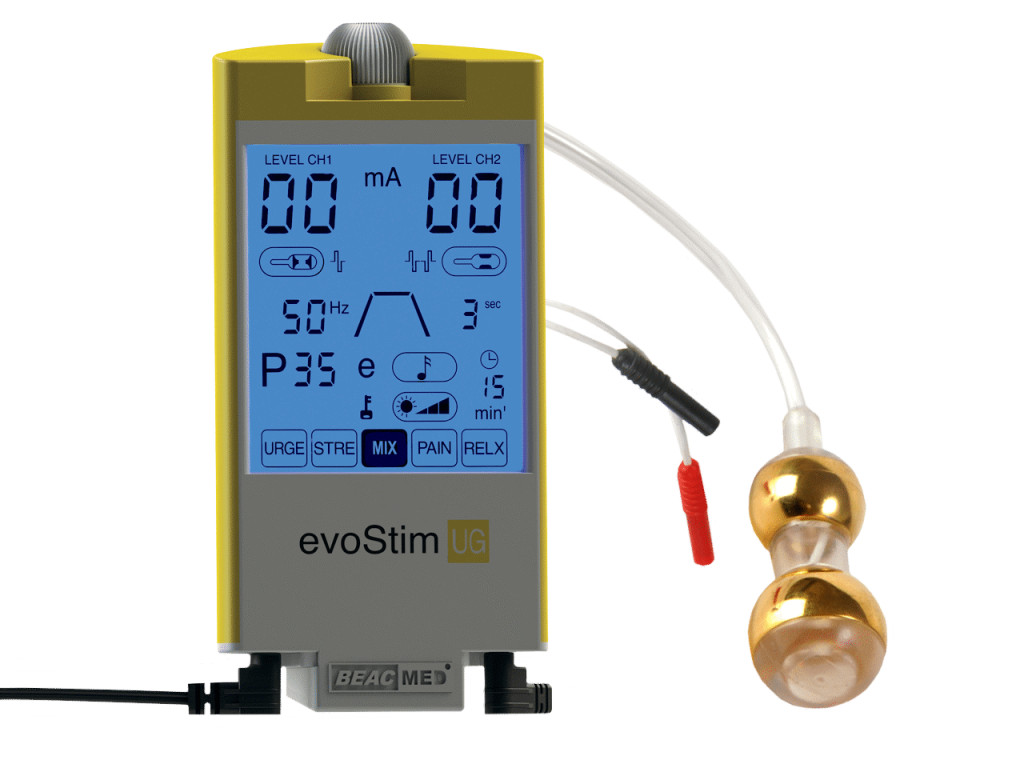
The evoStim UG is a professional-grade device: the five program groups and fully customisable parameters allow each patient to receive an individual protocol. The device is suitable for clinic and home use – the therapist configures the program, and the patient continues treatment at home.
How does functional electrical stimulation work?
The evoStim UG uses functional electrical stimulation (FES): mild electrical impulses delivered through the probe stimulate pelvic floor muscles to contract – similar to performing Kegel exercises yourself, but more targeted and controlled.
For stress incontinence higher-frequency stimulation (35–100 Hz) targets fast-twitch muscle fibres responsible for reflex sphincter closure during events like coughing or lifting.
For urge incontinence lower-frequency stimulation (5–10 Hz) targets bladder muscle overactivity: it can help reduce involuntary contractions and sudden urges to urinate.
Advantage of 2 channels: with two-channel probes (PeriSphera H, U, A) you can stimulate internal and external pelvic floor layers simultaneously with different parameters – enabling more targeted treatment than single-channel devices.
Frequently asked questions
evoStim P includes a biofeedback function: it measures muscle contractions in real time and provides visual feedback so you can see how well your muscles are working. The evoStim UG is a pure stimulation device without biofeedback, but has a wider range of indications (incontinence + pain + relaxation) and more compatible probes. If biofeedback is important to you, choose the evoStim P. If versatility and program variety are priorities, evoStim UG is the right choice.
No. Pelvic floor electrostimulation is contraindicated during pregnancy. Treatment can be started after delivery with medical approval – typically from 6–8 weeks postpartum.
Probe selection depends on treatment goals and anatomy. For women with urinary incontinence PeriSphera O (single-channel) or PeriSphera H/U (two-channel) is recommended. For vaginismus use PeriSphera AT. For men or fecal incontinence use PeriSphera A (two-channel) or PeriProbe Analis (single-channel). Your treating physician will help you choose the correct type.
IntelliSTIM is evoStim UG's intelligent parameter-tuning function: in the default programs (P10, P20, P30, P40, P50) it automatically optimises pulse width and other parameters when frequency is changed. You don't need to set every value manually – the device selects combinations aligned with clinical protocols.
Experience shows that for stress incontinence improvements are often noticeable after 4–6 weeks of regular treatment. Some users report positive changes for urge incontinence within the first weeks. Mixed types generally take longer. Treatment success varies individually – regular, protocol-based use is key.
Yes. evoStim UG is suitable for men using an anal probe (PeriSphera A or PeriProbe Analis). It can be used for post-prostatectomy incontinence, fecal incontinence and chronic pelvic pain. For men, the PFE for Men is also a recommended alternative.
3× AAA (1.5V) alkaline batteries. Battery life is approximately 20 hours – sufficient for months with weekly regular use. Remove batteries before prolonged storage.
How to use the evoStim UG?
1
Choose the appropriate probe
For women use a vaginal probe (PeriSphera O, H, U or AT); for men or fecal incontinence use an anal probe (PeriSphera A, PeriProbe Analis). Probe type is selected according to treatment goal and anatomy – your clinician will help you choose.
2
Connect the probe
Connect the probe to the device with the cable (1 or 2 channels depending on probe type). Insert the probe following the user instructions, using a water-based lubricant.
3
Select the program
Use the touchscreen and rotary knob to navigate to the appropriate program group (URGE, STRE, MIX, PAIN or RELX). IntelliSTIM automatically optimises parameters when frequency is changed in the default programs.
4
Set the intensity
Start the program and gradually increase the current intensity with the rotary knob until you feel a noticeable but comfortable muscle contraction. The device operates between 1–99 mA – the correct level varies by individual.
5
Complete the treatment
Treatment time can be set between 5–90 minutes. Typical sessions last 20–30 minutes. The device stops automatically at the end of the program. Regular daily use or 2–3 sessions per week is recommended depending on the protocol.
6
Cleaning and storage
Wash the probe with warm soapy water after each use and dry it. Wipe the device with a soft, slightly alcohol-based wipe (e.g. Clinell). Remove the batteries before prolonged storage.
Package contents and accessories
The basic evoStim UG package includes:
- 1 pc evoStim UG stimulator (2-channel)
- 3 pcs AAA alkaline battery (1.5V)
- 1 pc user manual
Vaginal probes:
- PeriSphera O – single-channel, general incontinence treatment
- PeriSphera H – two-channel, professional treatment
- PeriSphera U – two-channel, professional treatment
- PeriSphera AT – two-channel, designed for vaginismus and narrow vaginal canals
Anal probes:
- PeriSphera A – two-channel, fecal incontinence, professional treatment
- PeriProbe Analis – single-channel, for defecation-related problems
The probes have a smoke-gold coating and are made of hypoallergenic materials. For personal use only – do not share probes!
Technical specifications
| Type | 2-channel FES (functional electrical stimulation) stimulator |
| Channels | 2 independent channels |
| Program groups | 5 (URGE, STRE, MIX, PAIN, RELX) – up to 10 customisable programs per group |
| Frequency range | 1–150 Hz |
| Pulse width | 50–400 µs |
| Current intensity | 1–99 mA (at 1 kΩ load) |
| Waveform | Biphasic symmetric / biphasic symmetric alternating |
| Treatment time | 5–90 minutes (in 5-minute steps) or continuous mode |
| IntelliSTIM | Yes – automatic parameter optimisation |
| User interface | Touchscreen + rotary knob |
| Power supply | 3× AAA alkaline batteries (1.5V) |
| Battery life | ~20 hours |
| Certification | CE 0051 – Class IIa medical device, ISO 13485:2016 |
 When NOT to use it?
- Pregnancy
- Cardiac pacemaker or severe cardiac arrhythmia
- Epilepsy (use only after medical consultation)
- Kidney disease
- Active lower urinary tract infection
- Pelvic tumours
- Residual urine volume greater than 100 ml
- Vesicoureteral reflux
- While driving or operating machinery
Unsure? Consult your treating physician before use!
 Important information
The evoStim UG is CE 0051 marked, a Class IIa medical device. Pelvic floor electrostimulation is a recognised conservative treatment for incontinence supported by multiple clinical studies.1
Functional electrical stimulation (FES) can help train pelvic floor muscles, but individual results depend on regular use and the type of incontinence. It can be used as an adjunct to medical treatment.2
The information on this page is for guidance only. Home therapeutic devices are intended to complement medical treatment and do not replace it. Consult your treating physician if you have complaints.
Scientific background
Clinical evidence supports the effectiveness of pelvic floor electrostimulation in treating incontinence:
- Stewart F, Berghmans B, Bø K, Glazener CM. (2017). Electrical stimulation with non-implanted devices for stress urinary incontinence in women. Cochrane Database Syst Rev. 12(12):CD012390. PubMed
- Dumoulin C, Cacciari LP, Hay-Smith EJC. (2018). Pelvic floor muscle training versus no treatment, or inactive control treatments, for urinary incontinence in women. Cochrane Database Syst Rev. 10(10):CD005654. PubMed
 Incontinence treatment at home – complete guide →
 Treatment in practice – step by step →
 Urinary incontinence and its treatment →
 Fecal incontinence and its treatment →
 evoStim P – biofeedback rehabilitation →
 All incontinence devices →