
Femoral Neck Fracture
In this article I briefly review the study titled “Pulsed Electromagnetic Field (PEMF) treatment in the management of femoral neck fractures”, published by the Italian E. Betti and colleagues.
The femoral neck fracture
Fracture of the femoral neck is especially common in old age and also most dangerous at that time. Patients rendered immobile by the fracture quickly develop other complications such as thrombosis and edema, as well as pneumonia. These rapidly weaken the elderly patient and can lead to life-threatening conditions.
In elderly femoral neck fractures the aim of treatment is the earliest possible mobilization — the patient must be enabled to leave the bed. The sooner they can move, the lower the risk of severe complications.
Study population
In the study by E. Betti and colleagues, 77 patients with femoral neck fractures participated: 63 women and 14 men. The mean age was 69 years ± 5.8 years. All patients underwent surgery performed by the same surgeon using an identical technique (the fractured bones were fixed with three screws).
After surgery everyone took part in the same conventional rehabilitation program (e.g., physiotherapy, medications, nutrition) which was identical for all.
The patients attended follow-up examinations. During the first 90 days they were checked every 30 days, and then again at 6, 12 and 24 months. At every follow-up a radiograph of the hip was taken, range of motion was precisely assessed, and the Scott-Huskisson pain evaluation was performed.
PEMF treatment in femoral neck fracture
Within at most seven days after surgical fixation of the femoral neck fracture, all patients were discharged home with a magnetic therapy device.
All devices looked identical and displayed the same data during treatment. However, half of the devices were modified so that, despite appearances, they produced no magnetic field. The devices recorded the total duration of use.
The active stimulators generated a 75 Hz, 30 Gauss (3 mT) magnetic field, and patients were asked to use them for at least 8 hours daily.
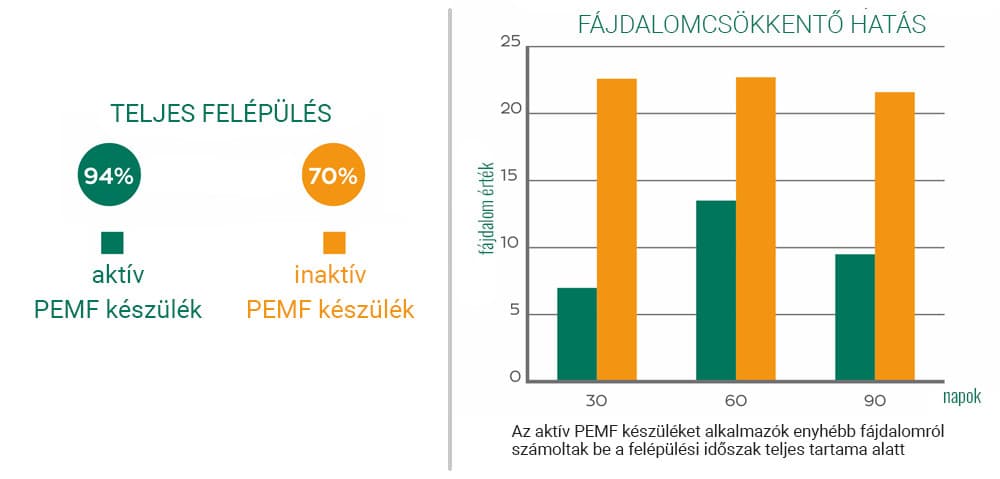
During the 90-day stimulation period patients used the active stimulators for an average of 486 hours, and the inactive devices for 391 hours. Twelve patients did not perform the home treatments and were therefore excluded from the study.
Results
- Pain resolved sooner in those who used the magnetic field treatment for the prescribed 8 hours daily.
- Magnetic field treatment effectively aided bone healing and remodeling.
- More complications occurred in those who did not receive the treatment.
Note
Magnetic therapy is a biostimulation method. The alternating (pulsed) magnetic field created by electrical coils stimulates cellular function. When applied near a fracture, it increases the activity of bone-forming cells, thus accelerating and strengthening bone formation.
Long-duration, even 8–10 hour pulsed electromagnetic field therapy is made possible by the so-called magnetic therapy mattress. This can be placed in the bed. Because a person remains in one place while sleeping, it is ideal for carrying out the magnetic treatment.
The Magnum pulsed electromagnetic field therapy devices provide medically supervised programs that promote fracture healing and offer magnetic therapy accessories.

