
Herniated Disc – What Can You Do About It?
Your spine is built from separate "bricks", the vertebrae. The gap between them is filled by a flexible material, the intervertebral disc. This prevents the vertebrae from contacting each other directly. The spine's stability is provided by ligaments and numerous muscles. If your spinal-supporting muscles are strong, they hold the vertebrae and only a load that does not damage the disc reaches it. If you carry too much load or your muscles are weak, excessive stress falls on the disc. If it deforms, it causes complaints of varying severity. Many people are affected by herniated discs, but surgery is not necessary for everyone. Those affected often don't really know what they should or can do to avert the threat of pain, paralysis and surgery. This article is for them.
Paths leading to a herniated disc and prevention possibilities
The bones of the spine continue to develop until the end of adolescence. After that they no longer grow.
Your spine supports your body. With each step of walking, your body weight presses down. The vertebrae, the intervertebral discs between them, the supporting ligaments and the spinal-supporting muscles together "dampen" the shock.
As long as your spinal-supporting muscles hold strongly enough, you have no problem. However, this shock-absorbing system can weaken or become imbalanced for many reasons.
Most often the causes behind spinal complaints are things for which you or your lifestyle are responsible.
- An acute injury usually occurs due to an accident, such as a fall or collision. I know—this can happen even to the most careful among us.
- Genetic predisposition – you "inherit" this from your parents. You can't do anything about the predisposition itself, but a predisposition alone would not necessarily cause a herniated disc. If your joint ligaments are lax or there is a family history of herniated discs, you must prepare consciously to avoid it. You can "replace" lax ligaments by making your spinal-supporting muscles stronger. In other words, regular spinal exercises, yoga, etc. are mandatory for you.
- If you are overweight, your muscles bear more load than planned. It's like constantly carrying something, as if you always had a sack on your shoulders. You can imagine that your spine wasn't "designed" for that! If you are overweight, aim to lose the excess weight or you must train your back muscles especially hard so they can carry your "sack." Overweight combined with untrained muscles is a direct cause of back pain and may predispose you to other joint complaints.
- If you do heavy physical work, your muscles may handle your own body weight but not the regularly carried objects.
- A driver or a jackhammer operator is exposed to continuous vibration. In these jobs the spine receives more stress than normal.
- Today the most common cause, however, is sedentary work and lack of movement. You sit in the office, on the bus, the subway, in the car, in front of the TV, at the cinema, at the theatre… everywhere.
My advice
If you miss the chance to prevent and a herniation develops, you can only restore your condition slowly. Prevention is not very costly. "Undoing" a herniated disc, well—that is expensive.
You will need multiple tools and professionals: a physiotherapist, a physical therapist, a masseur, a muscle stimulation device, softlaser, therapeutic ultrasond… you would have to pay for their expertise and buy the devices. This will particularly hurt because your herniated disc may not allow you to work and earn income.
My advice: Don't let it get to a hernia! Regular spinal exercises can prevent it "cheaply".
How a herniated disc develops
In everyday Hungarian the term "gerincsérv" (literally: spine hernia) is common, but it's not precise. In fact the intervertebral disc between the vertebrae is affected, so the correct term is "disc herniation".
The intervertebral disc consists of an outer fibrous ring and a jelly-like material held together by it. Imagine a jam-filled doughnut. The dough on the outside is like the fibrous ring and inside the jam is like the jelly-like material in the disc. The jam is invisible and stays inside, only appearing if you squeeze it, the dough tears and gives a way for the jam. Now sit on the doughnut… it gets squashed. You get the idea! The more load on your disc, the more the jelly-like material can be "squeezed out."
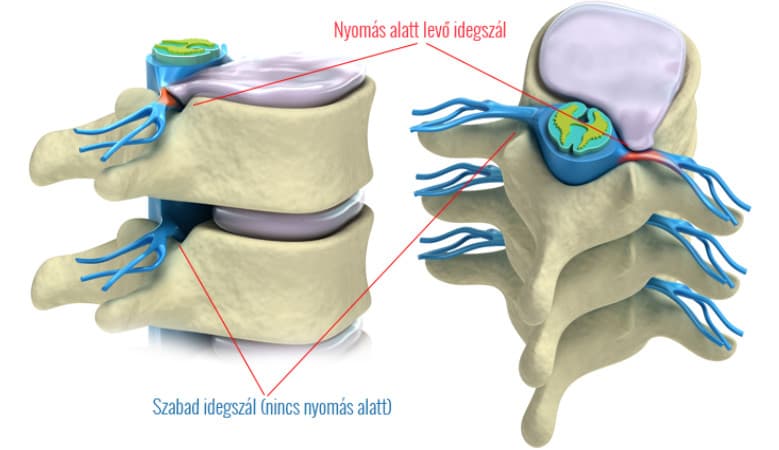
Space around the spine is very limited. There is nowhere for the "jelly" to flow! Yet there are plenty of sensitive structures: the spinal cord and the nerve roots that exit between the vertebrae are found here.
If you're lucky the disc herniates in a direction that doesn't press on a nerve – in that case you may have no complaints despite the herniation.
Most often, however, the herniation becomes apparent when the pain prevents movement. It's not the herniation itself that causes this but the fact that it presses on the spinal cord or a nerve root. The location and form of your symptoms depend on which vertebral level the herniation is at.
Because the greatest load is concentrated in the lumbar region, herniations most commonly occur there. But they can also appear in the neck or thoracic spine.
Symptoms of a herniated disc
Usually severe, sharp, stabbing pain that forces you into a guarded posture and simply won't let you move. Increased abdominal pressure (sneezing, coughing, straining) typically intensifies the radicular pain; lying with the knee drawn up and hip flexed usually reduces it.
The pain radiates into the area supplied by the affected nerve (dermatome), where sensory disturbances may occur (burning sensation, numbness, loss of sensation). Reflexes may weaken or disappear.
If the nerve remains under pressure for a long time, the motor nerve can be "injured", which may result in muscle weakness or even peripheral paralysis.
Read my article about dermatomes and study the illustrations in it carefully.
Based on the location of your pain you can often determine yourself which vertebra is the root of the problem.
What to do in case of a herniated disc
The complaints described above will probably force you to see a doctor. If they don't, don't delay examination. It's essential to know exactly what's going on.
It is the doctor's task to decide what to do. Surgery is usually performed if the herniation exerts such significant pressure on a nerve that it causes neurological symptoms or paralysis. If immediate surgery is not necessary, conservative treatment is started. If there is no meaningful improvement after six weeks, they may decide on surgery for "secondary" reasons.
In most cases surgery is not indicated; treatment reduces but does not eliminate complaints. A sudden movement, a sneeze, lifting even a small weight can provoke pain. This makes everyday life very difficult.
In case of a herniated disc avoid physical exertion for as long as your rehabilitation lasts. Sleep on a firm mattress (soft and sagging is not good), lie on your side with knees pulled up and a "rounded" lower back. This relieves the lumbar discs.
Drug treatment for lumbago aims to relieve pain and relax muscles. However, orally taken medications do not reach only the painful spot; they spread throughout your body. They act in places where you don't need them – which can lead to unwanted side effects, especially if you need to take them for more than a few days. Many patients think they will get anywhere with taking these drugs… and they are not informed that they will not. Much more needs to be done to recover.
In addition to medicines, you will probably be prescribed physical therapy procedures. You'll get a combination of ultrasond, electrotherapy, softlaser and magnet therapy. Their effect develops slowly and as soon as you start sensing the positive effect, the prescribed course often ends. You cannot get more state-funded (i.e. "free") treatments, even though you feel: you're half healed…
Unfortunately, from this point you are on your own. You will need to use private providers: physiotherapists and physical therapists.
Methods that provide symptomatic therapy
You can use a number of home physical therapy devices to reduce your herniation-related complaints. These devices are designed to be used simply, effectively and safely. It's not very complicated, but not completely risk-free either – you can only harm yourself if you ignore the rules and recommendations.
You must understand that different medical devices act in different ways and are meant for different purposes. All aim to restore your health, but in different ways. It's like a spoon, knife and fork: all for eating, but each for something else.
First let's look at devices that help reduce or temporarily eliminate your pain. However, these methods do not add anything to long-term treatment and do not restore the original condition. So although you may be pain-free, the problem can flare up at any time.
Massage roller (Foam-Roller)
A Foam-Roller massage roller can be used to relieve muscle pain, release muscle stiffness and knots, for stretching, warm-up and to improve muscle regeneration.
The main benefit of rolling is that it provides many advantages of physiotherapy and massage. A roller is cheaper than a single therapy session and can be used for years. Of course it does not replace exercise or massage. But for someone who can afford few treatments, buying and using a roller is very worthwhile.
During rolling the muscles lengthen and loosen. It squeezes blood out of the muscles while fresh blood flows in, carrying vital nutrients such as oxygen and glycogen to muscles, fascia and tendons. You can control the pressure of the roller—the more body weight you put on it, the greater the pressure.
Better-perfused and more relaxed muscles hurt less during movement. Increased circulation flushes out accumulated waste products. Muscles receive the necessary nutrients more quickly, which results in better regeneration.
TENS treatment
You may decide you don't want the side effects of painkillers and choose TENS for pain relief. This easily performed treatment acts in two places and results in pain relief lasting a few hours after treatment.
Because a herniated disc can cause prolonged pain (even weeks), choose a device that has a so-called modulated TENS program. Devices without this produce only a few days of pain relief because the brain adapts to the stimulation (unfortunately the most widespread Omron and Beurer stimulators do not have this, so they are only temporarily useful for herniated disc pain)!
IMPORTANT: TENS is symptomatic treatment. It relieves your pain but has no therapeutic effect on the herniation itself.
These TENS devices I recommend: Dolito, Myolito, MyoBravo, Elite SII, Genesy SII, Premium 400, Genesy 300 Pro
Microcurrent treatment
Provides more effective pain relief than TENS, but currently only the more modern and more expensive devices offer this treatment. It is not only symptomatic! It reduces edema around the nerve root compressed by the herniation and relieves pain. It stimulates regeneration of the injured tissues. This method also does not eliminate the herniation itself.
These MENS devices I recommend: Genesy 300 Pro, Premium 400, Genesy 600, Genesy 1500, Genesy 3000, etc.
Ultrasond treatment
Ultrasond waves warm the tissues, increase circulation, relax tense muscles and reduce edema around the nerve root. Its effect develops more slowly than with softlaser and more sessions may be required. Ultrasond devices are cheaper than, for example, softlasers. Also, with ultrasond you must pay attention to correct dosing, and you cannot use it directly over the spine—only on the two sides of the spinal column, on the spinal-supporting muscles. Ultrasond reduces pain but does not eliminate the herniation or the underlying cause.
Here you can find therapeutic ultrasond devices: M-Sonic 950, MediSound 3000
Softlaser treatment
Its effect is similar to microcurrent. It reduces edema around the nerve root, which leads to pain relief. Based on a 2017 study the American College of Physicians (ACP) recommends softlaser as a first-line procedure for (non-operated) herniated discs. In two-thirds of cases surgery became avoidable. A softlaser device is more expensive than a microcurrent or TENS device, and unfortunately it also does not provide a definitive solution for the herniation because it does not eliminate the herniation or the underlying cause.
Softlaser devices providing proper treatment: Personal Laser L400, B-Cure Laser Pro, Energy Laser L500 Pro, Energy Laser L2000
Muscle stimulation and herniated disc – effective help
If you've read this far you already know: a herniated disc is caused when your muscles are not strong enough for some reason to keep the distance between the vertebrae. Thus the intervertebral disc between them receives so much pressure that it "squeezes out its contents" – and a disc herniation is formed.
While it's obvious that regular spine-strengthening exercises reduce the likelihood of a herniated disc, when a herniation has already occurred exercise can be very risky and even contraindicated! If you start strengthening your back with those weak muscles that led to the herniation, you will make the situation worse.
This is where muscle stimulation (EMS) comes into play. With this method you can strengthen your back muscles without putting extra weight or load on your spine and without causing greater harm.
I recommend these muscle stimulators: MyoBravo, Elite, Elite 150, Premium 400, Genesy 300 Pro, Genesy 1500, Genesy 3000, etc.
The aim of muscle stimulation is to strengthen the spinal-supporting and back muscles enough to make spine exercises, yoga or even gym workouts safe for you.
From a muscle's perspective stimulation is no different from conventional training. If a muscle grows stronger with training, it will also respond to stimulation. The only differences are efficiency and time. Read my article on the theoretical basics of stimulation and you'll understand that muscle stimulation is more effective than exercise and therefore can develop a target muscle group in a shorter time.
Of course stimulation is not a replacement for exercise. It complements it. In case of a herniation, however, it is the only possible and effective method. You should treat at least once daily. You will feel improvement after 2-3 weeks. Within 2-3 months you can strengthen your muscles enough to safely switch to physical exercise.
And here is the next piece of news: from then on you must not drop exercising. If you do nothing, the painstakingly strengthened muscles will regress to their initial state in about 2-3 weeks, and you'll be left struggling with your herniation again….
But you didn't fight for this for nothing, did you?!?
Also read my article Back muscle strengthening with a 4-channel muscle stimulator! It includes a 3-month daily "training plan" that can help restore your spinal-supporting muscles.

