Who is SineBravo for and what is it good for?
Stroke can leave residual symptoms — varying degrees of paralysis of arms and legs or motor clumsiness. Paralyzed limbs can be improved with massage, physiotherapy, EMS stimulation and constant practice: instead of the “lost” movement we teach a new movement to the muscle, the brain and the motor nerve (neuroplasticity).
SineBravo plays a motivational key role in this process: when the patient attempts voluntary movement of the paretic limb, SineBravo detects even the smallest effort and makes it visible. Therefore the patient senses progress even if visible results are not yet present.
Kegel exercises — conscious contraction and relaxation of the pelvic-floor muscles — are key for stress incontinence and postpartum rehabilitation. The classic problem: the patient DOES NOT know whether they are activating the correct muscle. Often they contract abdominal or gluteal muscles while the true pelvic-floor muscle remains passive.
With the appropriate probe (pelvic probes sold separately) SineBravo makes it visible: if the pelvic-floor muscle truly contracts, the bar graph rises. This supports the development of conscious control — far more targeted training than Kegel exercises without visual feedback.
EMG-biofeedback is a key method in modern physiotherapy — in the West it is increasingly integrated into rehabilitation treatments. With clinical-level sensitivity (resolution on the order of 1 microvolt) SineBravo enables patient re-education. The desktop stand supports hands-free treatment (critical for paretic patients). 365-day statistics + PC connection for clinical documentation.
After childbirth the pelvic-floor muscles often weaken — this can present as stress incontinence, low back pain, or sexual dysfunction. Classic treatment is Kegel exercises, but many women are unsure if they perform them correctly. With the appropriate pelvic probe SineBravo provides visual feedback on correct Kegel execution. Starting after 6–8 weeks postpartum (with gynecologist approval), training of 3–4 sessions per week is recommended.
In post-operative rehab patients often fear “doing the exercises wrong" or that a muscle “is not working." SineBravo makes it visible: does the quadriceps actually activate during a squat attempt? Is the hamstring stronger than the quadriceps (which may be problematic for knee stability)? EMG measurements provide quantitative feedback that greatly aids conscious rehab training.
EMG-biofeedback can also be useful in athletic practice: for example you can measure the activity of a muscle you cannot properly activate or identify side-to-side differences to help learn the correct movement. Developing conscious muscle activation can impact performance. It DOES NOT replace classic EMS training but complements it.
SineBravo and DuoBravo N are complementary devices for different stages of the rehab process:
- Early stage – DuoBravo N (ETS mode): the patient’s voluntary effort is supplemented with electrical stimulation. Useful when the patient cannot yet achieve a visible contraction independently.
- Middle–late stage – SineBravo: developing conscious muscle control with visual feedback. The patient can produce substantial volitional activity and the goal is independent muscle control without stimulation.
A complete rehab protocol can use both devices according to recovery stages.
SineBravo's 365-day statistics storage is the longest in the portfolio. Stroke rehab or incontinence training often takes 6–24 months — SineBravo tracks progress throughout. Long-term EMG activity trends are objective evidence that rehab advances even when the patient subjectively does not feel progress. At clinical visits the treating physician or physiotherapist can analyze the data — if transferred to a PC with separate software.
Capabilities — highlighted features
SineBravo is a pure biofeedback device, but that focus includes many detailed refinements: sensitivity, visual/audible feedback, data logging and clinician collaboration all serve rehab effectiveness.
EMG (electromyography) measures the muscle's electrical activity. With clinical-level sensitivity SineBravo detects the smallest muscle effort — at the microvolt level. It detects contractions even if involuntary or not visible. This is particularly important in paretic patients where visible contraction is often MISSING in the initial rehab phase, while SineBravo still senses baseline activity.
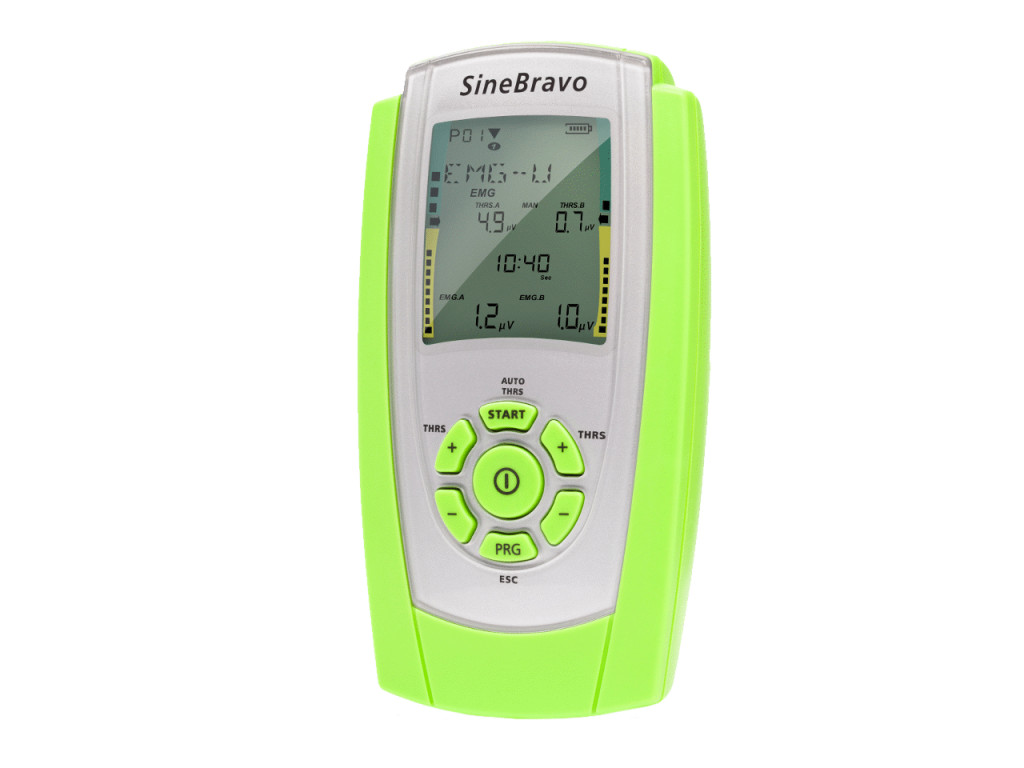
The display shows a yellow-green bar graph on both sides (left and right channel) and a numeric value (microvolts) on the bottom line. Audible tones accompany higher activity levels — important for patients with impaired visual concentration (e.g., post-stroke visual field deficits). The combined visual + auditory feedback enhances learning efficiency.
SineBravo can continuously monitor muscle activity on two independent channels. Examples:
- Bilateral (left-right) comparison: channel 1 on the paretic side, channel 2 on the healthy side. Changes in the difference indicate rehab progress.
- Agonist-antagonist pair: channel 1 on the quadriceps, channel 2 on the hamstrings. Analyze muscle balance.
- Pelvic-floor + abdominal muscle: during Kegel exercises the pelvic-floor muscle should be ACTIVE while the abdominal muscle is NOT (exclude compensatory movement).
Placed on the supplied desktop stand SineBravo stands in front of the patient for hands-free use. For paretic patients this is critical: the intact hand can be free for other tasks or there may be no need to hold the device. Combined with a mirror it becomes even more effective: the patient sees their limb in the mirror and the bar graph simultaneously.
365-day treatment data storage covers a full annual rehab cycle. Average values can be displayed on the screen, and with separate software + USB connection data can be transferred to a PC for detailed analysis. This is especially useful for:
- Treating physician: objective evidence of rehab progress at clinical visits.
- Physiotherapist: fine-tuning training protocols based on data.
- Patient: motivation — long-term statistics show progress even when day-to-day change is not felt.
Incontinence training (or postpartum pelvic rehab) requires special pelvic probes — these are NOT part of the SineBravo package and are ordered separately:
- PeriSphera O: vaginal probe for general female incontinence training and visual Kegel feedback.
- PeriProbe Analis: anal probe for fecal incontinence training or urine leakage training in men.
Both probes have gold-plated surfaces — usable even in case of metal allergies. The probe measures EMG activity directly adjacent to the pelvic-floor muscle — far more targeted than surface electrodes.
Frequently asked questions
SineBravo is a MEASURING DEVICE — IT DOES NOT electrically stimulate, so the risk for pacemakers and other implants is LOWER here than with stimulating devices. STILL: if you have a pacemaker or ICD or any implanted medical device, consult your cardiologist or treating physician before use. Surface sensing cables on the skin do not deliver direct current to the implant, but begin use only with medical approval for full safety.
SineBravo is a home biofeedback device, but for stroke rehab or incontinence training clinician (neurologist, rehabilitation specialist) or physiotherapist/gynecologist supervision is RECOMMENDED for the initial assessment. The specialist determines:
- Which muscle to measure (paretic limb, pelvic-floor muscle)
- Exact electrode placement
- Training protocol and duration
- Interpretation of the data
Home practice should follow the protocol set by the specialist. The 365-day statistics can be reviewed and optimized at clinical visits.
Both are MTR+ Bravo-line rehab devices, but there is a FUNDAMENTAL DIFFERENCE:
- SineBravo: ONLY EMG-biofeedback. DOES NOT STIMULATE. The patient learns to activate the muscle independently with visual + audible feedback. Purely "volitional" training without electrical assistance.
- DuoBravo N: combination of EMG measurement + electrical stimulation (ETS function). The patient attempts to move and the device ASSISTS with electrical stimulation.
The two devices can complement each other at different rehab stages: early stage DuoBravo N (ETS assistance), middle–late stage SineBravo (pure volitional control). Some clinics use both across the full process.
Kegel training requires a pelvic probe (PeriSphera O vaginal or PeriProbe Analis anal — ORDERED SEPARATELY). Steps:
- Hygiene preparation: clean the probe thoroughly before use.
- Insertion: in a comfortable position (lying, on your side) with a small amount of lubricant.
- Connection: connect the probe to one measurement channel of SineBravo. Place a surface electrode on the abdominal muscle for channel 2 — this checks that you are NOT contracting the abdominal muscle.
- Training: try to contract the pelvic-floor muscle ("as if stopping urine flow"). SineBravo’s probe channel should show a rising bar graph while the abdominal channel shows MINIMAL activity.
- Duration: initially 10–15 minutes, 1–2 times daily. Full training cycles of 8–12 weeks.
IMPORTANT: start Kegel training with gynecologist or urogynecology approval. Home biofeedback can greatly accelerate progress because visual control develops conscious muscle activation.
Stroke rehabilitation duration depends on many factors (stroke severity, affected brain area, patient age, general condition, intensity). SineBravo is especially valuable in the middle–late rehab phase:
- 0–3 months: initial rehab. SineBravo can be used if the patient already has a BASIC level of volitional activity. If not, DuoBravo N (ETS assistance) is recommended first.
- 3–12 months: intensive training phase. SineBravo is ideal for developing conscious muscle control and learning "new movements."
- 12–24 months: fine-tuning phase. SineBravo supports detailed motor control development.
- 24+ months: maintenance training to preserve gained functions.
Long-term EMG trends provide objective evidence of progress even when the patient does not subjectively feel changes.
EMG-biofeedback principle is simple: the patient does not feel or see muscle activity — the device measures and feeds it back (visually + audibly). Classic physiotherapy often proceeds "blind": the patient tries and the therapist watches. With EMG-biofeedback the PATIENT SEES what they do.
Typical situations where EMG-biofeedback is advantageous:
- Paralyzed limb after stroke: minimal visible movement but measurable EMG activity.
- Kegel exercises: the patient cannot identify which muscle they activate — EMG clearly shows it.
- Post-surgical rehab: the patient fears doing exercises incorrectly — EMG proves muscle activation.
- Chronic muscle spasticity: practice of relaxation and measurable muscle release.
EMG-biofeedback DOES NOT replace classic physiotherapy — it complements it and in many cases accelerates progress.
Stroke rehab or incontinence training often takes 6–24 months. Day-to-day progress is often not felt — the patient may feel they speed up or stall. Long-term EMG data, however, give an objective picture:
- 6 months ago: average EMG activity was 5 µV for a contraction attempt.
- Now: the same muscle shows 15 µV.
- Therefore: activity tripled — even if the patient does not subjectively feel it.
A 365-day annual rehab-cycle record has clinical value — at visits the physiotherapist can optimize the training protocol based on analyzed data.
How to use it step by step?
1
Initial setup by a specialist (initial assessment)
Start using SineBravo after a physician or physiotherapist assessment. The specialist determines which muscle to measure (paretic limb, pelvic-floor muscle, etc.), the EMG sensitivity, and the training goals and duration.
2
Insert 4 AA batteries
The device operates on 4 AA batteries — included in the package. For long-term daily use you can switch to NiMH rechargeable AA batteries.
3
Place electrodes precisely
The package includes 8 self-adhesive 4×4 cm electrodes + reference cable. For stroke rehab electrodes are placed on the target muscle of the paretic side (e.g., quadriceps, biceps). For incontinence rehab special pelvic probes are available separately (PeriSphera O vaginal, PeriProbe Analis anal). The reference electrode provides the basis for EMG measurement.
4
Desktop stand + deliberate positioning
Placed on the supplied desktop stand, SineBravo stands in front of the patient for hands-free use. This is critical in stroke rehab because we train the paretic side’s volitional effort and the patient can visually follow the bar graph. Combined with a mirror, visual feedback becomes even more effective.
5
Active practice — “try to move!”
After turning SineBravo on the patient attempts to VOLUNTARILY activate the muscle. The display shows a yellow-green bar graph + numeric value (in microvolts) representing activity. Audible feedback may accompany higher activity levels. The patient sees in real time: "it moved!" even if no visible result is apparent.
6
Statistics + data handover to the physician
At the end of treatment average muscle-activity values automatically appear on the display. Detailed 365-day statistics are stored in memory. With separate software + USB connection you can transfer data to a PC. At clinical visits the treating physician or physiotherapist can analyze progress.
Demo and usage video
The video below demonstrates the SineBravo device and general usage.
SineBravo biofeedback device demonstration
The SineBravo EMG-biofeedback operation, interpreting the bar graph, electrode placement, and basic principles of rehab training.
What’s included in the package?
The SineBravo base package — with all necessary accessories to start biofeedback training immediately. Pelvic probes for incontinence training are ordered separately.
- 1 pc SineBravo device (1-channel, biofeedback)
- 2 pcs stimulation cables (measurement cables)
- 1 pc reference cable
- 8 pcs 4×4 cm self-adhesive electrodes
- 1 pc desktop stand (for hands-free use)
- 1 pc carrying bag
- 4 pcs AA batteries
- 1 pc Hungarian user manual
Self-adhesive electrodes: adhesion gradually decreases after 25–30 uses. Replacements in 4×4 cm size are available separately. After use store them back on the protective foil.
AA batteries: 4 pcs included. With average use runtime lasts several weeks. Remove batteries during long non-use. You can switch to NiMH rechargeable cells.
Device cleaning: wipe the exterior with a dry or slightly damp cloth. Clean contact points (cable connectors) with a dry cloth.
Desktop stand: place it stably so it does not move during treatment. Cleanable with a damp cloth.
SineBravo can be complemented with additional accessories:
- PeriSphera O vaginal probe: for general female incontinence training and visual Kegel feedback.
- PeriProbe Analis anal probe: for fecal incontinence training or urine-leakage training in men.
- USB fiber-optic adapter + PC software: for clinical documentation and data export. Ordered separately.
- Spare electrode sets: 4×4 cm size, replacement after ~25–30 uses.
- NiMH rechargeable AA batteries + charger: cost-effective for long-term daily use.
Technical specifications — detailed
| Property | Value | What it means for you |
|---|---|---|
| Type | EMG-based biofeedback device | Measuring device – DOES NOT STIMULATE, only measures muscle activity |
| Stimulation modes | Biofeedback (DOES NOT electrically stimulate) | Develops purely volitional muscle activation |
| Channels | 2 independent measurement channels | Simultaneous bilateral or agonist-antagonist monitoring |
| EMG sensitivity | Microvolt-level (clinical-level) | Detects the SMALLEST voluntary effort |
| Visual feedback | Yellow-green bar graph (left+right channel) + numeric value | Continuous feedback during treatment |
| Audible feedback | Audible tones at higher activity levels | Dual (visual + auditory) sensing — more effective learning |
| Data storage | 365-day detailed therapy statistics | The portfolio's longest data retention |
| PC connection | USB connection (with separate software) | Clinical analysis and documentation |
| Desktop stand | Included | Hands-free use — key for paretic patients |
| Display | LCD — bar graph + numeric values + parameters | Continuous feedback |
| Power supply | 4 AA batteries | Long runtime, easy battery replacement. You can switch to NiMH rechargeables. |
| Incontinence probes | PeriSphera O (vaginal), PeriProbe Analis (anal) — ORDERED SEPARATELY | Gold-plated surface — usable in case of metal allergy |
| Certification | CE 0123; Class IIa; ISO 13485:2021; MDD 93/42/EEC | European conformity, clinical quality assurance |
| Manufacturer | MTR+ Vertriebs GmbH (Germany) | Manufactured according to German quality-assurance standards |
 When NOT to use SineBravo?
SineBravo is a MEASURING DEVICE — it does not electrically stimulate, so the contraindication list is shorter than for stimulating devices. Still, in some situations consultation with the treating physician is necessary before starting use.
- Presence of a pacemaker, implanted defibrillator (ICD) or any electronic implant — cardiology consultation required (SineBravo is a measuring device, but consult for full safety)
- Skin lesion, fresh scar or open wound on the treatment area (avoid electrode placement until healed)
- Active dermatitis or infection at the electrode site
- Nickel or other metal allergy — monitor skin reactions carefully
- For pelvic-probe use: active vaginitis, vulvovaginitis, acute vaginal infection, prostatitis or acute ano-rectal inflammation — contraindicated
- For pelvic-probe use: pregnancy or possibility of pregnancy — avoid unless cleared by treating physician
- Severe cognitive impairment preventing interpretation of visual/audible feedback (supervision required)
- Severe depression or other psychiatric conditions where active participation training is contraindicated — consult a psychiatrist
- Hypertensive crisis or unstable severe cardiovascular disease
- Fever or acute infectious diseases
- New neurological symptoms in a post-stroke patient (new weakness, speech disturbance, vision loss) — STOP use and notify the treating physician
- New, severe incontinence symptoms (especially if accompanied by blood or pain) — urological/gynecological evaluation required
- Children for unsupervised use (under 12 years only with adult supervision)
Unsure? Consult your treating physician before use — neurologist for stroke rehab, gynecologist/urogynecologist for incontinence training is recommended. Detailed information by Dr. Zátrok Zsolt on contraindications of electrotherapy is available here.
 Important information
SineBravo is a CE-certified, Class IIa medical device (CE 0123, according to MDD 93/42/EEC), a clinical-level EMG-biofeedback device. Home use is recommended under the supervision of a treating physician (neurologist, rehabilitation specialist) or physiotherapist/gynecologist. The device does not replace medical diagnosis, an individualized physiotherapy protocol or prescribed medication. It is an adjunct device to be used alongside comprehensive rehabilitation therapy.
If new or worsening symptoms occur (e.g., new muscle weakness, sensory loss, speech disturbance, vision loss in post-stroke patients; new or worsened incontinence with blood/pain) STOP use and seek URGENT medical attention. New neurological symptoms after stroke may indicate another stroke and require immediate evaluation.
SineBravo IS NOT a diagnostic EMG device — it is not suitable for diagnosing neurological diseases. It is a biofeedback device that supports existing rehabilitation processes.
Use only original accessories; replace electrodes regularly (after 25–30 uses). Hygiene maintenance of pelvic probes is critical — clean before and after each use. Always keep the device out of reach of children.
The information on this page is for general guidance and does not replace individual medical advice, diagnosis or treatment. For specific complaints always consult your treating physician.