
Muscle-stimulation treatment for incontinence in practice
One of the most effective ways to treat incontinence is muscle stimulation. A muscle stimulation device is usually a very simple tool and its use is not complicated — provided someone explains the steps properly. In this article I try to do exactly that.
The role of the pelvic floor sphincter muscles
Healthy pelvic floor sphincter muscles surround the urethra and the anus and the more urine or stool pushes down from above, the more they close. In various forms of incontinence this sphincter function is lost due to weakness or elongation of the pelvic floor muscles, reduced squeezing force, or excessive bladder activity.
The strength of voluntarily controlled muscles is maintained by physical activity, i.e. they can be trained. Various pelvic floor exercises aim to improve the strength and support of the sphincter muscles by repeatedly contracting the pelvic floor muscles with specific exercises. Such exercises are time-consuming: even with daily routines, months are usually required to see improvement.
Why muscle stimulation?
A muscle stimulation device is recommended in addition to muscle training to make it more effective. Stimulation treatment is targeted and concentrated, so significantly faster and stronger effects can be achieved than with exercises alone. Usually improvement is noticeable after 2–3 weeks of treatment, but a course of 2–3 months (daily treatments) is recommended. This length of treatment can produce substantial improvement.
The achieved state can be maintained with maintenance treatments, i.e. less frequent sessions of 1–2 times per week.
In cases of incontinence it is clear that Kegel exercises combined with muscle stimulation are the most effective.
The importance of the correct treatment
Different forms of incontinence require different treatments, since the causes of the problem also differ.
- In stress incontinence the pelvic floor muscles are weakened and do not provide adequate support. In such cases the aim of treatment is to strengthen the muscles.
- In urge incontinence the muscle tone is increased, therefore the aim of treatment is to relax them.
- In mixed incontinence the above two occur together, so the treatment program also consists of several phases. It is divided into parts that reduce tension and parts that strengthen the muscles.
When you notice incontinence, the first step is to see a doctor so the type of incontinence can be determined.

Article recommendation: Urinary incontinence and its treatment
Urinary incontinence means difficulty holding or being unable to hold urine, which is associated with very unpleasant symptoms and complicates daily life. In Dr. Zátrok Zsolt's article you can learn the most important information.
Muscle stimulation devices
Based on the above, it is therefore important to choose a device that provides the appropriate program. There are many different devices available for treating the pelvic floor muscles.
There are simple and inexpensive devices which in most cases have sufficient functionality. An examination is necessary before choosing and the doctor must determine the type of incontinence! The most common form is stress, followed by urge and then mixed incontinence. You should choose a device that provides a treatment program suitable for your problem.

Incontinence treatment devices
Stress, urge and mixed forms of incontinence can be treated by several methods. Muscle stimulation is one of the most effective. A beneficial effect can be felt after 2–3 weeks of treatment and persistent treatment will in most cases completely eliminate, or at least significantly reduce, the symptoms.
The cheapest device (e.g. Kegel Toner) is suitable only for stress incontinence and is not appropriate for urge or mixed forms.
The Perfect PFE for Men device is designed for treatment of men (not recommended for women).
The Biolito, Myolito, UniCare devices provide treatment programs for all forms of incontinence and are suitable for both men and women.
The Genesy SII, MyoBravo, Premium 400, Triathlon Pro devices are not only good for incontinence treatment. They also provide treatment for many other problems, such as muscle and joint pain, inflammatory musculoskeletal complaints, etc.
The evoStim UG, evoStim E and evoStim P devices are for special and severe cases. They allow many settings and personalization of stimulation impulses. These are usually provided by the therapist or treating physician (for example via rental). These devices typically require 3–6 months of use.
Before purchasing, therefore, learn about your own problem. Knowing the type of incontinence will make choosing easier.
Preparations for treatment
Muscle stimulation only produces results with regular daily and persistent treatment (applied for a minimum of 2–3 months). The good news is that you do not need to travel to a clinic or hospital for the treatment — you can perform it safely and effectively in the comfort of your home, at times that suit you and without having to stick to appointments.
Carrying out the treatment is not complicated. The first time it may feel unfamiliar, but after a few sessions you will get used to it and it will become routine.
- Before using an electrical stimulator, check whether there are any contraindications to electrotherapy.
- Find a place in your home where you can perform this intimate treatment in privacy.
- Do not switch on the device yet!
- Depending on whether you perform transcutaneous (on the skin) or intracavitary treatment, take out the self-adhesive electrodes or the treatment probe.
- Connect the electrodes or the vaginal or rectal probe connectors to the cable and the cable to the device.
- Self-adhesive electrodes are pre-gelled, so you do not need to wet or apply gel to them (in fact doing so can damage the adhesive surface).
- For vaginal/rectal probes moisten with water or use a lubricant gel to facilitate insertion. Lubricant also helps impulse transmission to the muscles. It is particularly useful if you suffer from vaginal dryness.
- Get comfortable. This can be sitting, semi-reclining or lying down. You can change your position even during treatment. You can move during treatment without harming the effect. Of course, a comfortable resting position is better.
Performing the incontinence treatment
- Attach the self-adhesive electrodes to the skin as shown in the diagrams below or
- Insert the vaginal probe into your vagina as you would insert a tampon. Depending on body type, you should insert it about 3–5 cm deep. The part of the probe where the cable meets it should remain outside the body. For example, the PeriSphera O probe has a stop at 5.7 cm, i.e. a maximum depth, but in very slim individuals it may be less.
- If you use a rectal probe, insert it into the anus like a suppository. The probe has a "bulge" at the end which is thicker than the probe shaft. Insert slowly; you will feel the bulge pass the external and then the internal sphincter. Depending on body type, it should be 2–3 cm, maximum 5 cm deep.
- The PeriSphera O probe has a circular electrode surface, so treatment is the same regardless of rotation.
- Some electrodes have electrode surfaces on both sides. Position the electrode so that the metallic surfaces point forward-backward.
- Now switch on the device by pressing the Power button.
- Select from the device menu the program appropriate for your symptoms. It matters which type of incontinence you have! Stress, urge, mixed and fecal incontinence require different impulses.
- When ready, start increasing the intensity (usually with a plus or up-arrow button).
- At first you may feel nothing, then a pinching, tingling sensation will appear. This is caused by the electrical current. Don't be alarmed, it should not be unpleasant.
- Gradually increase the current intensity.
- With probes the maximum current intensity is typically 10–30 mA. Do not exceed 30 mA.
- The higher the current intensity, the stronger the contraction you will feel. However, higher currents are associated with an unpleasant, pinching sensation. If the sensation is uncomfortable, reduce the intensity by a few steps. The treatment should not be painful.
- On the device display you can usually see the remaining time of the treatment; the device will switch off at the end of the program.
- If it has stopped, switch off the device.
- If you used self-adhesive electrodes, remove them from your skin and stick them back onto the plastic backing.
- If you used a probe, pull it out. Do not grab it by the cable, as this can damage it. Hold the rim of the probe and remove it that way.
- Clean the probe with lukewarm water. Do not put it in boiling water or in a microwave!
- You can use a disinfectant solution to clean the probe.
- Wipe with a damp cloth or disinfectant wipe if needed. Do not use caustic cleaning or disinfecting agents as they may damage your device.
- Dry the probe and store it in a clean, dry place.
Placement of electrode or probe
Incontinence treatment can be performed through the skin with self-adhesive electrodes attached to the skin or "from inside" via a probe inserted into the vagina or the anus. These are not entirely equivalent. The advantage of probe use is that the pelvic floor muscles can be stimulated directly and from close range.
Intracavitary probe treatment is somewhat more effective than with self-adhesive electrodes. This is because the probe is closer to the pelvic floor muscles than a skin electrode, so the effect can be more direct and stronger.
Use self-adhesive electrodes if you are reluctant to insert a probe into a body orifice. There can also be medical reasons, for example hemorrhoids, anal fissure, fistula, etc., in which case prefer the self-adhesive electrode. The pressure of a probe and the direct electric current on an already damaged mucosa or hemorrhoid can worsen the condition.

Product recommendation: intracavitary probes
Incontinence treatment (that is, stimulation of the pelvic floor muscles) can be performed in two ways: from the body surface with self-adhesive electrodes, or via probes placed into body cavities (vagina/rectum). Probe treatment can be more effective.
Transcutaneous stimulation 1: pubic bone to sacrum
Many stimulator manufacturers recommend this electrode placement. In my opinion the distance between the electrodes is relatively large, so the pelvic floor treatment is less effective. Additionally, not only the pelvic floor but also the lower abdominal muscles can contract if the impulse passes through them.

This variation requires two large surface self-adhesive electrodes (e.g. 50x90 mm). One should be placed on the pubic mound. Remove hair in that area. For men it should be 2–4 cm above the base of the penis. The other electrode is placed on the sacrum at the back. The electrodes should be connected to the two ends of the same stimulating cable. After starting the stimulation program appropriate for the form of incontinence (stress, urge or mixed), increase the impulse until distinct contractions occur.
I have already mentioned that this method may be suggested to you elsewhere; however, I consider the pubic-to-sacrum placement moderately effective for treating incontinence because it is too far from the pelvic floor.
Transcutaneous stimulation 2: upper inner thighs
You can use both large (e.g. 50x90 mm) and smaller (e.g. 50x50 mm) self-adhesive electrodes. Place the electrodes on both sides in the groin folds. Position the electrodes so that the vaginal or anal opening lies between them. Leave a palm's distance between the two electrodes. After starting the stimulation program appropriate to the form of incontinence (stress, urge or mixed), increase the impulse until distinct contractions occur in the pelvic floor muscles.
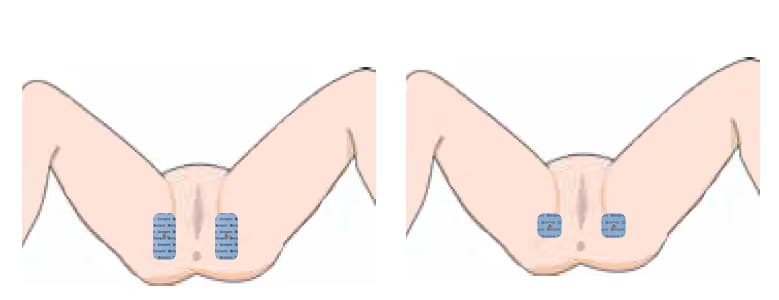
I consider this version more effective because with this placement the stimulation is directed at the pelvic floor. It can even approach the effectiveness of intracavitary probes. Self-adhesive electrodes are simpler to use than intracavitary probes.
Possible methods of intracavitary stimulation are shown in the diagram below.
On the left you can see the position of a treatment probe placed into the vagina, while on the right you see a probe inserted into the anus. In this case the two ends of the cable connected to the device must be connected to the two connectors of the probe. After starting the stimulation program appropriate for the form of incontinence (stress, urge or mixed), increase the impulse until clearly perceptible contractions are produced in the pelvic floor muscles without causing discomfort.
Change the electrode position with small movements (deeper or more superficial) and rotate it to find the position where you feel the strongest contractions. Use lubricant when inserting the probe — this also enhances impulse transmission.

I recommend trying all the suggested methods. Based on your experience you can decide which gives better results.
When can you expect results?
The effect of muscle stimulation in incontinence treatment appears similarly to exercise: if you do it rarely, the effect will be like running once a month — nothing. If you start with overly frequent and high-intensity treatments you will exhaust muscles that are not prepared for it. The golden mean is the right approach. In the first two weeks perform treatments every other day. After that you can switch to once-daily treatments.
If you follow the above and set the treatment intensity sufficiently high, you will feel definite improvement within a few weeks. Within 2–3 months you may completely eliminate your complaints. That is a very short time compared to how long the complaints developed and how long you have been suffering from them.
If your symptoms disappear, that is joyful, but you must not sit back! If you stop treatment completely, the muscles will weaken again, elongate and the unwanted effects will return. Therefore perform maintenance, reminder treatments. Once or twice a week is enough to preserve the good condition. If symptoms recur, you will need an intensive treatment period again.
Muscle stimulation is an excellent and effective method and can be performed completely safely at home.

