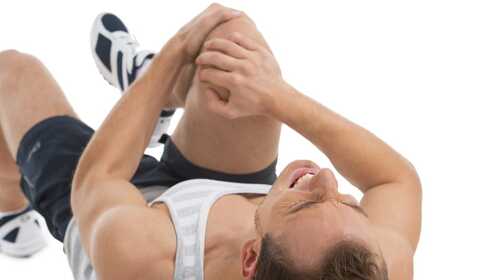

 What is jumper’s knee — and why does it not go away on its own?
The typical complaint is pain at the lower tip of the kneecap, at a point you can show with one finger: at first only after training, then at the start of training (when it “goes away after warming up”), and finally during training and in everyday life too — when climbing stairs, squatting or after sitting for a long time. And this is the trap that prompted me to write this article: jumper’s knee is not an injury you can simply “rest off”. Rest reduces the pain, but the tendon does not become stronger — at the first serious load, everything starts again. The way out is the opposite of what instinct tells you: you must not simply spare the tendon; you must load it intelligently and gradually.
 Key point
According to current research, jumper’s knee is not classic inflammation, but a disorganised, “poorly repaired” remodelling of the tendon caused by overloading — which is why simple rest, anti-inflammatory tablets or a steroid injection alone do not provide lasting benefit. What works durably in studies is a consistently performed loading exercise programme over several weeks — decline squats or heavy-slow resistance training — which gradually rebuilds the tendon. Physiotherapy (soft laser, ultrasound) may accompany this process; it does not replace the exercises.
 What happens in the tendon — and who develops it?
Click the tabs:
A tendon is like a braided rope: thousands of parallel collagen fibres carry the force. If the load persistently exceeds what the tendon can regenerate, microtears develop in the fibres and repair becomes disorganised: weaker connective tissue, ingrown small blood vessels and nerve endings — the latter being the main source of pain. Histologically, there are very few inflammatory cells at this point — so tendinopathy is a more accurate term than tendinitis, and this is why anti-inflammatory treatment does not heal the process: the remodelled tendon segment must not be “calmed down”, but rewoven through organised loading. The same mechanism affects the Achilles tendon and the elbow — the principle is the same there too: Achilles tendon inflammation →
Jumper’s knee typically progresses in stages.
Stage 1: pain only AFTER training — performance is not yet affected.
Stage 2: pain at the start of training that “goes away” with warming up, then returns when tired.
Stage 3: pain during and after training, with declining performance — everyday activities (stairs, squatting, prolonged sitting) are also affected.
Stage 4: partial or complete tendon rupture.
The lesson is clear: the earlier you start managing the load, the shorter the way back — weeks in stages 1–2, typically months in stage 3. “It goes away after warming up” is not a reassuring sign; it is the definition of stage 2.
The strongest factor is a sudden increase in load: a new season, training camp, hard indoor flooring or more jumps — the tendon likes a slowly increased load, not a sudden shock. Contributing factors include stiff thigh and calf muscles (a tight muscle transfers more force to the tendon), weak gluteal and core muscles (poor landing mechanics), flat feet or a high arch, excess weight, and it is more common in boys and men.
In adolescents, the same load is absorbed not by the tendon but by the growth plates — pain in the bump below the kneecap is Osgood–Schlatter disease in teenagers, not jumper’s knee, and requires different treatment.
Prevention follows the same list in reverse: gradual load increase (the ~10% per week rule), stretching, strong gluteal and core muscles, and good footwear.
 The backbone of treatment: a loading exercise programme
After diagnosis (palpation, ultrasound and, where necessary, MRI) and exclusion of a rupture, treatment is based on a consistent 12-week exercise programme. There are two research-supported versions — both can also be done at home:
| Programme | How? | For whom? |
|---|---|---|
| Decline (eccentric) squats | On an approximately 25-degree decline board, you slowly lower yourself into a squat on one leg, using the painful leg (this is the painful phase), then stand back up using the other leg or assistance. 3×15 repetitions, twice daily, for 12 weeks.1 | The classic, most extensively studied protocol; outside the season or for lower activity levels |
| Heavy-slow resistance training (HSR) | Squats, leg press using a machine or weights: high resistance, very slow tempo (3 seconds down, 3 seconds up), 3 sessions per week, with gradually increased weight, for 12 weeks.2 | For patients with access to a gym who want to return to sport — in the study, they were the most satisfied with this approach |
| Additional elements | Daily stretching of the thigh, calf and gluteal muscles; gluteal and core strengthening; improving landing technique (soft landing with bent knees) | For everyone — long-term unloading of the patellar tendon depends on this |
Two rules make it work. First: moderate pain during the exercise (up to 3–4 out of 10) is allowed and even expected — it is not a sign of damage; sharp, increasing pain that is worse the next day is not acceptable. Second: you do not need to reduce sports loading to zero; adjust it to the pain stage (fewer jumps, more technique and strength work), then build it back up step by step: Building up load during rehabilitation →
Additional home physiotherapy
Alongside the exercise programme — not instead of it — these devices can provide additional treatment for pain and tendon regeneration:
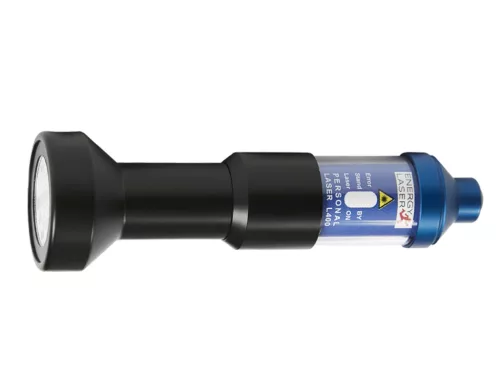
Personal-Laser L400
An 808 nm soft laser for point treatment: the tendon attachment point and the course of the tendon can be treated with it in courses, as an adjunct to the stretching and strengthening programme. A separate article covers laser treatment of tendinitis and dosage: Soft laser for tendinitis →
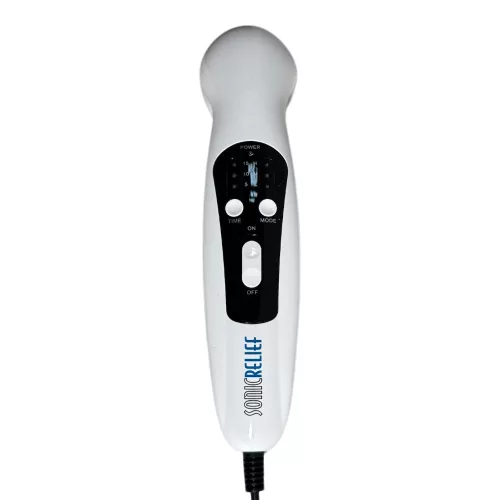
SonicRelief
Home therapeutic ultrasound: deep-tissue micromassage is a long-established adjunctive treatment for tendons and attachment points — suitable for small, precisely targeted areas and treatments of a few minutes per day.

Premium 400
Its TENS programmes are intended for pain relief (so that the exercise programme can be completed), while its EMS programmes strengthen the thigh and gluteal muscles — the sports programmes (Runner, Soccer, Cycling Pro) were specifically designed for athletic use.
 When a home programme is not appropriate — the red flags
- Sudden, snapping pain + inability to straighten the knee – suspected partial or complete rupture of the patellar tendon (during a jump landing or sprint start): immediate orthopaedic trauma care is needed; complete rupture is a surgical emergency.
- Pain below the kneecap in an adolescent – in teenagers, this is typically Osgood–Schlatter disease or overloading of the growth zone at the tip of the kneecap: the adult tendon protocol (decline squats, HSR) is not appropriate — sports medicine or orthopaedic supervision is needed.
- A swollen, warm knee that is painful even at rest – jumper’s knee causes point-specific, load-dependent pain; inflammation of the entire joint indicates another condition (arthritis, gout or infection) — assessment: Joint pain guide →
- No improvement after 3 months of a consistent programme – imaging follow-up and specialist reassessment are appropriate (partial rupture? another cause?) — not pushing the programme indefinitely.
- Repeated steroid injections into the tendon – steroid injected into the patellar tendon may provide temporary improvement, but weakens the tendon structure and increases the risk of rupture — if this is suggested, ask for the details and read: Steroid: friend or foe? →
 What does the research say? Based on readers’ questions
“Why do the squats have to be done on a decline? Doesn’t it make any difference?”
It does make a difference — and a direct comparison demonstrated this. In a pioneering study at an Australian sports clinic, one group of athletes with chronic jumper’s knee performed eccentric lowering squats on level ground, while the other used a 25-degree decline board for 12 weeks. The result was a dramatic difference: pain in the decline group fell from 74 to 28 points on a 100-point scale, and most returned to their sport — those squatting on level ground improved practically not at all.1 The explanation is that the decline switches off the “help” from the calf and directs the load specifically to the patellar tendon — exactly where we want to trigger remodelling. A decline board can also be improvised at home (a thick book or wedge-shaped board); the key is the angle and slow, controlled lowering.
“Wouldn’t a steroid injection be simpler?”
In the short term, yes; in the long term, it typically backfires. A Danish randomised study compared three treatments for jumper’s knee: steroid injection, decline eccentric squats and heavy-slow resistance training (HSR). At 12 weeks, all three groups had improved — the steroid group improved fastest. Six months later, however, the steroid group had deteriorated again, while the effects of both exercise programmes remained; the HSR group was the most satisfied, and measurable structural improvement in their tendon tissue (more organised collagen remodelling) was also taking place.2 The lesson is twofold: rapid symptom relief and healing are not the same — and in tendon conditions, the more patient route is more lasting.
“What can soft laser add?”
It has a place as an adjunct when correctly set up. A meta-analysis of laser treatment for tendon conditions concluded, based on 25 studies, that soft laser produced consistent pain reduction in tendon complaints when used within the recommended (WALT) dose range — the lower “economy” settings were ineffective.3 This is the general lesson of the technology: it is not the presence of a device, but the wavelength, power and dose per point that matter. In practice, laser accompanies the loading programme during the more painful phases — I described the dosage and treatment points in detail in the tendinitis article: Soft laser for tendinitis →
Frequently asked questions
In most cases, yes — with modifications. In stages 1–2, you can continue sport with fewer jumps; in stage 3, jumping and sprinting elements usually need to be paused, but strength and technique work can continue. Complete rest is rarely a good solution: tendons need loading. The measure of return is not the calendar but the pain test: a single-leg squat, followed by jumps without pain — and the reaction the next day.
Yes, as symptomatic support: the strap changes the tendon’s angle of pull and distributes the load, and many athletes can train with noticeably less pain while wearing one. What it cannot do is heal the tendon — the strap may complement the exercise programme, but cannot replace it. If you are pain-free with the strap, this does not mean the tendon has recovered; it means you have bypassed the symptom — you still need to complete the 12-week programme.
Tendon tissue is slow — depending on the stage, a realistic timeframe ranges from 6 weeks to 6 months, and the study protocols are 12 weeks for a reason. The most common reason for failure is not the wrong method but impatience: returning to full loading after 2–3 weeks of improvement — and starting all over again. Allow for the tendon’s load-bearing capacity to continue building for weeks after the pain has gone; phase your return and continue with 1–2 maintenance strength sessions per week afterwards.
By the location and character of the pain. Jumper’s knee is felt in the tendon BELOW the kneecap, at a point you can show with one finger, and occurs with jumping or braking loads. Patellofemoral pain (behind the kneecap) is more diffuse, felt “around or behind the kneecap”, and worsens when walking downstairs, squatting or sitting for a long time. The two conditions are treated partly differently, so it is worth clarifying the diagnosis — the full knee guide can help you find your way: Causes of knee pain →
Rarely. Surgery (exposing and removing the remodelled tendon segment) is reserved for persistent cases that do not respond to well-managed conservative treatment lasting at least 3–6 months, and for ruptures — the vast majority of patients recover without it. If surgery is needed, you will still face the same gradual rebuilding of load afterwards as with conservative treatment — so you cannot avoid the exercise programme; you will simply start it later.
 Summary – Quick overview
Sources
- Purdam CR, Jonsson P, Alfredson H, Lorentzon R, Cook JL, Khan KM. A pilot study of the eccentric decline squat in the management of painful chronic patellar tendinopathy. Br J Sports Med. 2004;38(4):395-397. DOI: 10.1136/bjsm.2003.000053
- Kongsgaard M, Kovanen V, Aagaard P, et al. Corticosteroid injections, eccentric decline squat training and heavy slow resistance training in patellar tendinopathy. Scand J Med Sci Sports. 2009;19(6):790-802. DOI: 10.1111/j.1600-0838.2009.00949.x
- Tumilty S, Munn J, McDonough S, Hurley DA, Basford JR, Baxter GD. Low level laser treatment of tendinopathy: a systematic review with meta-analysis. Photomed Laser Surg. 2010;28(1):3-16. DOI: 10.1089/pho.2008.2470