
 Knee osteoarthritis (cartilage wear): what you should know after diagnosis
“The cartilage has worn away – you have to live with it.” If you heard this sentence alongside your test results, this article is for you – because the first half is true, but the second is misleading. Knee osteoarthritis is the most common joint disease: above the age of 65 it is almost a widespread condition, but overuse, injury or excess weight can cause it much earlier. And although worn cartilage does not grow back, pain and mobility do NOT depend on the X-ray image – but on a range of factors that can be changed: muscle strength, body weight, inflammation around the joint and circulation.
In this article I will review what happens in your joint, what stages the process has, and what you can do to prevent it and reduce the symptoms – from exercise and body weight through medicines and home device-based therapies to the question of surgery. Throughout, the focus will be on what research shows most clearly: osteoarthritis is a condition that can be actively managed, and you yourself can do the most to improve it.
 Key point
With knee osteoarthritis, the severity of pain and the extent of wear visible on an X-ray are often not related at all: some knees are severely worn but barely painful, while others show mild wear and are very painful. This is the most important piece of good news about the disease, because it means that pain is largely driven by factors you can influence – inflammation, weak thigh muscles and overuse. Research shows that a regular exercise therapy programme alone can produce as much pain reduction as anti-inflammatory medicines – without side effects.1
 What happens in your joint – and why does it develop?
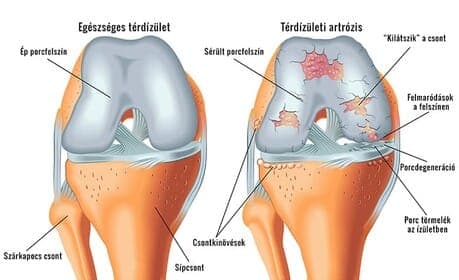
In a healthy knee, the ends of the bones are covered with a smooth, flexible layer of cartilage that reduces friction and cushions impacts – joint fluid provides the “lubrication”. In osteoarthritis, this cartilage layer becomes thinner, its surface frays and its load-bearing capacity decreases. In response, the body remodels the joint: the bone edges become thicker, bony growths (osteophytes) form, and the synovial membrane becomes inflamed from time to time – this is responsible for the painful, swollen “bad periods”.
We distinguish between two forms according to their causes. Primary osteoarthritis develops without a clear trigger, typically above the age of 45, and is more common in women – inherited susceptibility and decades of loading are behind it. Secondary osteoarthritis can be traced to an identifiable cause: a previous knee injury (ligament or meniscus injury), prolonged overuse (kneeling work, high-impact sport), a congenital alignment abnormality (knock knees or bow legs), significant excess weight, diabetes or inflammatory joint disease. In secondary osteoarthritis, treating the cause – for example, managing body weight or correcting the alignment – is key to slowing the process.
| Stage | What can be seen in the joint? | What should the focus be? |
|---|---|---|
| Stage I (mild) | The amount of cartilage is slightly reduced, while the joint space is still preserved; symptoms typically occur with loading | The most favourable stage for taking action: exercise programme, weight management, muscle building – this is when the process can be slowed the most |
| Stage II (moderate) | The joint space narrows, the cartilage surface becomes fragmented and the first bony growths appear | Measures from Stage I plus targeted symptomatic treatment during painful periods (device-based therapies and, if needed, medicines) |
| Stage III (advanced) | Significant narrowing of the joint space, extensive cartilage damage, more frequent inflammatory episodes and early deformity | Regular, gentle exercise (cycling, water-based exercise), consistent symptom management and orthopaedic care |
| Stage IV (severe) | The joint space has almost disappeared, the bone ends move against each other, with deformity and persistent restriction of movement | Orthopaedic decision about joint replacement – at this stage it is not a failure, but an established way to regain quality of life |

The symptoms follow a characteristic pattern: at first the knee hurts only after heavier loading, then “start-up pain” appears – the first steps hurt after standing up, and then the knee “warms up”. Later, pain may occur with lighter loading and eventually at rest; morning stiffness lasting a short time is also typical, as are crackling and grinding during movement, swelling and warmth during bad periods, and, in advanced disease, a reduced range of movement and a visible change in the alignment of the leg.
 Why does it hurt – and what can you change?
A surprising fact: cartilage itself contains no pain-sensing nerve endings – so thinned cartilage does not hurt by itself. Pain comes from the other parts of the joint that are richly supplied with nerves: the inflamed synovial membrane, the tense joint capsule, the overloaded periosteum and the muscles that tense up defensively and become fatigued. This is why there is no close relationship between the X-ray image and symptoms.
And this is why the disease can be managed: every one of these sources of pain can be influenced. Inflammation can be reduced, muscles can be rebuilt and loading can be adjusted intelligently – the extent of wear is only one factor, and not even the most important one, in the pain picture.
If I had to highlight a single message from the past decades of osteoarthritis research, it would be this: a regular exercise programme is the most effective and safest treatment. Based on 54 studies, the Cochrane Collaboration confirmed with high-quality evidence that exercise reduces pain in knee osteoarthritis by an average of 12 points on a 100-point scale, and improves function and quality of life – an effect comparable to anti-inflammatory medicines, without side effects.1
The second major tool is body weight: in the 454-person IDEA study, weight loss of around 10% achieved through diet and exercise measurably reduced loading on the knee, improved inflammatory blood markers (IL-6), and produced more favourable pain and function outcomes than any other group.2 Every kilogram lost “counts” several times over for the knee – when climbing stairs, the joint is loaded with more than three times the body weight.
Exercise and body weight are the foundation – home therapeutic devices help you build that foundation without pain. For soft laser therapy, a summary of 22 placebo-controlled studies confirmed dose-dependent pain reduction in knee osteoarthritis: in the treated groups, symptoms fell by 19 units on a 100-point scale, and the effect peaked weeks after the course had ended.3 For magnetotherapy (PEMF), a meta-analysis covering 614 patients also demonstrated improvements in pain, stiffness AND physical function.5 Electrical muscle stimulation has proved useful for rebuilding weak thigh muscles – in a meta-analysis of rehabilitation after knee surgery, it measurably increased muscle strength within the first month.6
The common logic is that these devices interrupt the vicious circle of pain, inflammation and muscle weakness at different points – which is why they can be combined with each other and with exercise.
 Prevention – maintaining the cartilage
Cartilage has no blood supply of its own: it takes up nutrients from the joint fluid during movement – alternating loading and unloading pumps nutrients in, like water into a sponge.
That is why the cartilage’s most reliable friend is regular, even, low-impact movement: cycling, swimming, walking and using an elliptical trainer. It is also why the two extremes are its enemies: lack of movement (cartilage that is not nourished deteriorates faster) and sudden, high-impact loading of an untrained joint.
Further pillars of prevention are strong thigh muscles (a well-functioning muscular “sleeve” takes some of the load off the joint), a healthy body weight2, stable shoes with good cushioning – and taking injuries seriously: proper treatment and complete rehabilitation of a knee injury in young adulthood (ligament or meniscus) is one of the most important steps in preventing later osteoarthritis.
The treatment ladder – from lifestyle to surgery
The foundation at every stage: a regular, measured exercise programme and weight management – this is not “additional advice”, but the first-line treatment in international guidelines, with medicine-like effects.12 It is worth having the exercises set up by a physiotherapist (or medical fitness trainer), after which you can continue at home.
Medicines: painkillers and anti-inflammatory medicines are useful symptomatic tools during worse periods – they do not reverse the process, and taking them every day for a prolonged period may cause side effects, so the aim is sensible, intermittent use in consultation with your doctor. Evidence for cartilage-protective products (glucosamine, chondroitin) is mixed: trying them carries low risk, but do not expect a miracle.
Injection treatments: hyaluronic acid (“joint lubricant”) and steroid injections are tools available to the orthopaedic doctor – the latter for rapidly reducing intense inflammatory episodes, and the former for making movement easier, with results varying from person to person.
Home device-based therapies – supporting daily symptom management and exercise:
| Method | What does it provide? | When is it reasonable? |
|---|---|---|
| Soft laser | Dose-dependent pain and inflammation reduction – research has found a significant effect compared with placebo, lasting for weeks afterwards3; the key is a regular dose targeted at the joint space4 | For course-based treatment during painful periods, helping to make exercise possible – detailed protocol in the article Soft laser for knee pain |
| Magnetotherapy (PEMF) | According to the meta-analysis, pain, stiffness and physical function all improved compared with control groups5 | For long, comfortable courses, including overnight use – details in the PEMF guide |
| TENS | Fast, medicine-free pain relief – the effect is felt during and after treatment | On bad days, as needed – a symptomatic tool that helps you remain active |
| Muscle stimulation (EMS) | Building the thigh muscles even when pain makes exercise difficult – a meta-analysis confirms increased muscle strength in post-operative rehabilitation6 | Alongside exercise when the thigh muscles are weak; details in the article Rebuilding thigh strength with a muscle stimulator |
| Ultrasound therapy | Deep-tissue micromassage for soft tissues – mainly for early symptoms where soft-tissue problems predominate | As an adjunct – details in the therapeutic ultrasound guide |
Surgery: if conservative treatment has been exhausted and pain is persistently damaging your quality of life, knee replacement is now a routine operation with excellent long-term results – a well-timed replacement is not giving up, but regaining an active life. The decision is made together with the orthopaedic doctor; the devices described here (EMS, laser) can again have a role in rehabilitation after surgery.
 My advice
Osteoarthritis treatment is not a one-off decision, but a daily routine – and the most effective programme is surprisingly simple: 20–30 minutes of gentle movement every day (cycling, walking, water-based exercise), 2–3 targeted thigh-strengthening sessions a week, course-based device treatment during painful periods (laser or magnetotherapy), and patience with the scales. In a month, the X-ray image will not be prettier – but climbing stairs will be easier, and that is what matters. Your knee is not a car tyre that “runs its course”: it is living tissue that rewards good care.
Devices for managing osteoarthritis symptoms
One tried-and-tested device from our range for each method:
Personal-Laser L400
400 mW, 808 nm soft laser – points in the joint space can be treated for a short time per point; a practical, portable choice for the knee protocol.
Magnum 2500 magnetotherapy device
Two-channel PEMF device with strong field intensity and ready-made joint programmes – a comfortable solution for long courses, including overnight treatment.
Myolito TENS/EMS device
Pain relief and thigh-muscle-strengthening stimulation in one device – TENS treatment on bad days and a muscle-building programme can be managed with one device.
You can find the full range in the osteoarthritis treatment category – our knee article can help you choose a laser.
 When should you NOT try home treatment?
- A hot, red, swollen knee with fever – this may indicate a joint infection or acute inflammation: urgent medical care is needed
- A locking, “giving-way” or unstable knee – a meniscus or ligament problem may be behind it: orthopaedic assessment first
- Sudden, severe pain and swelling after an injury – diagnosis first, treatment afterwards
- Uninvestigated symptoms that are worsening rapidly – osteoarthritis is a slow disease; a knee that deteriorates dramatically over weeks suggests another cause
- The specific exclusion lists for device-based therapies – pacemaker (electrical and magnetic treatments), pregnancy, cancer and thrombosis: details are given in the article on the relevant method
 A diagnosis is not self-diagnosis
Knee pain can have many causes besides osteoarthritis – inflammatory joint disease, gout, meniscus injury and osteoporotic fracture. The programme described here applies to osteoarthritis that has been investigated and diagnosed by a doctor. If you have not yet seen a doctor about your symptoms, that is the first step – a treatment plan can only be based on an accurate diagnosis.
Frequently asked questions
The honest answer is that hyaline cartilage has very limited regenerative capacity – according to current knowledge, significant wear cannot be reversed. But it is worth reframing the question: you do not need to “regrow” the cartilage to feel well. Pain is caused by inflammation, weak muscles and overloading – all of these can be improved, and the condition of the remaining cartilage can be preserved for many years with appropriate load management. The aim is not a twenty-year-old knee, but pain-free everyday life – and that is achievable.
Not only can you – you should. Exercise is the first-line treatment1; the question is only WHAT and HOW MUCH. Knee-friendly activities include cycling, swimming, water exercise, walking, using an elliptical trainer and targeted strengthening. What is worth considering are high-impact sports and sports involving sudden changes of direction (running on hard surfaces, football and basketball) – these are not forbidden for everyone, but with more advanced wear it is worth changing to a knee-friendly alternative. The rule of thumb is that mild muscle soreness the day after exercise is acceptable, while pain and swelling in the joint lasting until the next day indicates overloading.
Glucosamine and chondroitin are the most debated options: some studies have found modest symptomatic improvement, while others have found none – neither has been shown to rebuild cartilage. The balance is low risk, uncertain and at most modest benefit. If you try one, give it 2–3 months and assess honestly – but never take it INSTEAD of the proven foundations (exercise and body weight12), only possibly alongside them.
It is quality of life, not the X-ray image, that decides: if pain continues to damage your everyday life despite consistent conservative treatment (exercise, weight management and symptomatic therapies) – you cannot sleep, you give up your favourite activities and every step is a burden – it is worth discussing surgery with your orthopaedic doctor. The good news is that knee replacement is now one of the most successful routine operations, and most patients gain decades of active, pain-free use. Strong thigh muscles before surgery are also key to faster recovery – “pre-replacement training” is the most worthwhile investment.
The nature of your symptoms is what matters. If pain prevents you from moving, start with a soft laser course (the strongest knee evidence3) and build up your exercise alongside it. If you prefer long, comfortable treatment, or cannot fit laser treatment in every day, magnetotherapy is a good alternative.5 If your thigh muscles are visibly weak, use EMS alongside exercise.6 And for bad days, TENS. The methods can be combined – a typical pairing is a laser or magnetotherapy course plus a weekly EMS programme between exercise days.
 What research says – answers to readers’ questions
“Is exercise really as effective as a medicine? I find that hard to believe.”
Yet this is one of the strongest findings in osteoarthritis research: based on 54 randomised studies involving several thousand patients, the Cochrane Collaboration confirmed with high-quality evidence that a regular exercise programme reduces pain in knee osteoarthritis by an average of 12 points on a 100-point scale and improves function and quality of life – the effect size is comparable to anti-inflammatory medicines, without side effects, and continues for months after the programme ends.1 This is why it is a first-line treatment in every international guideline.
“How much difference does body weight really make?”
In numbers: in the IDEA study, which followed 454 overweight people with knee osteoarthritis for 18 months, weight loss of around 10% achieved through diet and exercise reduced compressive forces on the knee, lowered inflammatory blood markers (IL-6), and the diet-plus-exercise group achieved the greatest reduction in pain and the most favourable function of all groups.2 Body weight is therefore not “secondary lifestyle advice”, but a treatment that affects both the joint’s biomechanics AND its inflammation.
“And what evidence is there behind home devices?”
The two best-documented methods are laser therapy and magnetotherapy. For soft laser therapy, a meta-analysis of 22 placebo-controlled studies demonstrated dose-dependent pain reduction – in the subgroup receiving the recommended dose, almost 19 mm on a 100 mm scale, with the effect peaking in the weeks after the course. 3 For PEMF magnetotherapy, a meta-analysis involving 614 patients confirmed improvements not only in pain but also in stiffness and physical function.5 Across chronic joint pain more broadly, treatment targeted at the joint capsule with a regular dose proved to be the key to the effect.4 The lesson for both methods is the same: known dose, regular course – this is how they produce the results measured in research.
Summary
What is this article about? A complete guide to knee osteoarthritis: causes and stages, symptoms, prevention and every stage of treatment – from the proven most effective exercise and weight-management programme through medicines and home device-based therapies to the decision about surgery.
Who is it for? People who have just received a cartilage-wear diagnosis and are looking for a plan – and those who have lived with it for years but want to get more from their treatment.
Main message: Wear cannot be reversed – but pain and mobility largely do not depend on the wear itself, but on factors you can influence: muscle strength, body weight and inflammation. Exercise has medicine-like effects, weight loss reduces loading and inflammation together, and home devices (laser, magnetotherapy, EMS and TENS) make it possible to carry out this basic programme without pain.
Next step: Once you have an investigated diagnosis, start the three-part foundation programme: gentle daily movement + thigh strengthening 2–3 times a week + weight management, with course-based device treatment during painful periods. You can feel the difference after one month of consistent routine.
Read more
Scientific sources
- Fransen M, McConnell S, Harmer AR, et al. (2015). Exercise for osteoarthritis of the knee. Cochrane Database of Systematic Reviews. DOI: 10.1002/14651858.CD004376.pub3
- Messier SP, Mihalko SL, Legault C, et al. (2013). Effects of intensive diet and exercise on knee joint loads, inflammation, and clinical outcomes among overweight and obese adults with knee osteoarthritis: the IDEA randomized clinical trial. JAMA. DOI: 10.1001/jama.2013.277669
- Stausholm MB, Naterstad IF, Joensen J, et al. (2019). Efficacy of low-level laser therapy on pain and disability in knee osteoarthritis: systematic review and meta-analysis of randomised placebo-controlled trials. BMJ Open. DOI: 10.1136/bmjopen-2019-031142
- Bjordal JM, Couppé C, Chow RT, et al. (2003). A systematic review of low level laser therapy with location-specific doses for pain from chronic joint disorders. Australian Journal of Physiotherapy. DOI: 10.1016/s0004-9514(14)60127-6
- Tong J, Chen Z, Sun G, et al. (2022). The efficacy of pulsed electromagnetic fields on pain, stiffness, and physical function in osteoarthritis: a systematic review and meta-analysis. Pain Research & Management. DOI: 10.1155/2022/9939891
- Peng L, Wang K, Zeng Y, et al. (2021). Effect of neuromuscular electrical stimulation after total knee arthroplasty: a systematic review and meta-analysis of randomized controlled trials. Frontiers in Medicine. DOI: 10.3389/fmed.2021.779019