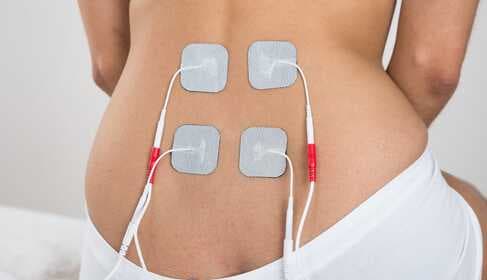

 What is Kotz (Russian current) muscle stimulation?
Kotz stimulation (also known as "Russian current" or kHz-AC – kilohertz alternating current) is named after the Russian sports scientist Yakov Kotz, who developed this method in the 1970s for training elite Soviet athletes. Early reports documented strength increases of up to 30–40% using the Kotz protocol in a short time — a sensational claim at the time that attracted attention from the sports world.
Muscle stimulation is today a widely known and used method in medicine, rehabilitation and sport. By using electrical impulses, muscles can be induced to contract, which increases tone, improves endurance and supports recovery after injuries. Most are familiar with EMS/NMES technology — the most common approach in everyday practice. Kotz stimulation represents a different family of waveforms: it is based on carrier-frequency modulation.
 Key idea
Kotz stimulation uses a 2500 Hz carrier frequency modulated by lower frequencies (5–100 Hz). The method is an effective strength-building technique — BUT the independent, peer-reviewed research since the 1970s has not confirmed the 30–40% superiority claim over modern NMES waveforms. Current evidence considers Kotz one valid NMES option, not demonstrably "better" than others. It may offer advantages in perceived comfort, but it is often more fatiguing and can require higher current amplitudes.2, 4, 5
Parameters of Kotz stimulation – What do they mean exactly?
The Kotz principle is built on two main components:
- 2500 Hz carrier frequency: the sinusoidal base current that penetrates the skin and superficial tissues. It is too fast to directly elicit a muscle contraction — it acts only as a "carrier."
- Modulation frequency (burst rate): the 2500 Hz carrier is organized into groups (bursts) at a lower frequency (typically between 5–100 Hz). This is the actual "muscle-stimulating" frequency that determines which muscle fiber types are activated.
Work–rest ratio (duty cycle) is also important — classically 10 seconds work and 50 seconds rest (Kotz original protocol), but modern devices offer options such as 5/5, 10/10, 10/15, etc.
| Modulation frequency | Activated muscle fiber type | Training effect |
|---|---|---|
| 5-10 Hz | Circulation, recovery | Rhythmic, milder contractions; recovery, microcirculation |
| 30 Hz | Slow (type I) muscle fibers | Endurance, stabilizer muscle strengthening, prevention of low back pain |
| 50 Hz | Mixed (type I and II) | Classic strength development – this is Kotz's original setting |
| 80-100 Hz | Fast (type II) muscle fibers | Explosiveness, sprint power; more fatiguing, more intense contractions |
 How does Kotz stimulation affect the muscle?
Kotz stimulation has three main, interrelated effects. These are produced by the combination of the carrier frequency and modulation:
Reduction of skin resistance and perceived comfort
The 2500 Hz carrier frequency significantly reduces the skin's capacitive resistance. Therefore, in theory the current "travels" more easily to deeper tissues and superficial sensory nerve receptors are less stimulated. Some studies did measure slightly lower pain scores with Kotz compared to conventional biphasic pulses.5
Important nuance: the same studies also showed that Kotz stimulation often requires higher current amplitude to reach the same muscle force and is overall more fatiguing than modern biphasic pulses. So the comfort advantage is relative.5, 8
Muscle fiber activation according to the modulation frequency
The 2500 Hz carrier frequency alone does not elicit muscle contractions — the modulation (burst frequency) is needed for that. This determines which muscle fiber type is primarily activated:
- Around 30 Hz: mainly type I (slow, endurance) fibers work
- Around 50 Hz: mixed activation — this is the classic Kotz strength-setting
- 80-100 Hz: favors type II (fast, power) fibers
The original claim of "deep muscle fiber activation" is popular — but modern research does not support this as clearly as the 1970s Russian literature suggested.2, 4
Strength and endurance adaptations
Regular Kotz stimulation provokes real muscular adaptations — this has been confirmed by several modern clinical studies. A 2024 clinical trial showed that a single 15-minute session measurably increased maximal quadriceps contraction torque.6 In a 6-week trial (76 participants, 3 sessions per week) Kotz stimulation alone and combined with voluntary contractions produced better quadriceps strength outcomes than voluntary exercise without stimulation.7
Thus, Kotz is a valid and effective tool for strengthening, endurance development and athletic preparation.
 Is Kotz really more effective than conventional NMES?
This is the most common question — and it deserves an answer. Kotz stimulation historically carried the reputation of being "proven better," but modern, peer-reviewed research has substantially revised that view.
"What did Kotz's original studies claim in the 1970s?"
The original Russian studies published by Kotz documented 30–40% strength increases in elite athletes over a short period. However, a 2002 historical review noted that Kotz "did not provide methodological details or references" for these claims, and English-language replication studies were "inconclusive."1 In other words: the 30–40% figure was never independently confirmed in the peer-reviewed literature.
"What does modern literature review say?"
The 2018 scoping review by Vaz & Frasson (15 comparative studies) clearly stated: "The available evidence does not support the claim that kHz-frequency alternating current (including Kotz) is superior to low-frequency pulsed current for strength training and rehabilitation." kHz-AC generally produced similar strength and greater fatigue.4
"What did head-to-head clinical trials find?"
A 2012 RCT by Bellew (knee extensors) reported that interferential and burst-modulated biphasic pulsed currents produced greater force than Russian current using matched parameters.3 A 2018 study found that, at equal discomfort levels, burst-modulated biphasic current generated ~33% greater force than Kotz and required lower current amplitude.8
"So what is the value of Kotz?"
Kotz is a valid, functioning NMES method for strengthening and endurance training. Modern studies show measurable benefits compared to voluntary exercise alone.6, 7 What is not supported is the claim that it is "proven superior" to modern alternatives. Kotz is an option among several effective NMES waveforms — if your device includes it, it is worth trying; but there is no compelling reason to prioritize a Kotz-capable device over modern biphasic NMES devices.
 Scientific summary in one sentence
Kotz stimulation is historically important and clinically usable, but modern PubMed evidence indicates it is NOT superior to conventional biphasic pulsed currents — it may offer comfort advantages for some, but in terms of force production and energy efficiency it is roughly equivalent.1, 2, 3, 4, 5, 8
Where is Kotz stimulation worth using?
Based on clinical trials and sports practice, Kotz works measurably in the following areas:
The most common and best-documented application. After knee surgery (ACL, meniscus, TKA), Kotz can measurably increase quadriceps torque even after the first treatment.6 A six-week program (three times weekly) produces significant strength gains compared to voluntary exercise alone.7 Detailed protocol: Use of muscle stimulation after surgery.
With 30 Hz modulation, Kotz activates endurance muscle fibers — ideal for strengthening postural muscles. Modern biphasic NMES can achieve the same effect, but for those who prefer Kotz, it is a working alternative. Details about related programs: Back muscle strengthening with a 4-channel stimulator and Muscle stimulation + physiotherapy in disc herniation rehabilitation.
At 80–100 Hz modulation, Kotz activates fast muscle fibers — useful for sprint power, jump power and explosiveness. In sports preparation it should be used as a complement to voluntary training, not a replacement. Details: Muscle stimulation for athletes.
At 5–10 Hz modulation frequency, mild rhythmic contractions alternate with stimulation, increasing blood flow in the treated area. Useful after muscle soreness, at the end of training or for evening recovery.
Increasing muscle firmness — abdominal, gluteal, thigh tone. Kotz is a working option here as well, but classic NMES also works — there is no clear evidence-based advantage for Kotz in aesthetic applications.
 Devices that include Kotz stimulation
Kotz (carrier-frequency) operation requires a device with a specific mode — not every EMS device includes it. The high-end Globus Genesy models, however, include the Kotz protocol alongside classic EMS/NMES, TENS, MENS and iontophoresis:
Globus Genesy 1500
A multifunctional electrotherapy device with more than 150 programs – EMS, NMES, TENS, MCR, iontophoresis and Kotz stimulation. 4-channel, compact design. Suitable for both home and professional use. Modulation frequencies available: 5, 10, 30, 50, 80, 100 Hz.
Globus Genesy 3000
One of the manufacturer's most advanced models – all available electrotherapy programs and advanced configuration options. 4-channel, clinical-level. Used in professional physiotherapy clinics. Excellent fine-tuning of individual parameters, making the Kotz protocol customizable.
 My advice for choosing
If you are specifically looking for Kotz stimulation (e.g., in the spirit of the Russian traditional sports training), then the Genesy 1500 or 3000 is appropriate. However, if you want a device for general muscle strengthening — not only Kotz — then the Premium 400, Genesy 300 Pro or any member of the Globus sport device family is suitable: modern biphasic NMES provides equal or even better results than Kotz according to current studies. Consider what you will use most before choosing.
 Before you start Kotz treatment
The following situations are contraindications for Kotz stimulation or require specialist consultation:
- Implanted pacemaker, ICD or other active implant – the current may interfere with the device's function.
- Pregnancy – abdominal and lumbar treatment is forbidden at any stage of pregnancy.
- Epilepsy or other seizure disorders – stimulation can act as a trigger.
- Active malignant tumor in the treatment area – avoid the affected region.
- Skin disease, injury or sensory loss in the treatment area – the skin should be intact and sensate.
- Acute fever or infectious illness – wait for recovery.
- Deep vein thrombosis or active vascular occlusion – current may worsen the condition.
- Freshly operated area – wait for wound healing and start only with medical approval.
- Severe cardiovascular disease – in cases of arrhythmia or heart failure seek cardiology approval.
- Acute muscle rupture or immediate post-exercise DOMS – prioritise recovery first, then Kotz strengthening.
Further reading
For the full contraindication list and technology-specific information, read our article on electrical treatment contraindications.
Frequently asked questions
Classic EMS/NMES stimulates muscle with low-frequency (20–120 Hz) biphasic pulses. Kotz uses a 2500 Hz carrier frequency modulated by lower frequencies (5–100 Hz). The carrier frequency can slightly reduce perceived discomfort, but modern studies indicate that classic NMES usually yields equal or better strength results.3, 4, 8
Modern peer-reviewed research does NOT show proven superiority. A 2018 literature review (15 studies) concluded that kHz-AC (Kotz) is NOT superior to low-frequency pulsed current for strength development.4 The 1970s Russian "30–40% superiority" claim was never confirmed by independent studies.1 Kotz is a valid option, not the "best" choice.
Some studies did measure lower pain scores with Kotz,5 but this is nuanced: the same studies found Kotz to be more fatiguing and to require higher current amplitude for equivalent muscle force. Therefore the comfort advantage is relative and does not apply uniformly to everyone.5, 8
Clinical trials show that Kotz can increase quadriceps strength even during a single 15-minute session.6 A 6-week program (three times weekly) yields significantly better results than voluntary exercise without stimulation.7 Thus, post-knee surgery rehab, age- and sport-related strengthening, and low back pain prevention are the most common applications.
It depends. If you specifically train in the Russian tradition or seek the Kotz-type sensation: yes, consider Genesy 1500/3000. If you need a device for general rehab and muscle strengthening: the Premium 400, Genesy 300 Pro or the sport device family with modern biphasic NMES will deliver similar results at a lower price.
According to the classic Kotz protocol, effective work phases are 10–15 minutes, with 5–10 minutes of warm-up/cool-down — so a full session is 20–30 minutes. Three sessions per week are usually sufficient to see visible results within 4–6 weeks.7 Intensity should be near voluntary tolerance but without pain.
 Summary – Quick overview
Sources
- Ward AR, Shkuratova N. (2002). Russian electrical stimulation: the early experiments. Physical Therapy 82(10):1019-1030. PubMed: 12350217
- Laufer Y, Elboim M. (2008). Effect of burst frequency and duration of kilohertz-frequency alternating currents and of low-frequency pulsed currents on strength of contraction, muscle fatigue, and perceived discomfort. Physical Therapy 88(10):1167-1176. PubMed: 18703676
- Bellew JW, Beiswanger Z, Freeman E, Gaerte C, Trafton J. (2012). Interferential and burst-modulated biphasic pulsed currents yield greater muscular force than Russian current. Physiotherapy Theory and Practice 28(5):384-390. PubMed: 22136099
- Vaz MA, Frasson VB. (2018). Low-Frequency Pulsed Current Versus Kilohertz-Frequency Alternating Current: A Scoping Literature Review. Archives of Physical Medicine and Rehabilitation 99(4):792-805. PubMed: 29247626
- Bellew JW, Cayot T, Brown K, et al. (2021). Changes in microvascular oxygenation and total hemoglobin concentration of the vastus lateralis during NMES. Physiotherapy Theory and Practice 37(8):926-934. PubMed: 31402741
- Hasan A, Moustafa I, Shousha T. (2024). Effect of Russian current expert modes on quadriceps muscle torque in healthy adults: A single-blinded randomized controlled trial. PLoS One 19(1):e0297136. PubMed: 38271360
- Şimşek Ş, Oymak Soysal AN, Kaş Özdemir A, Baş Aslan Ü, Bergin Korkmaz M. (2023). Effect of Superimposed Russian Current on Quadriceps Strength and Lower-Extremity Endurance in Healthy Males and Females. Journal of Sport Rehabilitation 32(1):46-52. PubMed: 35894893
- Bellew JW, Allen M, Biefnes A, Grantham S, et al. (2018). Efficiency of neuromuscular electrical stimulation: A comparison of elicited force and subject tolerance using three electrical waveforms. Physiotherapy Theory and Practice 34(7):551-558. PubMed: 29308952