
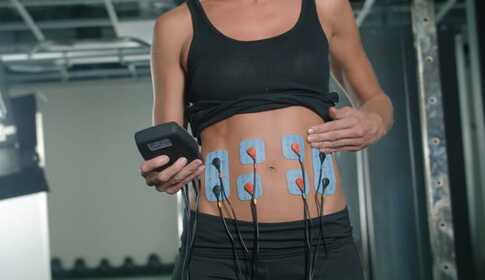

 Does a muscle stimulator really promote weight loss?
In this article I present, from a professional perspective, what can and cannot be achieved with a muscle stimulator in terms of improving body composition. The method is covered in more detail in the EMS overview article and the body-shaping with stimulation pillar.
 Key takeaway
According to the 2021 Kemmler systematic review and meta-analysis (PMID 33716787, 16 RCTs, n=897), WB-EMS produces a significant increase in muscle mass and strength, but does NOT significantly reduce body fat on its own. The 2025 Xu meta-analysis (PMID 40362811) demonstrated in sarcopenic obesity that NMES combined with exercise and nutrition together reduces body fat percentage and waist circumference. Thus, the muscle stimulator is a complementary tool in a comprehensive weight-loss program, NOT a standalone method.
Realistic message: weight loss is a matter of calorie balance. EMS can help preserve muscle mass (especially during calorie-restricted diets) and indirectly contribute to a higher resting metabolic rate—but it does not replace exercise, dietary adjustments, or specialist consultation.
 What does the 2020+ clinical evidence say?
Meta-analyses from the last five years paint a consistent picture: EMS is effective for increasing muscle mass and strength, but it only meaningfully affects body fat reduction when used as part of a combined program.
| Study | Main finding | What it indicates |
|---|---|---|
| Kemmler 2021 (PMID 33716787) Meta-analysis, 16 RCTs, n=897 |
Significant increases in muscle mass and strength; body fat reduction NOT significant | EMS alone does not cause weight loss |
| Yang 2022 (PMID 35798137) Meta-analysis, 11 RCTs, n=779 |
WB-EMS + protein supplementation: reductions in body fat %, fat mass and trunk fat; increased grip strength | Combined approach effective in sarcopenic obesity |
| Xu 2025 (PMID 40362811) Meta-analysis, 29 RCTs, n=1622 |
NMES reduced body fat % (MD −2.01%) and waist circumference (−1.72 cm); skeletal muscle index increased | Exercise + nutrition + EMS work together |
| Qin 2022 (PMID 36159315) RCT, n=20, 6 weeks |
WB-EMS produced outcomes comparable to conventional resistance training | EMS = a supplement to exercise |
| Beier 2024 (PMID 38339689) Evidence map, 86 trials |
In 58% of WB-EMS trials the target population was overweight/obese; interventions were safely tolerated | EMS is a safe adjunct |
The clear conclusion: EMS alone does not cause weight loss, but as part of a comprehensive weight-loss program (calorie-restricted diet + exercise + possible specialist or dietitian supervision) it can be a valuable adjunct, particularly for preserving muscle mass.
 Why isn’t a muscle stimulator a standalone fat-loss "magic wand"?
Weight loss is based on energy balance: if caloric intake is consistently lower than energy expenditure, the body draws additional energy from fat stores. No device—neither pills, nor a muscle stimulator, nor trendy diets—overrides this simple principle.
EMS impulses trigger muscle contractions, activating muscle metabolism with ATP and glycogen use—but the total energy expenditure is much lower than during a truly physically active workout because the following are missing:
- movement of the whole body (own bodyweight),
- cardiorespiratory load,
- the hormonal response (cortisol, growth hormone, catecholamines during exercise),
- the prolonged post-exercise metabolic elevation (EPOC – Excess Post-exercise Oxygen Consumption).
In other words: EMS "works" the muscle but cannot replace the complex systemic effects of cardio exercise. Anyone who tries to lose weight using only EMS will be disappointed on the scale.
 So how can EMS still help in weight loss?
EMS has three indirect roles in the complex process of dieting:
During dieting—especially with a more aggressive calorie deficit—the body may break down not only fat but also muscle. Regular EMS stimulation signals muscle tissue that it is being "used," so lean body mass is better preserved. The 2025 Xu meta-analysis (PMID 40362811) demonstrated this effect specifically in individuals with sarcopenic obesity.
Muscle is metabolically more "active" tissue than fat—more muscle mass means higher resting energy expenditure. Over the long term (3–6 months of a regular EMS + exercise program) this can indirectly support weight-loss success. However, muscle mass gains achieved with EMS alone are modest—realistically a few percent increase over three months with regular use.
Starting conventional training can be difficult with excess weight, joint pain or poor baseline fitness. EMS can help reintroduce muscle activity gradually, preparing the user for a later regular exercise program. The 2022 Beier evidence map (PMID 38339689) shows that a significant portion of WB-EMS trials were conducted in low-fitness, overweight populations of this kind.
 What are "lipolysis" programs for?
Some EMS devices offer dedicated "lipolysis" or "local metabolic stimulation" programs for the abdomen, buttocks and thighs. These low-frequency stimulations can support blood and lymph flow in the treated area. However, it is important to be aware of the following:
- Spot reduction does not exist physiologically. The body mobilizes fat stores systemically, not locally. Abdominal fat cannot be "burned away" by abdominal muscle stimulation alone—this is a long-established principle in exercise physiology.
- Lipolysis programs can support microcirculation, which, when combined with a healthy lifestyle (exercise, nutrition), can indirectly contribute to improved body composition—but they do not cause weight loss on their own.
- Claims suggesting sweat-free, standalone reduction of body fat are not supported by clinical evidence.
Within a comprehensive weight-loss program, lipolysis programs can be useful as beauty-oriented adjuncts, but the main work is still done by lifestyle changes (calorie intake, exercise, sleep, stress management).
 Comprehensive weight-loss program: where does EMS fit in?
Successful, lasting improvements in body composition require a combination of four pillars—EMS is one complementary tool among them:
| Pillar | Weight in weight loss | What does it address? |
|---|---|---|
| 1. Nutrition (calorie balance, adequate protein) | Dominant (approx. 70–80%) | Sustained calorie deficit is the condition for fat loss |
| 2. Exercise (cardio + resistance training) | Second most important (approx. 15–25%) | Energy expenditure, cardiovascular health, muscle mass |
| 3. Lifestyle (sleep, stress management) | Significant but often undervalued | Hormonal balance (cortisol, leptin, ghrelin) |
| 4. EMS / adjunct technologies | Supplementary (approx. 5–10%) | Muscle mass preservation, local microcirculation, movement assistance |
The proportions are approximate estimates and vary by individual and starting point. The key point: you can lose weight without EMS, but you cannot achieve meaningful body-composition change with EMS alone without diet and exercise. If you want substantial change, address the main pillars—the EMS is a "bonus," not a core element.
 If you still choose EMS—which device?
If you plan to include EMS as a supplement to your weight-loss program, important considerations are: options to target multiple muscle groups, beauty-focused built-in programs, and ease of use. From the Medimarket portfolio:
| Device | Positioning | Ideal for |
|---|---|---|
| Myolito | Entry-level EMS (HOME) | Home muscle-tone development for beginners |
| Globus Activa 700 | Top category, BEAUTY-focused | Specific body-shaping and local metabolic-stimulation programs |
| Globus Elite 150 | 4-channel mid-range | Multiple muscle groups simultaneously, combined with exercise |
General EMS portfolio: muscle stimulator category. Sport-oriented models are in the sport stimulator category.
 When is EMS NOT suitable for weight-loss purposes?
EMS is generally well tolerated, but in a YMYL-sensitive area (weight loss, metabolism) special attention to safety is required. Full list: electrotherapy contraindications.
- Implanted electronic device (pacemaker, ICD)
- Pregnancy (especially in the lower abdominal area)
- Active or unknown tumor in the treatment area
- Acute deep vein thrombosis, vascular inflammation
- Metabolic diseases (diabetes, thyroid disease) – require treating physician consultation
- Eating disorders (anorexia, bulimia, orthorexia) – in these cases dieting is risky on its own; EMS is NOT recommended without specialist supervision
- Epilepsy
- Acute fever, infectious condition
- Skin inflammation, wounds on the treatment area
- BMI < 18.5 (underweight) – weight loss is contraindicated here
- Under 18 years of age – parental and medical permission required
 Summary – what to take away?
- EMS alone DOES NOT significantly reduce body fat (Kemmler 2021, n=897 meta-analysis).
- EMS can support preserving muscle mass during a calorie-restricted diet, which indirectly helps weight-loss effectiveness.
- A comprehensive program is required: nutrition (70–80%) + exercise (15–25%) + lifestyle + EMS (5–10%).
- From a physiological standpoint spot reduction does not exist—abdominal fat cannot be "burned" by abdominal muscle stimulation alone.
- Lipolysis programs can support local microcirculation but do not cause weight loss on their own.
- Realistic expectation: perceptible body-composition improvements may occur after 3 months of regular use combined with lifestyle changes.
- YMYL topic: when planning significant weight loss always consult a specialist physician or registered dietitian.
Beauty-focused mid-range choice: Globus Activa 700. Entry-level home: Myolito. Muscle stimulator use must be combined with healthy nutrition, regular exercise and adequate sleep. Details in the body-shaping with stimulation article.
Frequently asked questions
EMS alone typically does not produce measurable significant weight loss (Kemmler 2021, PMID 33716787). Clinical trials show that visible body-composition improvements (reduced body fat %, decreased waist circumference) are only achievable with the combination of EMS + exercise + nutrition. No specific kilogram figure can be promised—results depend on individual baseline fitness, diet, activity and condition.
Unfortunately no. Abdominal stimulation can increase abdominal muscle tone, but visible abs depend on the thinness of the abdominal fat layer. That requires whole-body calorie deficit, adequate protein intake and cardio/resistance training to reduce fat meaningfully. Spot reduction does not exist physiologically—the body mobilizes fat systemically, not locally.
"Lipolysis" programs can support blood and lymph flow in the treated area via low-frequency stimulation, which may indirectly aid metabolism. Clinically, however, they are not supported as standalone methods for local fat mobilization. They can play a supplementary role within a comprehensive program (diet + exercise). Do not expect "local fat dissolution" as an independent effect.
Yes—indeed it can be particularly useful. During a calorie-restricted diet the body tends to break down muscle tissue. Regular EMS stimulation signals the muscle that it is being "used," so lean body mass is better preserved. The 2025 Xu meta-analysis (PMID 40362811) confirmed this clearly in sarcopenic obesity. Adequate protein intake (1.2–1.6 g per kg body weight) is essential for this effect.
No. Cardio training (running, cycling, swimming) has complex effects on the cardiovascular system, respiration, hormonal response and resting metabolism—effects EMS cannot replicate. EMS impulses trigger muscle contractions, but lack whole-body load, the cardiorespiratory response, and the post-exercise EPOC effect. Full fitness requires EMS + cardio + dietary adjustments together.
When used appropriately it is generally not dangerous. Contraindications include implanted electronic devices (pacemaker), pregnancy, tumor, acute vascular disease, eating disorders and very low BMI (underweight). In cases of drastic, rapid weight loss (more than 5 kg in one month) specialist or dietitian supervision is recommended—EMS introduction should be coordinated in such situations. EMS for weight-loss is not recommended for those under 18 or users prone to eating disorders without specialist oversight.
Related articles
Scientific sources (2020+)
- Kemmler W, Shojaa M, Steele J, Berger J, Fröhlich M, Schoene D, von Stengel S, Kleinöder H, Kohl M. Efficacy of Whole-Body Electromyostimulation (WB-EMS) on Body Composition and Muscle Strength in Non-athletic Adults. A Systematic Review and Meta-Analysis. Front Physiol. 2021 Feb 26;12:640657. DOI: 10.3389/fphys.2021.640657 · PMID: 33716787
- Yang JM, Luo Y, Zhang JH, et al. Effects of WB-EMS and protein supplementation on body composition, physical function, metabolism and inflammatory biomarkers in middle-aged and elderly patients with sarcopenic obesity: A meta-analysis of randomized controlled trials. Exp Gerontol. 2022;166:111886. DOI: 10.1016/j.exger.2022.111886 · PMID: 35798137
- Xu S, Tu S, Hao X, et al. Exercise, Nutrition, and Neuromuscular Electrical Stimulation for Sarcopenic Obesity: A Systematic Review and Meta-Analysis of Management in Middle-Aged and Older Adults. Nutrients. 2025 Apr 29;17(9):1504. DOI: 10.3390/nu17091504 · PMID: 40362811
- Qin Y, Chen H, Liu X, Wu J, Zhang Y. Effects of whole-body electromyostimulation training on upper limb muscles strength and body composition in moderately trained males: A randomized controlled study. Front Public Health. 2022;10:982062. DOI: 10.3389/fpubh.2022.982062 · PMID: 36159315
- Beier M, Schoene D, Kohl M, von Stengel S, Uder M, Kemmler W. Non-Athletic Cohorts Enrolled in Longitudinal Whole-Body Electromyostimulation Trials—An Evidence Map. Sensors (Basel). 2024 Feb 2;24(3):972. DOI: 10.3390/s24030972 · PMID: 38339689

This article provides general information and does not replace specialist medical or dietitian consultation. When planning significant weight loss always consult a specialist physician or registered dietitian. A muscle stimulator is an adjunct to a comprehensive weight-loss program—NOT a standalone fat-loss method. For eating disorders, anorexia, bulimia, orthorexia, chronic disease (diabetes, thyroid, cardiovascular) or age under 18, home EMS use must be discussed with your treating physician in advance. EMS devices are CE/MDR-certified medical devices—use according to the user manual is recommended.

