What should be on my plate?
If you want to see clearly among the millions of diets, nutritional systems and recommendations today, you really have to "roll up your sleeves." Mediterranean, DASH, Keto, blood type, carbohydrate-free, juice fasting, South Beach, paleo, flexitarian, vegetarian and vegan — and who knows how many other diets exist. On top of that, almost every fitness model, celebrity, etc. has some personal version of a nutritional "idea." Which one is right? Who knows. And of course I believe in my own! 🙂
But why is this important?
If you pay attention to health statistics, you can see that since World War II the prevalence of chronic diseases has multiplied in our country (and everywhere in the developed world). An enormous number of people suffer from obesity, high blood pressure, diabetes, atherosclerosis, stroke, autoimmune, joint and musculoskeletal, vascular, lymphatic and cancerous diseases.
Today it has become clear that almost 80% of diseases have lifestyle-related causes — that is, they stem primarily from diet and lack of physical activity. It has also become clear that simply changing your diet and increasing exercise could prevent or improve many of these conditions. In other words, the development, severity, treatment success and mortality rate of most diseases largely depend on your lifestyle.
There is nothing new here. Hippocrates said 2,500 years ago: "If you do not change your lifestyle, no help can be given to you." Another saying attributed to him shows how important nutrition is: "You are what you eat."
And what should you do with this information?
Okay... so what? — you might ask.
Actually, nothing dramatic... but you can decide how much you invest in your own future. Because illness will severely limit you. I've written about this in detail, it's worth reading.
In this article, however, I will write about the general principles you should follow when composing your meals — what should be on your plate.
The recommendation that influenced me the most was the nutrition guideline from the Canadian Ministry of Health. In my opinion, this is currently the official, government-level recommendation in the world that takes medical evidence into account most comprehensively. Moreover, it is free from influence by the meat, dairy and confectionery industries.
And you'll be surprised! I looked into analyses by Hungarian ethnographers and found that the Canadian recommendation almost matches the traditional Hungarian diet (followed up until World War II). Back then, the Hungarian diet consisted mostly of cereals, vegetables and fruits; the average person rarely had access to meat.
This diet has changed enormously since then, so it is completely different from what Hungarians typically eat today.
General information
Forget what you knew about diets so far and remember this new, simplified grouping.
Components of a whole-food meal
- fruits and vegetables (about 50%),
- whole grains (about 25%),
- proteins (about 25%).
- Of course, drinking water is also very important.
What should be on my plate?
The recommendation is simple. Half of your plate should be covered with vegetables and fruits, one quarter with whole grains, and the remainder with protein sources. In addition, your body needs fluids — replace them with water, not sugary drinks.
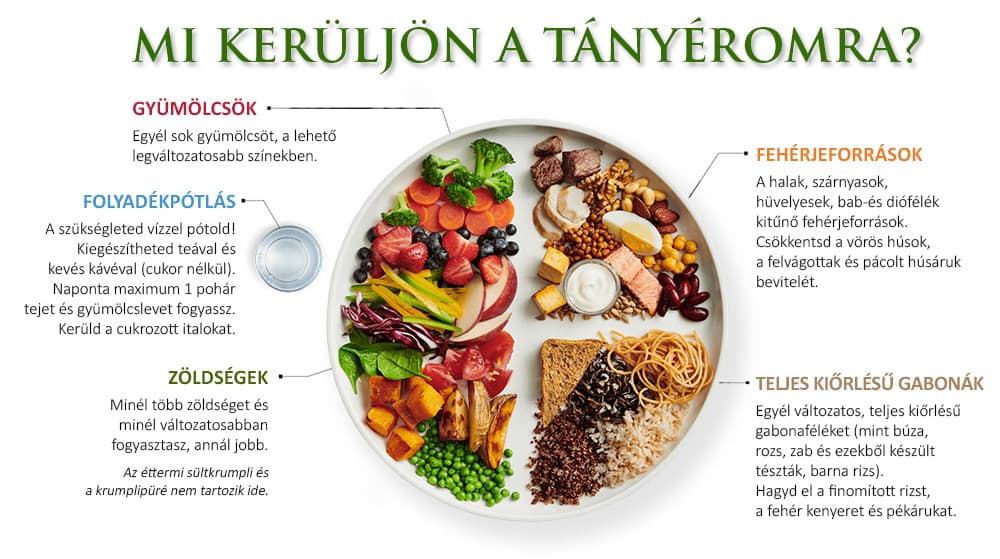
The most important message: half of your daily food should be vegetables and fruits.
If you achieve this, you're halfway there, because currently it's good if their amount reaches 10%. If you keep these proportions, you almost can't eat enough to create an energy surplus — that is, you won't have to worry about portion sizes or amounts.
It's not so much about what to eat as about which foods to AVOID! Don't eat processed and prepared foods. These are full of salt, refined sugar and saturated fats. The consumption of cold cuts, cured meats, canned foods, ready meals, etc., has increased significantly in recent years, and in parallel obesity, cardiovascular diseases, high blood pressure, diabetes and certain types of cancer have also risen.
Modern guidelines no longer treat meats as a separate category; instead they refer to protein sources. This includes dairy and meats as well as plant-based proteins (e.g. tofu, chickpeas or lentils). Among protein-containing foods, always choose plant-based options first.
Scientific research indicates that regular consumption of plant-based foods — vegetables, fruits, whole grains and plant proteins — can have positive effects on health, including lower risks of cardiovascular disease, colorectal cancer and type 2 diabetes. In contrast, animal-derived products tend to increase these risks.
Hold on! Current evidence-based dietary guidelines encourage plant-based eating while simultaneously downplaying meat and dairy products.
The message is clear: eat more plants, and less or no meat and dairy.
Fluid intake is important, but meet your needs with water — not sugary or alcoholic beverages. Today, sugary drinks are a major source of sugar intake, which already leads to obesity, diabetes and high blood pressure in children and adolescents. Even 100% fruit juices should be avoided; they also fall into the "sugary drinks" category that contribute to tooth decay, obesity and type 2 diabetes.
Moderate your alcohol consumption. Alcohol contains many calories while providing little or no nutritional value. It is also closely linked to an increased risk of certain cancers, including liver and laryngeal cancers.
Advice on healthy eating is not "set in stone" — think of it more as guidance.
Healthy eating
Nutrition should be about not only what you eat but also how you eat! Cook more at home, enjoy your meals and eat with others. These help you to:
- Pay more attention to what goes on your plate
- Avoid being swayed by food advertising
- Cook more often
- Enjoy your food, eat slowly
- Host others, dine with friends.
You spend time eating every day. How and what you eat significantly affects your health and performance, and thus impacts your ability to earn income and your whole life.
That's why you need to pay attention to it. For your own sake. Start with small changes!