
Muscle stimulation – what is it good for an athlete?
Muscle stimulation is a method to be used as a complement to training, not instead of it. Its “benefit” differs for professional athletes who live from sport and for amateurs who train alongside studying or working. The possible uses are diverse, so everyone can decide how to “deploy” it! One thing is certain: if you use it regularly, you will notice its beneficial effects just as you notice the effects of regular training. Let’s go through what an athlete can use a muscle stimulator for.
You can find the background to this article in my piece EMS, that is electrical muscle stimulation. It's worth reading to get the full picture and to understand where the points made here come from.
Applications of muscle stimulation for athletes
Watch my video about this — click the play button. If you prefer to read, scroll down.
accelerating muscle recovery
If you haven't used a stimulator yet, try the muscle recovery treatments first!
Especially after a demanding training session, place the electrodes on the muscle that was most stressed. Numerous studies confirm that muscle stimulation reduces metabolite levels and thus muscle fatigue and stiffness more effectively than other cooldown methods.
Muscle stimulation started within 90 minutes after training can increase blood circulation by up to 300%, speeding up the removal and flushing out of waste products from the muscle. Most metabolites are broken down in the liver, so the sooner they get there, the sooner muscle stiffness and fatigue dissipate. Recovery time shortens and muscle cramps are prevented.
The increased circulation not only helps wash out waste but also aids the replenishment of muscle stores.
A muscle properly treated after training will be noticeably fresher and more rested for the next session, allowing for more effective loading.
healing muscle injuries
Muscle stimulation originally started as a medical, hospital treatment used for restoring diseased muscles. In the case of a sports injury, you naturally want to return to training as soon as possible.
Muscle stimulation does not move the joint, so you can start muscle-preserving treatments the day after any tendon, ligament, joint capsule or cartilage injury!
After a muscle injury you should wait a few days for bleeding to subside. But 3–4 days after the injury you can already use it. It increases blood and lymph circulation, which delivers the nutrients needed for healing to the injury site. This accelerates the restoration of muscle fibers.
regaining muscle strength
After a fracture, cartilage surgery, ligament surgery, etc., you may be condemned to lengthy bed rest. The longer the forced rest, the more you lose the hard-earned muscle strength and mass. In two to three weeks off you can lose roughly six months' worth of training progress.
Because stimulation does not move the joints, you can start muscle-preserving and muscle-strength-recovery sessions a few days after surgery. By the time you are allowed to move the joint again, your muscles will already be ready for it. In other words, you can bring your return forward by weeks!
During rehabilitation, combining physiotherapy movements with stimulation can further speed up recovery. Stimulation can be performed simultaneously with voluntary movement, which helps “retrain” neuromuscular functions.
developing a “lagging” muscle
Many people find that no matter how they train a certain muscle conventionally, it refuses to grow. With electrical muscle stimulation you can target even a single muscle, and you can decide which muscular capacity you want to “tweak”. You can isolate and fine-tune endurance, aerobic tolerance, increase muscle strength and explosiveness, or even grow muscle mass. Note! Effects only appear in the muscles that are treated!
gaining training time
Most athletes train alongside family, work or studies and lack sufficient training time. Those who have office-based, sedentary jobs can “gain training time” with muscle stimulation. Passive stimulation while sitting is extra training for the muscles! It's just like doing one extra session!
Obviously, you should only treat the muscles most important to your sport. For runners or cyclists the thigh muscles, for swimmers the latissimus that provides propulsion, etc.
You can target the treatment: if you're a sprinter you should increase muscle strength and explosiveness. For endurance sports, muscle endurance and aerobic–anaerobic tolerance are decisive, so set the impulses accordingly.
avoiding regression
Imagine this situation: during a strength session you do squats with weights and the next day your knee hurts slightly. You think, “Ah… it’s from yesterday. No matter, I’ll push through.” You do the planned work. But the pain is still there the next day and now it seems to sting. Still you keep training. This goes on for two to three weeks until you realize it’s an overload injury that needs rest. The inflammation won't go away if you keep loading it. Yes, but if you skip 2–3 weeks, you lose the results of the past 3–4 months of hard work and in this season you can't get back into form.
This is where the muscle stimulator comes in. While you rest the joint (i.e. you do not perform the traditional movement that loads your knee), you can maintain the condition of your leg muscles with stimulation! That means: even if you don't run or cycle for two weeks, your thigh muscles won't wither! As soon as your knee recovers and you return to training, you can basically continue where you left off.
Another similar area is mainly interesting for high-level athletes. For someone preparing for a competition with two training sessions a day, traveling to a distant event is a major problem. On a 30+ hour flight the muscles stiffen and, at this level, even a two-day break shows. In such cases, the muscle stimulator is an invaluable asset. It fits in your pocket, you can use it on the plane, and it fully maintains your most important muscles. Arriving at the destination there will be no trace of muscle fatigue.
How is it useful for the professional?
The life of a professional athlete is filled with training. They don't have to deal with anything else but the most intense possible training and maximizing their development. However, heavy loading causes their muscles to fatigue more and they need more rest.
Muscles refuel nutrient and energy stores, remove metabolites and repair micro-injuries during rest. Supercompensation — the incorporation of training work — happens during rest. Your body optimizes circulatory, respiratory and metabolic processes for the load. Muscle fibers strengthen, blood supply improves, metabolism adapts to tolerate oxygen deficit, and the efficiency of heart and lungs improves. These are slowly adapting processes that develop only with sustained effective loading.
If you neglect recovery, your progress slows, overtraining can cause decline, and your injury risk increases!
If metabolites remain in your muscles due to lack of rest, they make you tired, stiff and less flexible. If you try to keep training despite this, trying to complete the prescribed load at all costs, then eventually your knee, ankle, Achilles, shoulder or any muscle–tendon–joint will start to hurt. Chronic overload leads to inflammation, whose elimination can take months. Of course many continue despite the pain because competitions are more important … then suddenly a crack, and the Achilles tendon, ACL, rotator cuff, etc. is gone.
What happened? Nothing special… you just trained mindlessly… you ignored your body's signals, you didn't let it regenerate, rest and supercompensate. You overtrained!
For the pro, muscle stimulation gives the most by accelerating muscle recovery!
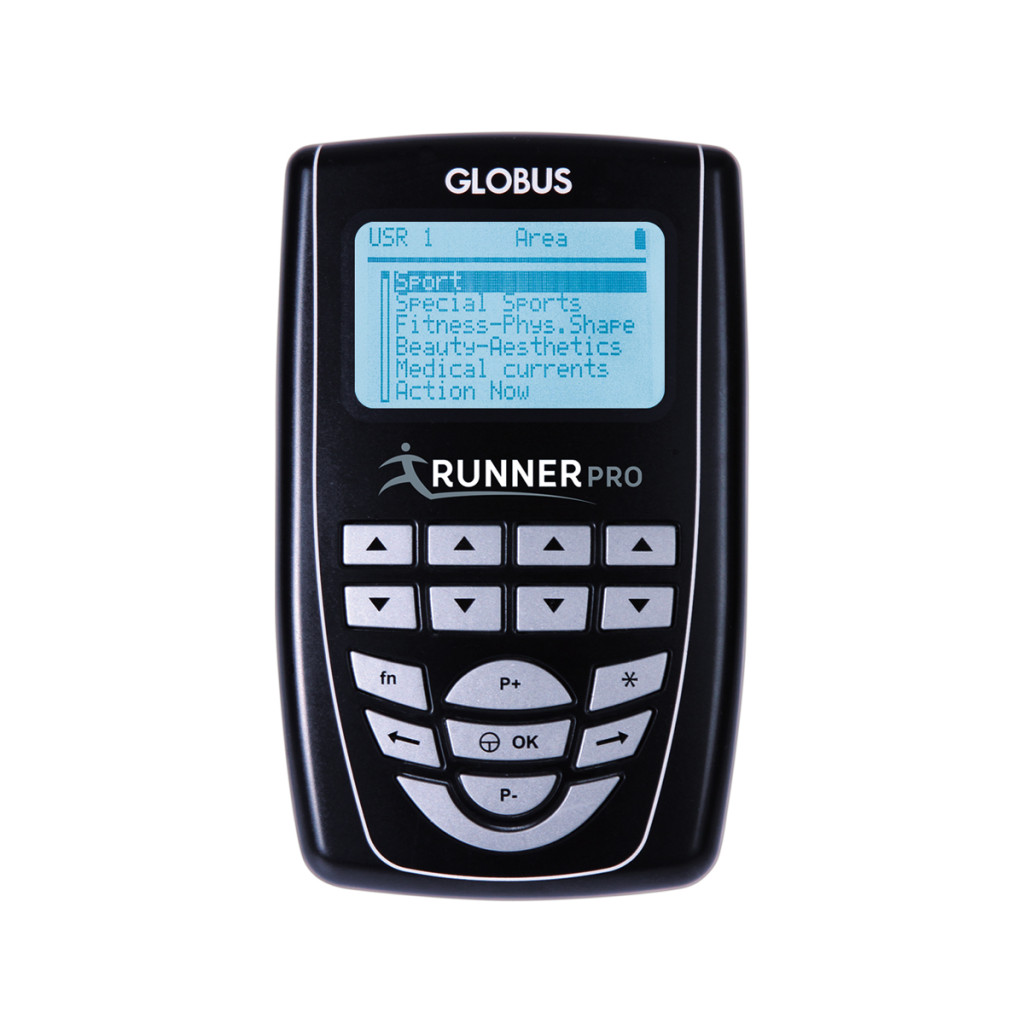
Runner Pro EMS device – muscle stimulation for sport and rehabilitation
Professional EMS device for runners and athletes. 30 pre-programmed treatments for muscle strengthening, recovery and pain relief. Ideal for post-injury rehabilitation and performance enhancement.
There are two approaches to recovery: stimulation before training and after training.
The pre-training stimulation is called Warm-up. Such stimulation prepares you for movement, increases blood circulation, warms up and makes tendons, ligaments and muscles more flexible. The vast majority of sports injuries result from skipping proper warm-up (read my related article). Stimulation can significantly reduce this risk.
A muscle stimulation treatment performed immediately after training, but no later than 90 minutes post-exercise (recovery programs), removes 35–50% of metabolites (lactic acid, CK)! This dramatically speeds up the flushing of waste, shortens the time needed for muscle recovery and reduces fatigue. Fatigue will not be a problem in the next training session, you won't need to reduce intensity. If you can train at higher intensity, your progress will be faster! Your injury risk will also be significantly reduced.
Injury management and maintaining muscle strength
High loads come with minor or major muscle and joint injuries, which is a main area of medical application for muscle stimulation. If injury forces you to stop training, your muscles can lose months' worth of training results in a few days. For example, if an ankle sprain forces you to rest for 10 days, you may lose the strength your leg muscles built over six months. Muscle stimulation does not load (does not move) the joints, so a few hours after a ankle injury (once bleeding has stopped) you can already treat the calf and thigh muscles. This way you can preserve muscle strength and prevent “breakdown”!!!!
A similar situation applies when traveling to a distant competition. You may have two idle days getting to a remote venue and you will feel the effect of the missed sessions at the competition. With muscle stimulation you can train your most important muscles on the plane, bus, anywhere, and maintain your muscle strength and freshness.
It helps where you are stuck
Despite much training, some muscles do not develop as you would like. One side (e.g. due to a past injury) may be weaker than the other and this asymmetry strains your lower back, etc. With a muscle stimulator you can correct these deficiencies. You can focus very effectively on a single muscle or muscle group.
A muscle stimulator holds many further possibilities. If you are a professional athlete, such a device should not be missing from your sports bag today. It will repay you!
How is it useful for the amateur?
In all the ways it is useful for the pro (read the previous chapter) and additionally in a few other respects.
Amateurs are typically "time-poor". They prepare alongside studies, work and family, so generally they don't have as much time to train as they'd like and especially not enough to reach the time-results they aim for.
They often rush into training straight from work and start without a meaningful warm-up. Therefore injuries are common. Any small progress is followed by regression, and they often don't reach what they desire.
A stimulator is recommended for those who have enough time for stimulation! If you do office work, you can be a major beneficiary of this technology. If you are continuously on the move, you won't have time or opportunity to stimulate, so for you it will only play a role in injury management.
A cyclist concentrates stimulation on the thigh muscles, a wrestler on trunk muscles, a swimmer on the latissimus, etc. That is, on the muscle that is essential for your sport. You should concentrate 80% of stimulation time on that muscle.
Of course it does not replace traditional training, which remains necessary for circulatory and respiratory adaptation and improving movement coordination. However, the treated and important muscles will visibly reward the treatment.
Is muscle stimulation useful for the athlete?
Guaranteed!
While technical innovations like a lighter bike or running shoe provide external help — they don't actually improve your capabilities (only contribute somewhat to better results) — muscle stimulation is a different dimension entirely!
With muscle stimulation you can max out the potential within your muscles – it improves your performance both directly and indirectly! Of course, only if you actually use it. Sitting it on a shelf has no effect. But if you apply it regularly as part of your training routine, you can expect significant added benefit.

