
Lymphatic drainage – what to know about compression therapy
The most effective treatment for lymphedema is massage. In this article you can learn about its three known forms: lymphatic drainage performed by a trained lymph therapist, self-lymphatic drainage that imitates it and can be performed by the patient, and the latest device-based compression therapy.
Lymphatic massage, also known as lymphatic drainage, is a special massage technique that supports the function of the lymphatic system. The aim of this massage is to stimulate the flow of lymphatic fluid in the body, thereby promoting the removal of toxins, reducing swelling, and improving immune function.
Effects of lymphatic drainage (compression therapy)
Compression therapy has many positive effects:
- Reduction of swelling. It effectively reduces swelling, for example lymphedema or edema due to venous insufficiency.
- Detoxification. It helps the body detoxify by promoting the removal of metabolic waste products.
- Supports immune function. Better lymphatic circulation helps the fight against pathogens.
- Pain relief, especially in the areas of joints and muscles.
- Improves skin condition. Improved lymph flow supports the maintenance of skin health.
- Relaxation. The soft, repetitive pressure helps body and mind relax, reducing stress and anxiety.
Applications of compression therapy
- Treatment of lymphatic circulation disorders (lymphedema). Lymphedema typically affects the limbs. The accumulation of lymph fluid between cells causes swelling and a stretching pain. It is particularly common after surgical or radiation treatment for cancer.
- Treatment of lipedema. This condition is a disorder of fat metabolism characterized by the formation of pathologically enlarged fat cells.
- Post-mastectomy conditions. After breast removal due to a tumor, the vast majority of cases develop swelling in the arm on the affected side. After abdominal-pelvic surgeries, swelling can occur in the lower limbs.
- Varicose vein disease. Treatment effectively relieves the aching pain, swelling and heavy-leg sensation caused by varicose veins. It can also be used safely for pregnancy-related varicose veins.
- Post-thrombotic residual condition (post-thrombotic syndrome). Deep vein thrombosis always heals with a residual condition that may include leg swelling.
- Peripheral arterial disease (arterial narrowing). Only those advanced devices with a “top-to-bottom” program — i.e., directing pressure from the thigh toward the toes — should be used for arterial narrowing. The treatment effectively improves limb blood circulation and also supports wound healing.
- Limb paralysis. Blood circulation in an immobile, paralyzed limb slows down, increasing the risk of thrombosis and/or pressure sores. Device-based compression therapy can "replace" the movement of limb muscles and thus help maintain lymphatic and blood circulation.
- Prevention. After surgery, immobility slows circulation and increases the risk of thrombosis (blood clot formation inside a vessel); device-based compression therapy helps prevent this. It is also used to reduce postoperative hematoma and limb swelling.
- Cellulite. Regular device-based massage breaks down the nodules in the skin that cause cellulite and helps eliminate it. It also enhances the effect of cavitation fat-reduction treatments.
- Wellness and relaxation. It provides a pleasant massage for a tired body. It refreshes, calms and relieves stress.
Contraindications for lymphatic drainage
Although lymphatic drainage is generally safe, it is not recommended in certain conditions, for example:
- Acute infections. Since pathogens and immune cells travel in the lymphatic system, massage during an infection may help spread the infection and may hinder immune function.
- Severe heart problems. Treatment is not automatically excluded, but in cases such as cardiomyopathy, heart failure, or uncontrolled hypertension despite medication, treatment must be performed more cautiously than usual. Massage pushes not only lymph but also some venous blood, which increases cardiac workload. If during treatment you notice pulsation at your temple, rapid heartbeat, or worsening headache, it means the treatment is too strong — notify the therapist.
- Malignant tumors. After radical removal of uterus and pelvic-abdominal lymph nodes for cancer (e.g., Wertheim operation), device-based compression therapy should be used only with caution and under specialist supervision. The same applies for edema after prostate cancer. If the tumor has been completely removed, lymphatic drainage carries low risk; if the tumor is active, pressure treatment may promote spread. Careful individual assessment is required. In some situations, despite a tumor, the massage may relieve suffering and be performed; in others, the risk outweighs the expected benefit. The decision is individual.
- Acute deep vein thrombosis. Massage cannot be performed within 90–120 days of its occurrence. However, after 4 months, it can be applied in the management of the residual condition.
Consult a physician or a qualified therapist before signing up for lymphatic drainage to be sure this is the appropriate treatment for you.
Lymphatic drainage — treatment performed by a trained therapist
In a lymphotherapy clinic or hospital ward, lymphatic massage performed manually by a trained therapist (lymphatic masseur) is called lymphatic drainage (i.e., lymph evacuation) in medical jargon.
Important! It should not be compared to sports massage; here they do not use deep, forceful kneading of muscles. If you experience strong pressure and sensations close to pain, you are not receiving lymphatic drainage!
During lymphatic drainage the therapist uses gentle, almost caressing movements. They follow a definite sequence, in which they first smooth the regional lymph centers (e.g., neck, underarm, groin, popliteal fossa, etc.). This is called "opening the lymph gates." This softens the lymph nodes so that subsequent movements can more easily pass lymph fluid through the area. The massage strokes are directed toward the regional lymph gates.
On the effectiveness of manual lymphatic drainage
The latest physiotherapy manual (Evidence-Based Physiotherapy, Tamás Bender, Medicina, 2017) states that there is no evidence for the efficacy of manual lymphatic drainage itself, let alone for the "opening the lymph gates" technique. Manual drainage is used because "people are used to doing it." The method was "invented" in 1903 and has been done like this ever since, despite medical studies not showing measurable results.
My related opinion is that manual lymphatic drainage can indeed be an effective treatment if it is performed with the proper frequency. The need varies by patient, but even in mild lymphedema several treatments per week would be required; in severe lymphedema at least once daily. Meanwhile insurance typically covers only 5 or at most 10 treatments per year. Obviously, if the frequency is inadequate, no measurable effect will be seen.
Most patients simply cannot afford the appropriate number of manual lymphatic drainage sessions.
Overall: lymphedema affects the patient every day of the year (365 days), so the 5–10 manual drainages that can be prescribed per year are clearly insufficient. Infrequent massage has no meaningful effect on lymphedema. You may feel its effect for a few hours, but then the swelling returns. In my view, manual drainage given once or twice weekly is wasting money. Most patients need daily or multiple daily treatments. This is in line with the treatment recommendations issued by the International Society of Lymphology (the so-called consensus documents). However, this is unrealistic, because a single limb massage today costs at least HUF 5,000–10,000, while a full-body session is HUF 10,000–15,000. The necessary number of treatments can amount to hundreds of thousands of forints per month.
Self-lymphatic drainage
The massaging movements that reduce lymphedema can be learned. This is a simple, risk-free method with which one limb can be treated in 8–10 minutes.
There are a few basic things you should learn and understand before you start self-treatment.
- Perform the massage with clean, dry hands and do not use cream or oil. The essence of the self-massage technique is to place your hand on the skin with slight pressure and move it 2–3 cm upward. Greasy hands slip on the skin, which reduces the effect.
- The massage should be done with light pressure. It should be barely more than the weight of your hand. Avoid strong, painful movements.
- The massage should be so gentle that your skin does not redden during the treatment.
How to perform manual self-massage?
Phases of self-massage
- preparatory phase, in which you gently massage and soften the lymph gates on the affected side (for arm edema: neck, underarm, chest; for leg edema: groin, popliteal fossa) so that lymph can flow more easily through the tissues
- treatment of the affected limb, which we start from above (the less edematous area) and proceed gradually downward. This is necessary because if you started at the toes you would have to press the entire lymph column upward from below. This would be very inefficient.
- on the leg begin the pulling-pressing movements first at the upper thigh, while on the arm start at the level of the underarm. This creates space so that in the next step you can draw lymph downward into that space. In other words, with each preceding step you create room for the lymph moved by the next stroke.
The essence of the massage stroke is to move the lymph a few centimeters upward with an upward motion of your hand. If you make strokes that are too long, the lymph will not move properly. The correct movement is short (about 2–3 cm). Make a stroke every ~2–3 seconds. Perform 15 repetitions on each area, then go through the entire limb once more (if you have time, up to 3 times).
Even a single self-massage can bring noticeable relief. It is more likely that with regular use you will feel a change after 10–15 days. To maintain the achieved state, continue the treatments. With lymphedema you must not stop this for the rest of your life. Accept it as part of your life and treat yourself. Then it will not interfere with your daily life. If you neglect it, it will.
The video below demonstrates the self-lymphatic drainage technique step by step. The exercise footage is taken from an informational film of the MD Anderson Cancer Center in Texas.
Click the play button!
Device-based compression therapy
The compression therapy unit is the latest treatment method developed because skilled lymphatic masseurs are not available on every corner, and most patients cannot access a therapist when they need one. So you never get treatment when you need it, only when you find a therapist.
During device-based compression therapy the device imitates the lymphatic masseur: the attached boot, glove, pants or belt-like cuffs have airchambers that are inflated and deflated in sequence.
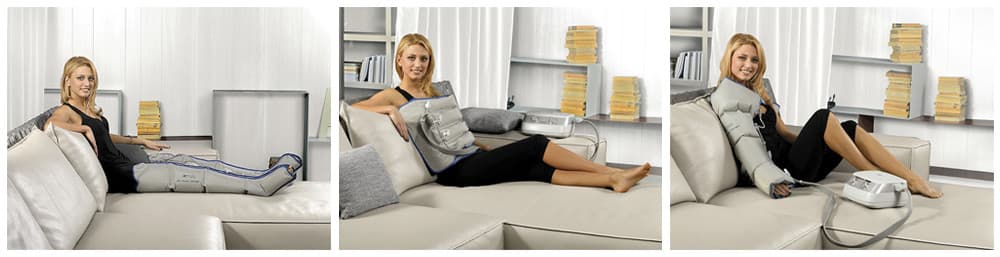
It exerts pressure on the tissues and, similar to manual drainage, moves the swelling. Edema decreases, acute and chronic limb tension is reduced, circulation improves, and pain eases.
The treatment is also called compression therapy with a device. In Hungary it is also referred to as pressure-, wave- or compression-therapy device, but these terms denote the same equipment.
Advantages of device-based compression therapy
- Price. The cost of a device and its accessories is roughly the price of one month of manual lymphatic drainage sessions. You can use it for 8–10 years after purchase.
- Time saving. You no longer have to travel to a distant clinic for treatment, wait in line, and return home.
- When needed. If you own a device, you can use it whenever you need it. You don't have to book appointments or adapt to someone else's schedule.
- As often as needed. If you have a device, you can use it as often as your condition requires, not only as often as prescribed or as much as you can afford.
- Effective. The device provides a circumferential, thorough treatment of the limb. For most patients, device-based massage is more effective than manual therapy.
- Take it anywhere. You can take your device with you on vacation or travel. This way you won't miss treatment even when visiting family or resting away from home.
I wrote about compression therapy units and what you need to know when choosing one in this article: Compression therapy unit – what it's for and how to choose? (click the link to read).
Summary
There are three main types of lymphatic massage for the treatment of lymphedema: therapist-performed lymphatic drainage, home self-massage, and device-based compression therapy. Therapist-performed lymphatic drainage is the most professional and most effective, especially in more severe cases, but it can be expensive long term. Home self-massage is a more cost-effective solution suitable for milder cases but requires technique and regularity. Device-based compression therapy is more effective than self-massage because it provides consistent and uniform massage; although it requires an initial investment, in the long run it can be more cost-effective than regular visits to a therapist, making it an ideal choice to combine cost-efficiency and treatment efficacy.
Frequently Asked Questions
Is compression therapy painful?
Compression therapy usually does not cause pain; it is rather a pleasant and relaxing experience. The goal of compression therapy is not to knead the person intensely, but to stimulate the lymphatic system. However, in some cases — for example, if lymph nodes are very swollen or inflamed, or if the person has certain chronic illnesses — mild pain or discomfort may occur during treatment.
Is compression therapy the same as a traditional massage?
There are many misconceptions about compression therapy that often mislead people. Many believe it serves the same purpose as a traditional massage, which is primarily aimed at muscle relaxation and stress reduction. However, compression therapy uses special techniques aimed at stimulating the lymphatic system and promoting lymph flow with an extremely gentle and delicate technique that relies on light pressure. Therefore, compression therapy fundamentally differs from a traditional massage both in purpose and in methods.
Can manual lymphatic drainage (lymphatic drainage) or a compression therapy unit be prescribed on public health insurance (TB)?
At present, lymphatic drainage sessions cannot be prescribed on public health insurance (TB) in Hungary. TB financing generally covers medical care and medications and does not include alternative or supplementary treatments. As for compression therapy units, these also cannot be prescribed on TB. Such devices are typically for personal use and are not considered reimbursable medical devices within the health care financing system. Overall, although compression therapy can be an effective method for certain health problems, currently neither the procedure nor the related devices can be prescribed on TB; these treatments are usually paid for out-of-pocket.

