Piriformis syndrome, i.e., sciatic nerve inflammation
Do you feel pain deep in your buttock muscles? Consider the possibility of Piriformis syndrome. The piriformis muscle compresses the nearby sciatic nerve, resulting in sciatic nerve inflammation and pain. The piriformis is a flat, band-like muscle beneath the gluteal muscles, "deep" in the buttock, at about the level of the top of the hip bone. Its symptoms can be confused with a number of spinal conditions (for example sciatica), and therefore you often may not receive the most appropriate treatment.
The piriformis is a key muscle in lower limb movement. It stabilizes the hip joint, lifts the thigh to the side and also externally rotates it. It contributes to walking and shifting weight from one leg to the other, in other words maintaining balance. You use it for almost every movement, especially those that require lifting or rotating the thighs.
The sciatic nerve is a thick and long nerve in the body. It exits the spine and runs deep, usually under the piriformis muscle, less commonly through it. It runs down the buttock, thigh and lower leg and finally branches into smaller nerves that end in the foot.
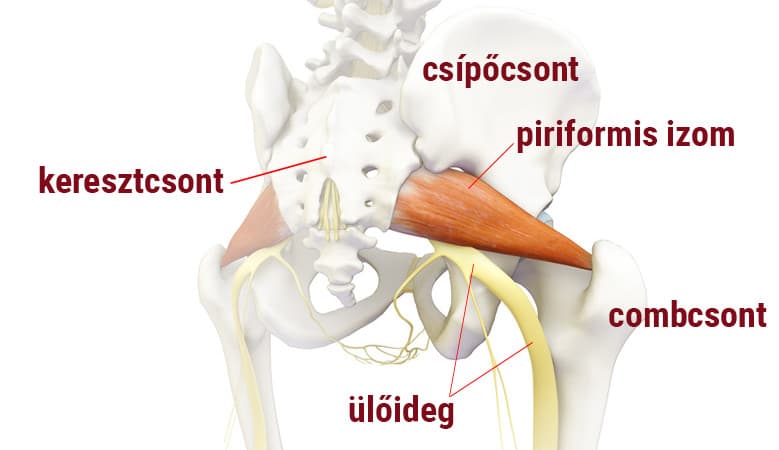
Causes of piriformis syndrome
It is generally accepted that nerve compression can be caused by spasm or tightness of the piriformis muscle. The consequence is inflammation of the sciatic nerve and pain.
There are, however, many possible causes. For example, trauma to the gluteal muscles (a blow in an accident, a kick, a fall) or, as some believe, in runners and cyclists repeated microtraumas caused by sustained and repetitive motion. These can lead to chronic inflammation; the muscle reflexively contracts, becomes stiff, and if the nerve is too close or positioned "wrongly," it can be pressed on or compressed, which triggers the symptoms.
Diagnosis is not simple because there is no detectable abnormality on ultrasound, X-ray or other imaging methods. Moreover, its symptoms are easily confused with sciatica. An experienced diagnostician can detect it by analyzing certain movements.
Symptoms of piriformis syndrome
Pain arises deep within the buttock muscles. This can be a tingling or numbness. The pain can also be unpleasantly strong and may radiate along the sciatic nerve (which is why it can be mistaken for sciatica). Symptoms worsen with sitting, walking, climbing stairs, running, etc.
Deep, firm pressure can directly trigger complaints under the gluteal muscles.
Because of the pain the piriformis muscle reflexively contracts and becomes stiff. In severe cases it may shorten so much that the affected leg twists outward and the foot points laterally.
It is often unrecognized or misdiagnosed because it is easily confused with other common disorders such as herniated disc, discopathy, lumbar radicular pain (pinched nerve), sciatica or hip bursitis. According to an American study (1), more than 16% of adult work disability is due to chronic low back pain, and at least 6% of that is actually piriformis syndrome. Correct evaluation of symptoms allows timely and appropriate treatment.
Home treatment for sciatic nerve inflammation
Conventional medical treatment is based on partial restriction of movement. Medications are used, for example non-steroidal anti-inflammatory drugs. If these do not work, steroid injections may follow, or for those who do not respond to steroids, botulinum toxin (Botox) injections. Fortunately, surgery is rarely recommended (or performed).
Physiotherapy methods are also used, such as therapeutic ultrasound. The softlaser would also be good for this, but not every softlaser can penetrate deeply enough to reach this muscle.
If you have been diagnosed with piriformis syndrome, you can also treat it yourself at home. You can combine several treatments for maximum effectiveness.
The goal of home treatment for sciatic nerve inflammation is to eliminate the inflammation and then relax and strengthen the piriformis muscle.
At home, follow the strategy below:
Temporarily reduce your training volume
If you keep recreating the triggering cause over and over, you're working against healing. Reducing training load helps the healing processes overcome the inflammation. But don’t become inactive!
Cool the painful area
Apply an ice pack to the painful area for 10–15 minutes. Do not place it directly on the skin, as it may cause frostbite.
Cooling reduces inflammation. When you remove the ice, the body warms the cooled area, which leads to increased circulation. This supports anti-inflammatory processes.
After 10–15 minutes of cooling, let the muscles warm up again (1 hour break). Repeat 3–4 times.
Do not overcool: do not use this method for more than 2–3 days and do not cool for longer than 15 minutes at a time.
Treat with therapeutic ultrasound
Because the piriformis muscle lies deep, use therapeutic ultrasound at 1 MHz frequency for treatment. Ultrasound has excellent anti-inflammatory effects. It warms the treated tissues, relaxes the stiff muscle and accelerates resolution of the inflammation. Treat once daily for 15–20 days. Use medium intensity for 10 minutes (on an area the size of a palm over the painful spot). Always use ultrasound gel during treatment!
If you stop ultrasound therapy after 12 days of treatment—even if your complaints are only partly resolved—do not continue beyond this. You should not give more ultrasound to the same place. You must wait 3–4 months before treating the same area again.
The M-Sonic 950 therapeutic ultrasound device is a suitable choice.
Use microcurrent!
Microcurrent is still a less widespread electrotherapy method. Yet it is the most effective pain-relieving and anti-inflammatory method that can be used at home. In my opinion it will become one of the most common treatment methods in the near future. Read about the effects of microcurrent here.
Treat 2–3 times daily for 20 minutes each session.
Globus Genesy 300 Pro, the Runner Pro, Triathlon Pro or the Premium 400 devices may be suitable.
Relax and strengthen the piriformis!
You can also relax and strengthen the muscle with exercise. Admittedly, this will take several months. Here are a few exercises.
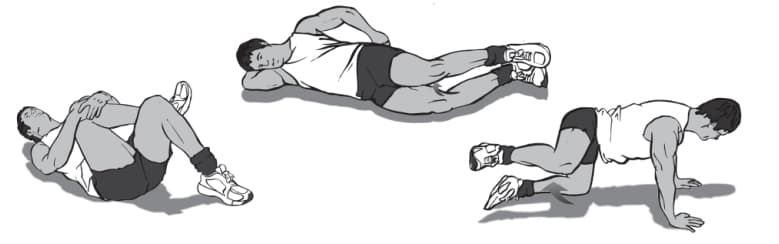
Piriformis stretch: Lie on your back. Bend one knee with the sole of the foot on the ground. Place the other leg crossed over it. Hold the bent knee and slowly pull it toward the opposite shoulder. Hold for a few seconds. Repeat 20 times on both sides. Gradually increase the hold time.
Strengthening exercise 1: Lie on your side. Bend your knees so that your hip and knee-shank form about a 60-degree angle. Now rotate the top thigh (lift the top knee). Hold for a few seconds, then lower. Make sure your ankles remain in contact, i.e., do not lift the ankle! Repeat 10 times on both sides.
Strengthening exercise 2: Get on all fours. Lift one knee sideways. Hold for a few seconds. Lower it to the floor. Repeat 10 times on both sides. Each day increase the hold time by 1 second.
Use a muscle stimulator!
If you don't have time to miss training for several months or you're simply too lazy to exercise for months, use an electrical muscle stimulator device to treat piriformis syndrome. With a quality muscle stimulator you can relax and strengthen the muscles more effectively and faster than with training alone, thus resolving complaints more quickly.
Globus sports muscle stimulators (Runner Pro, Cycling Pro, Triathlon Pro) or the Genesy 300 Pro all provide the necessary programs: combining pain relief, muscle relaxation and strengthening, you can achieve a definite improvement within 2–3 weeks. Even with regular stretching and stimulator use, full resolution of complaints may take a long time—possibly 2–3 months.
Use a vibration massage gun!
The vibrating massage head, which generates 30–40 vibrations per second, very effectively reaches deep muscles, including the piriformis deep in the gluteals. The strong massage action accelerates circulation, promotes removal of metabolites and relieves muscle tension. For the 4 Vibe device you get a small-surface massage head designed specifically for point treatments. For vibration massage you need only 1–2 minutes per specific area!!! You will understand why that is enough. Don’t be surprised if during self-treatment you "see stars"! :)