The Role of Regeneration in Sport
Among domestic athletes the stubborn belief persists that “you must train a lot and hard — nothing else is needed.” Many think the more they train, the more they improve! Those who do not understand how the human body works and how it responds to load may agree with them. In reality, however, this is not the case at all! During training destructive processes dominate in your body, which make improvement impossible. The effect of training does not take place immediately during the session, but afterwards, during rest. This process — regeneration — restores the stores “worn down” by training, heals torn fibers, clears metabolites and builds stronger tissue in their place. It has been proven that the correct balance of quality training and effective regeneration is the key to progress.

Training is of course necessary, but you do not improve by the number of hours you spend training. Worldwide, sports preparation has moved toward increasing training efficiency. The emphasis is on shorter but higher-intensity sessions and on more effective regeneration.
What makes you improve?
Your muscles — and your whole body — adapt to training. This means that increasing load is followed by changes in the muscles, circulation, breathing and metabolism. The body prefers to function in the most efficient, least wasteful way possible.
With greater load, muscle mass and muscle strength increase. But this also requires improved blood and oxygen supply to the muscles and more efficient cellular energy production processes.
It is important that the effect of training is not "built in" during the workout, but during rest — that is, during regeneration!
Read this earlier article about supercompensation!
“No pain, no gain!”?
Many coaches believe you must train a lot of hours — that suffering leads to improvement. Push on even when your muscles are burning and you're tired. This is not true! Evidence shows that the majority of Hungarian athletes are falling behind the top ranks.
From a medical point of view, more suffering often means less improvement. There is a point beyond which forcing it becomes counterproductive. It can even reduce performance by jeopardizing regeneration and increasing injury risk. Not to mention that suffering destroys motivation. Moreover!!!! There are cases when skipping a training session and taking a nap instead will do you more good than forcing a workout while exhausted.
Risks of neglecting regeneration
The greatest risk of "pushing" is overload and injury. Overtraining not only stresses your muscles, ligaments, joints and bones, it also endangers your immune system and weakens the body's defenses. Chronic stress without regeneration harms health. First your Achilles or your patellar tendon starts to hurt, then your knee joint itself, and so on. Eventually you develop various complaints that, despite examinations, show nothing wrong — yet you do not feel well.
Another consequence of joyless strain can be burnout — the loss of motivation and of the pleasure of cycling. If you focus solely on performance goals, you may lose sight of why you ride a bike in the first place.
It is a serious mistake if neither you nor your coach recognize that poor performance is caused by lack of regeneration and you continue to force training instead of resting.
What hinders regeneration?
Intense muscle work causes microscopic tears in muscle fibers. These injuries are indicated by a rise in CK (creatine kinase) enzyme. During intense exercise muscles can become oxygen-deprived and their energy production shifts to anaerobic pathways. This is when metabolites such as lactic acid are produced.
Both CK and lactic acid impair muscle blood flow. Slower circulation hinders oxygen delivery to cells, which in turn increases metabolite production. The more metabolites accumulate, the slower the circulation. Muscles stiffen and fatigue rapidly.
After training your body can break down these substances. The big question is how long that takes!?
For waste products to be removed, muscle blood flow needs to be good so lactic acid can be quickly transported to the liver for breakdown.
But as I noted earlier, lactic acid itself worsens circulation. Because of this, flushing is slow, fresh oxygen doesn't reach the muscle and energy (ATP) is not produced in muscle cells. If there is no energy, muscle stores cannot be refilled and regeneration does not occur.
As a result, at the start of your next session your legs may be so stiff that your cadence is 15–20 rpm lower. As the muscles pump, circulation slowly picks up and after about half an hour you begin to feel some improvement. But you cannot reach the prescribed intensity and must reduce effort. With that the session is essentially wasted — it did not contribute to improving your performance.
Rest becomes more important with age. Regeneration gradually slows with time. Most people notice in their early 30s that recovery capacity decreases — after a hard session you still feel tired the next day. Over time the amount of effective, high-quality training you can do decreases. For older athletes one limiting factor is that they tolerate high-intensity sessions less well, especially consecutively.
Is it worth helping regeneration?
Supercompensation works when you force your body into a positive adaptation, i.e. you force it to perform. Lifting an empty plastic bottle a hundred times will not make your arm any stronger. Low-intensity pedaling is good for fat burning, but it will not raise your race performance. Likewise, riding with tired, stiff muscles at reduced intensity will not provoke adaptation in your body.
Progress requires increasing training intensity.
And here is the TRAP! The greater the load, the longer the regeneration needed. Increasing training frequency and intensity requires more recovery time. That leaves less room in the day for both training and its recovery.
You can use many drug-free methods to speed up regenerative processes. If used correctly, they allow you to keep your training intensity consistently high!
Methods that improve regeneration
Methods to accelerate recovery are simple to apply after training. Of course you need to know how to use them and what their limits are.
Massage
Traditional massage primarily helps release adhesions and mechanically loosen muscle stiffness. It somewhat stimulates circulation as well, but in this it is far less effective than compression and EMS.
Another problem is that only professionals can afford to have a masseur available after every training session.
Vibration massage gun
This device is not meant to replace a masseur, but rather to substitute for foam rolling or complement it. It is excellent at releasing muscle knots and adhesions.
Cold and compression
Katinka Hosszú and László Cseh have often posted pictures of themselves sitting in ice baths after training, cooling their muscles and reducing inflammatory processes caused by load. In the photo below the MoviStar bus also uses such equipment.
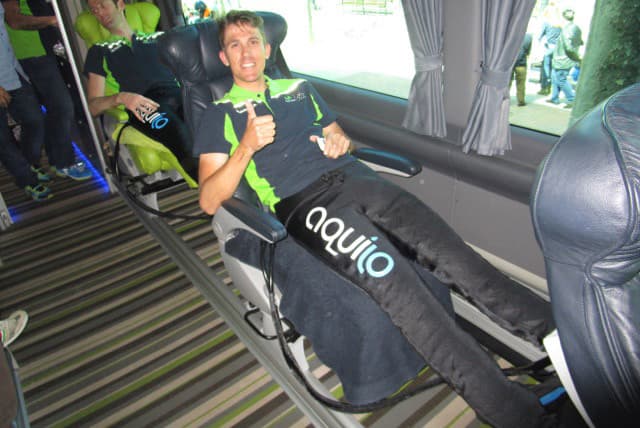
Intermittent pneumatic compression
This provides extremely useful help for post-exercise treatment of the lower limbs. The machine sequentially inflates the airchambers of cuffs pulled onto the legs to the desired pressure (60–80 mmHg is an effective value).
After exercise lactic acid causes venous dilation, which leaves a lot of blood "pooling" in the legs. Circulation slows and so does recovery.
The treatment pressure "squeezes out" metabolites from the muscle and "flushes" the stagnant blood from the limb. The blood returned to the circulation becomes oxygenated and is delivered back to the muscles, jump-starting regeneration.
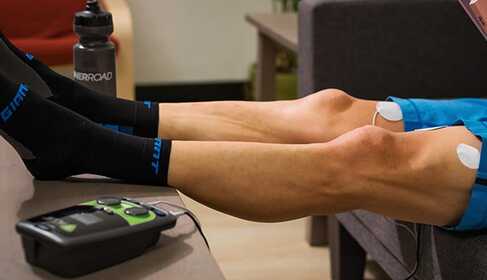
Electrical muscle stimulation (EMS)
For cyclists I believe this is the most effective aid. It is worth treating mainly the quadriceps and, to a lesser extent, the glute and calf muscles immediately after load.
Stimulation induces rhythmic contractions in the muscles, compressing the vessels and even the interstitial space. This can increase blood flow and metabolite flushing up to threefold. Medical studies show that EMS treatment performed within 2 hours after exercise removes 35–45% of the lactic acid produced during the workout from the muscles immediately.
This is why regeneration time is significantly shortened.
Summary
Improving cycling performance today is no longer primarily about long training sessions.
Success requires high-intensity training. For optimal "integration" you must increase the efficiency of regeneration. Drug-free devices (e.g. pneumatic compression units or muscle stimulators) are available to help with this.
You can expect a significantly greater performance advantage from regeneration aids than from a two-kilogram lighter bike. And while you might have to pay millions for an ultralight bike, a high-quality regeneration device costs only a fraction of that.
It's a better investment.