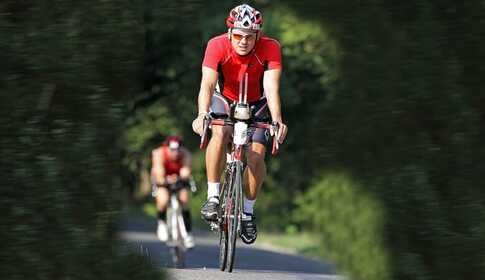
The Shadow of Spinal Surgery – Interview with Balázs Bicskei
Balázs Bicskei (an Ironman finisher) runs a business with his brothers. They build artificial turf sports fields, rubber-surfaced sports and running tracks, and playgrounds. The company has been growing nicely, the workload increased, and over the past years he gradually had less and less time for exercise. As the company leader he mostly did office work: sitting in the office, in the car, at business meetings. He quietly gained a few kilos. Then one day his lower back started to hurt. Off to investigations: CT, MRI… "Herniated disc!" they said. "No surgery yet! Take pain relief if needed!" Months went by and his complaints got worse. Slowly even tying his shoes became difficult because the muscles around his lower back had stiffened and hurt so much that they prevented him from bending forward… it was then he found my article about herniated discs…
Dr. Zsolt Zátrok (ZZs): How did you end up with a herniated disc? What led to this?
Balázs Bicskei (BB): I played competitive squash for 12 years, training was always part of my life. Seven years ago I completed an Ironman distance (a challenge consisting of 3.8 km swimming, 180 km cycling and a 42 km run - ed.), and before and after that I ran a lot and completed several marathons.
But as the children arrived and the workload grew, there was less and less time for training. About 3–4 years ago my lower back began to ache, and then one day I simply couldn't stand up, walk, or stroll. My doctor suggested: "you should get operated on..."

I thought to myself, I'm still too young for that, let's try alternative options: physiotherapy, shockwave therapy, exercises, yoga, incline treadmill, massage, manual therapy, chiropractors, etc. Sometimes it got better, sometimes worse, but the complaints never completely disappeared.
In the last six months it got progressively worse. I started resting. But as the muscles wasted away further, the pain increased — I couldn't bend or straighten up. It was terrifying; I lived on pain relief medications.
It was then I came across your article about herniated discs on Facebook. In the triathlon group someone shared your interview with Zoltán Petsuk, eXtremeMan champion, about his electrostimulator experiences. I read that and then noticed a recommendation... it was your article on herniated discs. Your arguments were so convincing and your problem description so clear that I immediately recognized myself in it. I had little to lose, so I decided to try it.
ZZs: The article explains that back muscle weakness can be quickly restored with muscle stimulation. It's also safer, because you can seriously injure yourself strengthening back muscles in a gym.
BB: I used to train regularly: I ran, swam, cycled, went to the gym, but moving became increasingly difficult.
My back was so painful and stiff that every movement and effort felt bad.
I became less and less motivated to train; movement no longer brought the joy it used to. I did exercises, stretches, went to a masseur and a chiropractor — each helped for a short while, but none were a long-term solution.
ZZs: How did you start the strengthening?
BB: I bought a Triathlon Pro sport muscle stimulation device and, following the "training plan" described in one of your blog posts (Strengthening the back muscles with a 4‑channel muscle stimulator - Ed.) I began treating my back.
After a week I began to feel a change; it was easier to get out of bed in the morning. I could put on my socks by myself!
It's incredible how much joy those small things — which are part of normal life and often taken for granted — can bring in such situations.
After a week I cautiously started stretching, did a bit of exercise, and treated myself twice a day. It was a good decision — things kept improving.
I'm now past week three and the improvement is fantastic. I'm not yet 100%, but I'm already thinking about slowly starting to run. A few months ago that would have been unthinkable. 😊
ZZs: The training plan is a 10‑week course containing several programs. Its aim in the early phase is to reduce muscle stiffness and pain and to prepare the muscles for the development programs. Do you have favorite programs? Which do you prefer?
BB: I don't have a particular favorite program; the device itself is my favorite.
It has earned my initial trust. I recommend it to everyone I know who might need it.
I use stiffness-relief, maximum strength, and endurance strength programs on my back muscles. Recently I included the quadriceps in the program because, due to weakness in my lower back, one muscle suffered from lack of training. After a few days there was already visible and noticeable improvement there as well.
ZZs: How clear and easy to follow is the treatment recommendation?
BB: I read your blog posts and watched the YouTube videos — learning from those, after 3–4 days it became routine where to place things and what mA to set the device to.
Really, it's dead simple; you need to spend an hour or two to learn the treatment, everything is written down.
I was grabbed by the first program: "stiffness relief" — I thought, I definitely need that, so I started the sessions. At first I dosed it cautiously; my wife applied the pads and we experimented where placement worked better or worse.
ZZs: How far have you come so far?
BB: I was a bit skeptical, but hopeful. I hoped it would work as you described. The result is fantastic.
My lower back can bend; three weeks ago I couldn't bend to pick up a dropped pen, today I can reach the floor with my palms... incredible...
Movement is getting easier, too; this week I cautiously did some bodyweight exercises and for the first time in months I didn't feel pain.
Yesterday I went cycling — a careful 40 km ride felt good as well. Of course I'll continue the treatments; I don't plan to stop for a long time. I hope that gradually training will take the main role and the muscle stimulation will remain as a supplement.
ZZs: That's the point! Muscle stimulation is only an adjunct tool that pulls you out of the hole, but exercises, training and strengthening the muscles heal. What are your plans for the near future?
BB: The treatment experience has re-evaluated the role of sport and back-strengthening exercises in my life. In a few days it became clear that my complaints were due to laziness, softening, and the weight I had gained.
It's also obvious that if I take care of myself, I don't have to fear pain, surgery or becoming disabled.
I'm slowly starting to plan in my head. If next year I could finish a 51.5 or 113 triathlon, regardless of time, it would feel to me like climbing Mount Everest. And it would be wonderful to take part next year in the family relay at the eXtremeMan in Nagyatád.
I don't need to do anything else but pay attention to myself; we've now set the path. Regular exercise is fundamentally important, especially strengthening the back muscles. The next step is to reduce my weight — with training and mindful eating that will happen.

Zsolt Zátrok: Good luck with that! Thank you for sharing your story!
Balázs Bicskei: Thank you for your help!
Balázs Bicskei used a Triathlon Pro device to strengthen his back muscles