Ultrasond dosing – treatment dosage
Ultrasond treatment is used very often for musculoskeletal conditions. However, the "dose" you receive matters, because ultrasond—similar to other procedures and to medicines—cannot be "consumed" without limit. Dosing requires attention, because it can be overdosed just like drugs. Fortunately it does not cause poisoning, but it can lead to symptoms and an increase in pain. If you experience this, stop the treatment and check what "dose" you need. Reducing the treatment frequency, duration and/or intensity is the solution in such cases. […]
Ultrasond treatment is used very often for musculoskeletal disorders. However, the dose you receive matters, because ultrasond—similar to other procedures and to medicines—cannot be "consumed" without limit. Dosing requires attention, because it can be overdosed just like drugs. Fortunately it does not cause poisoning, but it can cause symptoms and an increase in pain. If you notice this, stop the treatment and find out which "dose" you need. Reducing the treatment frequency, duration and/or intensity is the solution in such cases.
Basic information on ultrasond dosing
Ultrasond frequency
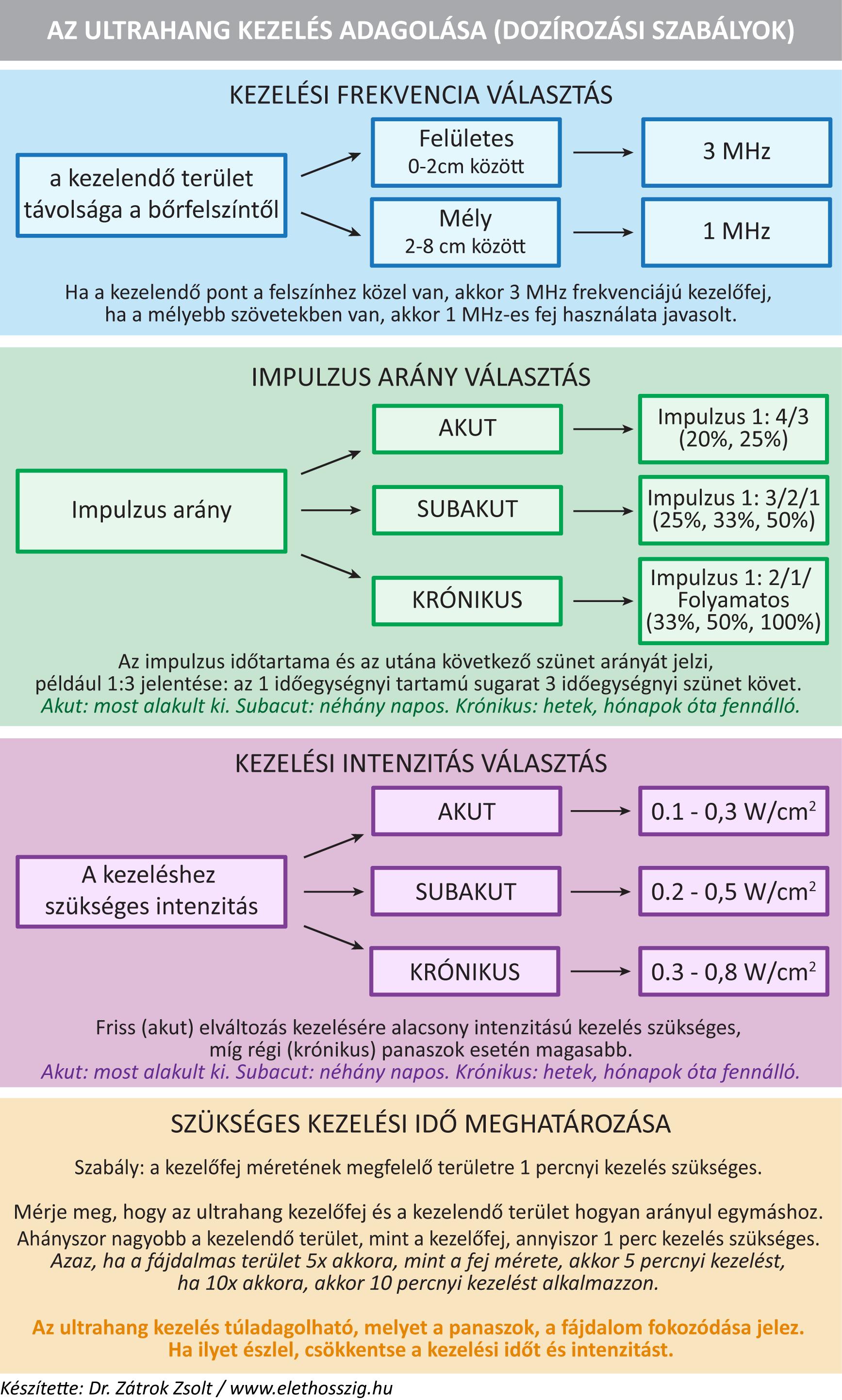
How deeply ultrasond waves penetrate the body depends on the frequency. The lower the frequency, the deeper they penetrate. Ultrasond treatments usually use frequencies of 1 and 3 MHz. If the target point is near the surface, use a 3 MHz applicator head; if the target is in deeper tissues, use a 1 MHz head. 3 MHz is typically used for skin and cosmetic treatments, while 1 MHz is suitable for musculoskeletal problems.
Pulse ratio
The ultrasond beam can be continuous or pulsed. Devices that deliver a continuous beam should be used only for chronic complaints. For example, if you have been struggling with tennis elbow or Achilles tendon inflammation for half a year, you can use the continuous mode.
In all other cases, especially acute inflammations, pains and injuries, use the pulsed mode. However, do not expect pulsed modes from inexpensive devices costing only a few tens of thousands of forints; only better devices provide this. Their price starts at about 200,000 HUF.
Pulsed ultrasond means the device emits for a certain time, then pauses. Different pathologies and conditions require different on/off ratios. Which ratio is appropriate for a given problem is usually found in the device's user manual.
The pulse ratio indicates the proportion of pulse duration to the following pause. For example, 1:3 means a radiating period of 1 time unit is followed by a pause of 3 time units (during which there is no ultrasond emission).
Choosing the correct pulse ratio largely depends on the condition of the tissues to be treated. The fresher the injury, the more sensitively the tissues react to energy. In acute conditions a longer pause should follow the ultrasond pulse, so ratios like 1:3 or 1:4 are recommended.
The older the injury, the more the tissues "tolerate" concentrated energy. In chronic cases you can therefore reduce the pulse ratio to 1:2, 1:1, or even use continuous (uninterrupted) ultrasond emission.
General principle: for ACUTE complaints use 1:4 or 1:3, for a few days–old SUBACUTE complaints use 1:2 or 1:1, and for chronic conditions use 1:1 pulsed or continuous ultrasond.
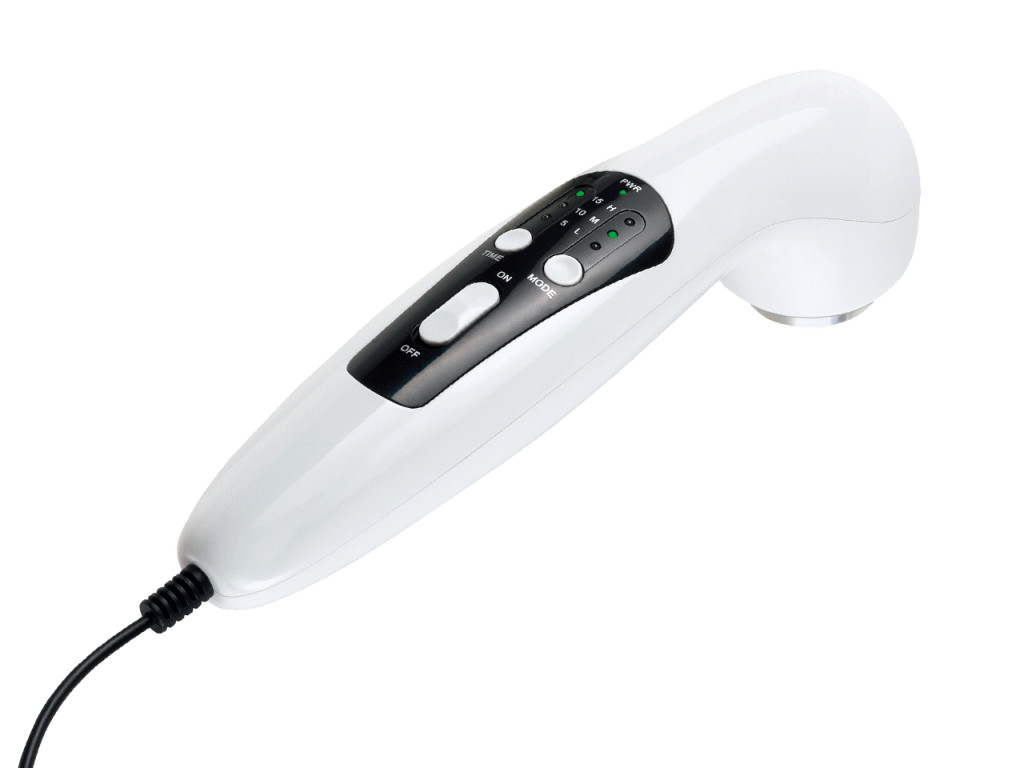
M-Sonic 950 therapeutic ultrasond device, 1 MHz
M-Sonic 950 therapeutic ultrasond (1 MHz) for inflammation- and pain-reducing treatments, for home use
Treatment intensity
As with choosing the pulse ratio, the ultrasond intensity required by the target tissue depends on the tissue condition. The more intense the injury, the milder the ultrasond radiation needed. The longer a condition has existed, the less sensitive the tissue and therefore the higher intensity you may use to initiate healing.
Also account for the fact that a portion of the ultrasond energy is lost—for example if you do not use enough gel.
You can determine the treatment intensity from the table below:
| Tissue condition | Required intensity |
| Acute | 0.1 – 0.3 W/cm2 |
| Subacute | 0.2 – 0.5 W/cm2 |
| Chronic | 0.3 – 0.8 W/cm2 |
Treatment depth
Ultrasond is absorbed in tissues. The degree of absorption varies depending on the thickness and condition of different tissues (e.g. skin, fat, muscle, etc.). It is currently generally accepted that 3 MHz treatment can be used for superficial lesions located within 2 cm of the skin surface. If the target area is deeper, a 1 MHz applicator head is recommended.
Knowledge of absorption is important because the intensity set on the device does not necessarily reach deep tissues. If you want to treat a structure at 6 cm depth, you must account for absorption. That is, the deeper you treat, the higher intensity you must set on the device. The table below helps determine the intensity value to set on your device.
Example: you want to treat an acute lesion located 5 cm deep. The acute tissue intensity requirement is 0.3 W/cm2. In the table follow the 5 cm column until you reach the 0.3 W/cm2 row. Here you can see that you need to set 0.68 W/cm2 on your device to deliver 0.3 W/cm2 at 5 cm depth.
| Lesion depth (cm) | |||||||
| Required intensity | 0.5 | 1 | 2 | 3 | 4 | 5 | 6 |
| 1.0 W/cm2 | 1.20 | 1.40 | 1.80 | 1.75 | 2.00 | 2.25 | 2.50 |
| 0.9 W/cm2 | 1.08 | 1.26 | 1.62 | 1.58 | 1.80 | 2.03 | 2.25 |
| 0.8 W/cm2 | 0.96 | 1.12 | 1.44 | 1.40 | 1.60 | 1.80 | 2.00 |
| 0.7 W/cm2 | 0.84 | 0.98 | 1.26 | 1.23 | 1.40 | 1.58 | 1.75 |
| 0.6 W/cm2 | 0.72 | 0.84 | 1.08 | 1.05 | 1.20 | 1.35 | 1.50 |
| 0.5 W/cm2 | 0.60 | 0.70 | 0.90 | 0.88 | 1.00 | 1.13 | 1.25 |
| 0.4 W/cm2 | 0.48 | 0.56 | 0.72 | 0.70 | 0.80 | 0.90 | 1.00 |
| 0.3 W/cm2 | 0.36 | 0.42 | 0.54 | 0.53 | 0.60 | 0.68 | 0.75 |
| 0.2 W/cm2 | 0.24 | 0.28 | 0.36 | 0.35 | 0.40 | 0.45 | 0.50 |
| 0.1 W/cm2 | 0.12 | 0.14 | 0.18 | 0.18 | 0.20 | 0.23 | 0.2 |
Treatment time
Rule: one minute of treatment is required for an area corresponding to the size of the applicator head.
Measure how the ultrasond applicator head compares to the area to be treated. For each time the treatment area is larger than the head you need one additional minute of treatment. That is, if the painful area is 5 times larger than the head, treat for 5 minutes; if it is 10 times larger, treat for 10 minutes.
You can overdose ultrasond treatment, which will be signaled by worsening of your complaints and pain. If you notice this, reduce the treatment time and intensity.
Harmful effects can occur if you treat an area with too high intensity and for too long. The main effect of ultrasond is heating of the tissues. If a site receives too much at once, it will not aid but rather halt healing. Imagine sunbathing: if you sunbathe regularly for 15–20 minutes you gradually tan; if you lie out for 3–4 hours, you don't tan—you get sunburned. Ultrasond helps when applied in appropriate and regular doses.
If you are uncertain, ask your treating physician or a physiotherapy professional experienced in ultrasond treatment to determine the settings appropriate for your complaints.