Who is the MyoBravo for and what is it good for?
The 23 sport programs offer classic EMS protocols: warm-up (10–15 minutes before competition), capillarization (improving oxygen transport), endurance (long-distance running, cycling), resistance, maximum force output (supplement to weight training), explosiveness (jumping, quick starts), muscle mass concentration (hypertrophy), regeneration (after training/competition). With 2–3 EMS sessions per week in addition to regular training, measurable differences can appear in 6–8 weeks.
The MyoBravo’s unique 2 × 2 output configuration allows simultaneous use of 4 electrode pairs (8 electrodes). Examples:
- Both thighs + abdomen + back – full-body EMS cycle in one session.
- Quadriceps + hamstrings + gluteus + calf – full chain treatment for runners or cyclists.
- Upper body 4 areas – chest + back + arm + shoulder.
The Dolito and Rehalito can only use 2 electrode pairs at the same time – the MyoBravo delivers twice the treatment capacity. It saves time during intensive sessions.
The 4 dedicated TENS modes (continuous, burst, HAN, modulated) cover classic pain-relief protocols. Continuous for acute pain, modulated for chronic pain, HAN (Dense-Disperse) to activate the endorphin system, and burst for specific situations. It can be used for arthritis, back, neck and lumbar pain, nerve pain, muscle pain and phantom pain — as a drug-free alternative for symptom relief.
The MyoBravo is the only device in the MTR+ line that covers the FULL incontinence spectrum: stress incontinence (leakage when coughing/sneezing), urge incontinence (sudden strong urge), mixed (combination), and fecal incontinence. For more targeted treatment a pelvic probe is recommended – PeriSphera O (vaginal) or PeriProbe Analis (anal) – sold separately. Probe treatment activates the pelvic floor muscles directly and is much more targeted than surface electrode therapy.
Postpartum rehab focuses on two main areas: strengthening the pelvic floor muscles (often associated with incontinence symptoms) and restoring abdominal muscle tone. The MyoBravo covers both: probe-based incontinence programs target the pelvic floor, while the EMS sport programs target the abdominal muscles and general body contouring. IMPORTANT: wait for gynecologist approval after childbirth (usually at the 6–8 week postpartum check) before starting treatment.
The MyoBravo can serve many clients in a physiotherapy practice: athletes (EMS training), pain patients (TENS), and incontinence patients (probe therapy). Four electrode pairs simultaneously = multiple muscle groups treated in parallel during a larger session. The three custom 5-phase programs are designed for client-specific protocols.
The MyoBravo’s EMS functions (capillarization, muscle mass concentration, regeneration) can play a role in postoperative rehab: preventing muscle wasting, restoring muscle strength. The TENS function may be used for postoperative pain relief with treating physician approval. Four electrode pairs simultaneously allow complex rehabilitation protocols. IMPORTANT: start rehab under approval from the treating physician or physiotherapist after surgery.
The MyoBravo runs on 4 AA batteries – no charging, swap and use. It fits easily into a sports bag or backpack, handy for training camps. Its compact, multifunction nature makes it a Swiss-army-knife type device: whatever home electrotherapy need arises (sport, pain, incontinence), it likely has a program for it.
The 31+3 programs in 4 main groups
The MyoBravo program library reflects its multifunctional purpose: 23 sport-EMS + 4 TENS + 4 incontinence + 3 custom = the full spectrum of classic home electrotherapy goals.
The MyoBravo sport programs cover classic EMS training protocols:
- Warm-up: short, low-intensity program 10–15 minutes before training or competition.
- Capillarization: aimed at improving oxygen transport (increasing capillary density).
- Endurance: supports long-term aerobic performance – marathons, long rides.
- Resistance Force: endurance strength, sustaining constant load.
- Maximum Force: supplement to weight training, strength development.
- Explosive Strength: sprint, jump, quick starts.
- Mass Muscle Contraction: hypertrophy program.
- Regeneration: rapid recovery after training or competition.
The 23 programs offer these at different intensities and durations – a physiotherapist or coach can help choose the right one.
4 different TENS modes covering classic pain-relief protocols:
- Continuous (CONT): constant-frequency stimulation. For acute pain. Based on Gate-Control theory it blocks pain signals.
- Burst: groups of high-frequency pulses at a low rate. May activate the endorphin system.
- HAN (Dense-Disperse): Professor Han method, alternating high (100 Hz) and low (2 Hz) frequency. A refined endorphin-activating mode.
- Modulated (MOD): variable frequency. Prevents neural habituation and can remain effective long-term. For chronic pain.
General advice: start with Continuous (quick relief), then for chronic problems switch to Modulated → Burst → HAN sequence.
4 dedicated incontinence programs:
- Stress incontinence: leakage when coughing, sneezing or jumping. Caused by pelvic floor weakness. Strengthening protocol.
- Urge incontinence: sudden, uncontrollable urge to void. Overactivity of the bladder muscle. Inhibitory-relaxation protocol.
- Mixed incontinence: combination of stress + urge. Combined protocol.
- Fecal incontinence: weakness of the anal sphincter. For use with the PeriProbe Analis.
More targeted treatment is provided with a probe: PeriSphera O (vaginal, for general female incontinence) or PeriProbe Analis (anal, for fecal incontinence or male dribbling). Probes are SOLD SEPARATELY in the webshop. They have smoke-gold plating – suitable for patients with metal allergies.
3 freely configurable program slots, each with up to 5 phases. Example uses: PC1 = runner prep (warm-up + max force + endurance + explosiveness + regeneration in one run). PC2 = postpartum rehab combined protocol. PC3 = multi-phase TENS for chronic pain.
Parameters adjustable per phase: frequency (1–200 Hz), pulse width (50–300 µs), intensity (0–90 mA), treatment time (1–99 min), ramp-up time (0.1–9.9 s).
The 2 channels can operate in two ways:
- Synchronous mode: both channels activate at the same time. E.g. treating both thighs in parallel.
- Alternating mode: the two channels work alternately. E.g. agonist–antagonist pair (one channel for quadriceps, the other for hamstrings), or alternating left–right activation. This mimics natural gait patterns.
The physiotherapist decides which mode is appropriate for a given patient.
Frequently asked questions
No. A pacemaker, implanted defibrillator (ICD) or any electronic implant is an absolute contraindication. EMS and TENS impulses can interfere with the implant’s function. If you have such a device, do not use the unit under any circumstances — not even on your limbs.
Use of EMS/TENS devices is NOT recommended during pregnancy. Treatment of the lower abdomen, abdomen and lumbar area is forbidden throughout pregnancy. After childbirth, wait for full recovery (usually the 6–8 week postpartum check) and only start with gynecologist approval. The MyoBravo is suitable for postpartum pelvic rehabilitation, but always under professional supervision.
They are all MTR+ Bravo-line devices but with different focuses:
- MyoBravo: Mid-range multifunction. Sport + TENS + incontinence. 2 channels × 2 outputs (8 electrodes at once). 23 sport + 4 TENS + 4 incontinence + 3 custom.
- PeroBravo: Peripheral denervation (denervated muscle). Selective stimulus current (1–1000 ms pulses). Single-channel. Clinical-level.
- DuoBravo N: Central paresis after stroke. EMG-driven stimulation (ETS) + biofeedback. 2-channel. Clinical-level.
- SineBravo: EMG biofeedback only, DOES NOT stimulate. For late-stage rehab conscious training.
If you need one device for many goals (sport + pain + incontinence) → MyoBravo. If you need specific neurorehab treatment (drop foot, Bell palsy, stroke) → PeroBravo or DuoBravo N.
All three are 2-channel multifunction categories but have different focuses:
- MyoBravo (MTR+): 2 channels × 2 outputs = 4 electrode pairs simultaneously. 31 programs (23 sport + 4 TENS + 4 incontinence). 90 mA max intensity. Probe-based incontinence.
- Globus Elite SII: 2 channels (1 output/channel = 2 electrode pairs). 100 programs (more versatile sport + shaping). 100 mA max.
- Globus Genesy SII: 2 channels. Incontinence-focused profile (Globus also offers probe solutions).
If 4 electrode pairs simultaneously is important (parallel large muscle group treatment) → MyoBravo. If you want versatile sport + shaping with 100 programs → Elite SII. If you need pure incontinence rehab → Genesy SII.
Steps for probe treatment (PeriSphera O or PeriProbe Analis):
- Hygiene preparation: clean the probe thoroughly before and after use. Alcohol is NOT recommended.
- Connection: connect the probe to one of the MyoBravo channels using the accessory cables.
- Insertion: in a comfortable position (lying, turned to the side), insert the probe gently with a small amount of lubricant. Vaginal probe halfway in, anal probe approx. 5–7 cm deep.
- Start program: select the appropriate incontinence program (stress/urge/mixed/fecal).
- Increase intensity: gradually raise until a visible pelvic floor contraction is felt. There is no need to reach painful levels.
- After treatment: carefully remove, clean and store the probe in a hygienic place.
IMPORTANT: always start probe-based incontinence treatment under the supervision of a gynecologist or urogynecology specialist. Probe treatment can deliver significant results (60–80% improvement in stress incontinence in an 8–12 week course), but it requires a specialist protocol.
Some proven example configurations:
- Thigh training (1st chassis A+B = left thigh, 2nd chassis A+B = right thigh): quadriceps hypertrophy protocol for runners or cyclists.
- Upper body training (1st chassis = chest + back, 2nd chassis = arm + shoulder): complex upper-body program.
- Chain training (1st chassis A+B = thigh, 2nd chassis A+B = calf): complete running muscle chain treatment.
- Abs + back (1st chassis = abdominals, 2nd chassis = lumbar strengthening): comprehensive trunk stability development.
- Bilateral pain (1st chassis = left-side pain, 2nd chassis = right-side): symmetric TENS treatment.
Channel synchronization (synchronous or alternating) affects whether the four electrode pairs work simultaneously or alternately.
Depends on program and goal:
- Sport EMS strength development: 2–3 times per week, 20–30 min/session. Rest days for recovery.
- Sport EMS regeneration: immediately after training/competition, even daily.
- TENS pain relief: 1–3 times daily as needed, 20–45 min/session.
- Incontinence treatment: daily or every other day, 20–30 min/session. Full course 8–12 weeks.
- Postpartum pelvic rehab: with gynecologist approval, 3–5 times weekly, 20 min.
Never use the device while driving or performing operative work. If new or worsening symptoms appear, consult your treating physician.
How to use it step by step?
1
Insert 4 AA batteries
The unit runs on 4 AA batteries – included in the package. Remove them for long storage. For long-term daily use consider rechargeable NiMH AA batteries.
2
Select programs (PRG button)
Use the PRG button to scroll through 31 pre-programmed + 3 custom programs. Four main categories: 23 EMS sport, 4 TENS, 4 incontinence, 3 custom (PC1–PC3, each with 5 phases). The LCD shows current frequency, pulse width and remaining time.
3
Place electrodes (4 pairs = 8 electrodes)
The package contains 4 × 40×40 mm (smaller areas) and 4 × 40×80 mm (larger muscle groups) adhesive electrodes + 4 stimulating cables. 2 channels × 2 outputs = 4 electrode pairs. Example placement for sport EMS: channel 1 A+B outputs on both quadriceps, channel 2 A+B outputs on abdominals + back. For incontinence use a probe (PeriSphera O or PeriProbe Analis), sold separately.
4
Set intensity per channel (+/− buttons, 0–90 mA)
Intensity is adjustable separately on both channels (0–90 mA). Gradually increase until you see visible muscle contraction for EMS or feel a pleasant tingling for TENS. Safety feature: intensity automatically drops to 8 mA when changing phases to prevent accidental overstimulation.
5
Run the treatment (1 minute to 10 hours adjustable)
Treatment time is freely adjustable from 1 minute to 10 hours (with a custom program). Sport EMS protocols typically work in 20–30 minute sessions, TENS 30–45 minutes, incontinence 20–30 minutes. The automatic timer stops the unit at the set time.
6
60-day memory + treatment statistics
The device automatically records every treatment’s date, duration and intensity per channel. Within 60 days the treating physician or physiotherapist can query the data to monitor adherence and optimize the protocol.
What’s in the package?
The MyoBravo base package – everything needed to use 4 electrode pairs simultaneously.
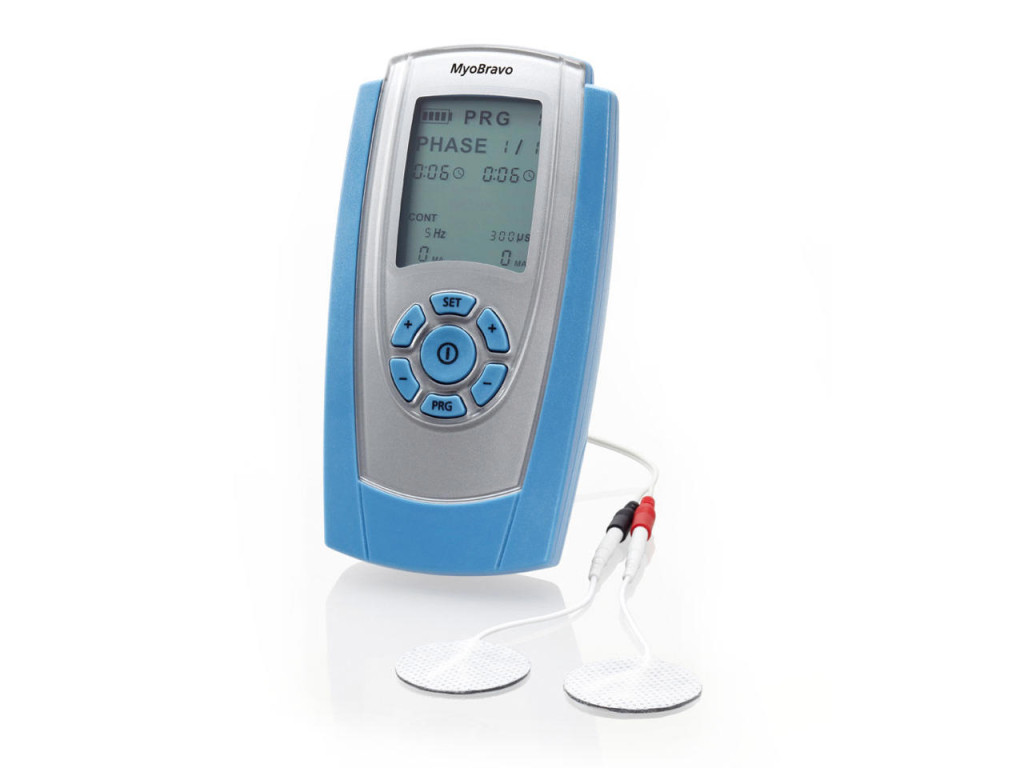
- 1 pc MyoBravo device (2-channel, 4-output)
- 4 pcs stimulating cables (for 4 electrode pairs)
- 4 pcs 40×40 mm adhesive TENS electrodes (for smaller areas)
- 4 pcs 40×80 mm adhesive TENS electrodes (for larger muscle groups)
- 4 pcs AA batteries (1.5 V)
- 1 pc user manual in Hungarian
- Carrying pouch (compact size, fits into a sports bag)
Adhesive electrodes: adhesion gradually decreases after 25–30 uses. Replacements in 40×40 mm and 40×80 mm sizes are available separately. After use, store them back on the protective foil.
AA batteries: 4 pcs included. Remove for long storage. For long-term daily use switch to NiMH rechargeable batteries.
Device cleaning: wipe externally with a dry or slightly damp cloth and mild detergent. Clean contact points (cable connectors) with a dry cloth.
Probe cleaning: pelvic probes (PeriSphera O, PeriProbe Analis) must be cleaned after each use for hygiene – with lukewarm soapy water or a special probe cleaner. Never boil or use alcohol!
To fully exploit the MyoBravo’s incontinence features the following accessories are recommended:
- PeriSphera O vaginal probe: for women, general incontinence treatment. Inserted into the vagina to directly activate the pelvic floor muscles.
- PeriProbe Analis anal probe: for fecal incontinence or male dribbling. Inserted into the rectum.
- Spare electrode sets: in various sizes, for replacement after 25–30 uses.
- NiMH AA rechargeable batteries + charger: for long-term daily use – more cost-effective than disposable AA batteries.
Probes have smoke-gold plating (very thin gold layer), so they are suitable for people with metal allergies.
Technical specifications – in detail
| Property | Value | What it means for you |
|---|---|---|
| Channels | 2 (A/B), 2 outputs per channel | 4 electrode pairs (8 electrodes) can be used simultaneously – the most in the MTR+ portfolio |
| Stimulation modes | TENS, EMS/NMES, FES | Sport + pain relief + functional stimulation |
| Number of programs | 31 preset + 3 custom (23 sport + 4 TENS + 4 incontinence + 3 PC1–PC3) | The full spectrum of classic home electrotherapy goals |
| Sport programs | 23 programs (the richest in the MTR+ portfolio) | Warm-up, capillarization, endurance, strength, explosiveness, regeneration |
| Incontinence programs | 4 (stress + urge + mixed + fecal) | Each incontinence type has a dedicated protocol |
| Channel synchronization | Synchronous or alternating | Agonist–antagonist pairs or bilateral treatment possible |
| Custom programs | 3 slots × 5 phases = 15 customizable phases | Physiotherapist can set individual protocols |
| Waveform | Asymmetric, rectangular, biphasic, zero DC | Even signal quality without polarization |
| Intensity | 0–90 mA | The highest intensity range in the MTR+ line (Dolito/Rehalito: 80 mA) |
| Frequency | 1–200 Hz | The widest spectrum in the MTR+ line (Dolito/Rehalito: 1–150 Hz) |
| Pulse width | 50–300 µs | Classic EMS/TENS range – for innervated muscle |
| Ramp-up time | 0.1–9.9 s | Gradual intensity increase at treatment start |
| Treatment time | 1 minute – 10 hours (with custom program) | Suitable for short acute treatments or long chronic protocols |
| Memory | 60-day treatment statistics | Treating physician or physiotherapist can check usage |
| Safety feature | Automatic drop to 8 mA when changing phases | Prevents accidental overstimulation |
| Display | LCD – shows timer + intensity | Continuous feedback on treatment status |
| Power supply | 4 × AA batteries (1.5 V) | NO battery charging – swap and use. You can switch to NiMH rechargeable cells. |
| Incontinence probes | PeriSphera O (vaginal), PeriProbe Analis (anal) – SOLD SEPARATELY | Smoke-gold plating – usable with metal allergy |
| Certification | CE 0123; Class IIa; ISO 13485:2021; MDD 93/42/EEC | European conformity, quality assurance |
| Manufacturer | MTR+ Vertriebs GmbH (Germany) | Manufactured according to German quality assurance standards |
 When NOT to use the MyoBravo?
The following situations may make electrotherapy treatment dangerous or cause adverse effects. If any apply to you, do not start using the device without consulting your treating physician.
- Wearing a pacemaker, implanted defibrillator (ICD) or any electronic implant – EMS/TENS impulses can interfere with their function
- Cardiac arrhythmia, myocardial damage or severe cardiovascular disease
- Pregnancy (especially treatment of the lower abdomen, abdomen and lumbar area is forbidden throughout pregnancy)
- Epilepsy or other seizure disorders of the nervous system
- Active malignant tumour disease near the treatment area
- Acute local inflammation or infection of the skin in the treatment area
- Deep vein thrombosis or known tendency to clot formation in the limb to be treated
- Skin injury, fresh scar or open wound in the treatment area (avoid until healed)
- Fever or acute infectious diseases
- Placing electrodes on the front of the neck (carotid sinus region), the skull or over the heart area – FORBIDDEN
- Reduced or absent skin sensitivity in the treatment area (e.g. diabetic neuropathy, sensory loss)
- Probe-based incontinence treatment: active vaginitis, vulvovaginitis, acute vaginal infection, prostatitis or acute ano-rectal inflammation are contraindications
- Children for unsupervised use (under 12 only with adult supervision and physiotherapist guidance)
Not sure? Consult your treating physician or physiotherapist before use – especially with chronic diseases, medication use or any implanted medical device. For incontinence treatment a gynecologist or urogynecology/urology consultation is recommended. Detailed information can be found in Dr. Zsolt Zátrok’s article on contraindications of electrotherapy: electrotherapy contraindications.
 Important information
The MyoBravo is a CE‑certified Class IIa medical device (CE 0123, according to MDD 93/42/EEC), intended for home use. Nevertheless, its use does not in any way replace medical diagnosis, a qualified physiotherapist’s individualized protocol or prescribed medication. The device is an adjunct tool to be used alongside existing therapy.
With new or worsening symptoms (persistent pain, numbness, weakness, worsening incontinence) always consult your treating physician — EMS/TENS does not replace medical evaluation and should not be used to “mask” symptoms that may indicate a more serious condition.
For incontinence treatment consult a gynecologist, urogynecologist or urologist to determine the correct probe type and protocol. Probe-based pelvic treatment can give significant results (especially for stress incontinence), but should be continued according to a specialist-set protocol.
When using sport EMS, always combine the treatment with classical training – it supplements, not replaces, exercise. EMS alone will not deliver full functional training results.
Only use original accessories; clean and replace electrodes and probes regularly (electrodes: replace after 25–30 uses). Always keep the device out of reach of children.
The information on this page is general in nature and does not replace individualized medical advice, diagnosis or treatment. Always consult your treating physician about your specific complaints.