 What happens after hospital?
A stroke is a life-threatening medical emergency that can only be treated in hospital. Most of what matters is decided in the first few hours after the emergency call. In the hospital ward, the immediate threat to life is addressed and your condition stabilised. This is followed by several days or weeks of hospital treatment, including physiotherapy and electrotherapy.
However, most patients go home once the life-threatening condition has been dealt with — even though their arms or legs do not move, they cannot speak, and they have other symptoms.
At this point, many patients and family members think, “That’s it; the rest is down to luck.” That is a mistake. The hospital phase is the acute, life-saving part. Regaining lost abilities — rehabilitation — begins afterwards, and it is measured not in weeks, but in months and often years.
 Key idea
The hospital deals with the acute phase. Restoring function takes long, persistent work, most of which happens at home, as part of everyday life — guided by a specialist, but with daily effort from you and your family. What matters is not the time spent with the therapist, but what you do on the days in between, when they are not there.
What is a stroke, and why can symptoms remain afterwards?
A stroke is a sudden disruption to the blood supply to the brain. There are two main types. Roughly 70–80% of cases are ischaemic strokes: a blood vessel in the brain becomes blocked — by a blood clot, narrowing of the vessel or an embolism — and nerve cells in the area deprived of blood supply die within minutes. The less common but often more serious type is a haemorrhagic stroke, when a blood vessel inside the skull ruptures and the leaking blood presses on and damages brain tissue. If the symptoms go away on their own within 24 hours, this is called a transient ischaemic attack (TIA) — it is not a “stroke you got away with”, but the strongest warning that the next one may cause lasting damage.
The area of the brain that is damaged determines which residual symptoms develop. If the motor cortex is affected, the arm and leg on the opposite side become paralysed (one-sided paralysis — hemiparesis). If the speech centre is affected, speech or understanding may be impaired. Balance, swallowing, vision, sensation, memory and thinking can also be affected — often several at once.
 What do the figures tell us?
Only a small proportion of people who have had a stroke get through it without residual symptoms. Most continue to live with damage ranging from mild to severe: many need outside help with certain tasks, and some need ongoing care. Two things can make a meaningful difference to these figures: getting to hospital quickly during the acute phase — and consistent rehabilitation every day for months after returning home.
One more important fact: a significant proportion of strokes could be prevented by reducing and managing risk factors. The most important are high blood pressure, heart disease — especially the heart rhythm disorder called atrial fibrillation — diabetes and smoking. If you have already had a stroke, this is not just theory: keeping your blood pressure and blood sugar under control and taking anticoagulant treatment as prescribed are just as much a part of recovery as exercise.
 Why is improvement possible?
Dead nerve cells do not “grow back”. However, the brain can gradually enable healthy areas around the damaged area to take over its functions. We call this ability neuroplasticity — all rehabilitation is built on this one quality. There are three things worth understanding about it.
The nervous system is not a rigid bundle of cables. If one pathway is interrupted, neighbouring areas may gradually take over its role in response to the right stimulation. But this requires trying the same movement many times, with a clear purpose and genuine intention. It is not enough for someone else to move your limb passively — your brain needs to send the “I want to move” command again and again, because this repeated signal is what starts the rewiring process.
In rehabilitation, what matters is not how many minutes you spend with your physiotherapist, but how many times in total you perform the targeted movement. Learning a movement again takes thousands of repetitions — one session a week with your therapist is not enough. Your physiotherapist’s real role is not to “exercise you”, but to teach you exercises and review them regularly so that you can do them many times a day when they are not there.1
The nervous system is most receptive to learning in the first few months after a stroke — during this time, the same amount of work may achieve the greatest gains.2 This does not mean the door closes after six months: progress slows, but persistent, targeted practice may still bring results later. The practical lesson is twofold: start as soon as possible — and do not stop, even if your stroke happened a long time ago.
First step: find a physiotherapist
Before buying any equipment, find a physiotherapist with experience in neurological rehabilitation. You do not need someone to “exercise you” now and then. You need a specialist who assesses your condition (which muscles move, the degree of spasticity, your balance), puts together a programme you can do at home, teaches you how to perform the exercises correctly — it is very difficult to correct a poor movement pattern later — and adjusts and progresses the exercises at regular check-ups.
The hour with your therapist is the lesson: that is when you work out what to do and how. The real work happens in between, when you repeat the exercises you have learnt several times a day in short sets. If you cannot find a local therapist, ask your doctor or the rehabilitation ward for a recommendation — online consultations and exercise checks guided by video call are now realistic options.
Stages of rehabilitation
Recovery is not one long march, but a series of stages that build on one another. Each has a different goal — and different tools may help.
| Stage | What do you experience? | What is the goal? | What may be considered? |
|---|---|---|---|
| 1. No voluntary movement | The limb does not respond, however hard you try | Maintain joint range of motion and circulation, protect muscle mass | Electrical muscle stimulation (NMES), passive ergometer, passive movement, massage |
| 2. A gross movement appears | You can make a weak, awkward movement, but it is unreliable | Link intention to movement and relearn movement patterns | ETS (EMG-triggered stimulation), active-passive ergometer, light-resistance exercise band |
| 3. Movement becomes more reliable | You can do it, but tire quickly and have little strength | Gradually rebuild muscle strength and endurance | Active ergometer, bands with increasing resistance, wrist and ankle weights |
| 4. Fine motor skills and coordination | You can make large movements, but cannot fasten a button | Finger movement, grip, balance and safe walking | Finger trainer, hand-strengthening and massage balls, balance-training equipment |
 Do not skip a stage
Introducing strong resistance too early or skipping a stage will not speed up recovery. It may reinforce a poor movement pattern, increase spasticity and overload your shoulder or knee. Your therapist should always set the pace of progress.
What can you do in different situations?
Stroke symptoms vary, and each calls for a different approach. Open the section that applies to you.
The problem is not the muscle — the nerve signal is not reaching it. Electrical muscle stimulation (EMS/NMES) provides the stimulus from outside that your brain cannot currently provide: the muscle contracts and the fibres work, which may help slow muscle wasting and maintain circulation. Very important: while the stimulation is on, also try to make the movement voluntarily — this links your intention with the movement you feel.
This is a turning point. This is where ETS, or EMG-triggered stimulation, comes in: the device detects the muscle’s own electrical signal and, when you try to move your limb, “boosts” the weak attempt — so the movement actually happens. This is fundamentally different from simple muscle stimulation: your intention starts the process, so your brain receives feedback that the command worked.6 Light-resistance band exercises can also begin at this stage.
Hand function usually returns later and with greater difficulty — this is one of the toughest areas of rehabilitation, and it needs separate, targeted attention. Finger trainers with different resistance levels help with bending and straightening; soft hand-strengthening balls help with gripping; massage balls help develop sensation in the palm and fingers. Short, frequent sets are most useful: a few minutes several times a day is better than one long session a week.
Pedalling while seated on an ergometer requires rhythmic, alternating leg and arm movements similar to walking, but without the need to balance, so the risk of falling is much lower. This makes it a good starting point when walking practice is not yet safe.3 As you become more stable, you can try balance-training equipment — but only with supervision and near something to hold on to: falling is one of the most serious risks after a stroke. I have written a separate article about ergometers: Ergometers in home rehabilitation →
Spasticity often develops after a stroke: the muscles on the affected side become unusually tight — the arm and hand pull into a bent position, straightening the elbow is painful, and the foot points downwards. Electrotherapy may help when opposing muscle pairs (the flexors and extensors) are treated together in a coordinated way — this requires multiple channels. Always leave the choice of programme and electrode placement to a specialist.
A painful shoulder after a stroke is very common, and there is a reason for it: the muscles that stabilise the shoulder weaken, so the weight of the upper arm slowly pulls the humerus out of the socket (this is called subluxation, or partial dislocation). Properly supporting and positioning the affected arm is essential — never leave the paralysed arm hanging down. In addition, electrical stimulation of the shoulder muscles in the early period may measurably reduce subluxation.10 This is another area where you should learn electrode placement from a therapist.
Pain after a stroke can have several causes: changes in posture and muscle tension, poor circulation, or the damage to the nervous system itself (so-called central, neuropathic pain). TENS may help as an additional option for suppressing pain signals, while microcurrent (MENS) may support tissue recovery — both are available in multi-function electrotherapy devices. For altered sensation, regular stimulation (electrical stimulation and sensory practice with massage balls) may bring gradual improvement. If the pain is new, severe or changing, always discuss the cause with your doctor first.
After a stroke, control over the bladder may be affected temporarily or permanently. This is an area that can be treated: targeted pelvic floor muscle exercises and electrotherapy (sometimes with a biofeedback device) may significantly improve your ability to control bladder function. It is a sensitive subject, so many people do not even discuss it with their doctor — yet it is just as much a function that can be rehabilitated as movement in the hand or leg. Tell your doctor and ask for a targeted programme.
Swallowing difficulties are not just inconvenient; they pose a serious risk: inhaling food or liquid can cause pneumonia, and malnutrition is also a real danger. Do not try to work this out at home. You need a speech and language therapist or a specialist in swallowing therapy, who will assess you, determine safe food and liquid consistencies, and teach you the right techniques. There are also targeted neuromuscular electrical stimulation devices for swallowing rehabilitation — such as Ami Pro and Ami Life — but these may only be used following specialist assessment and under specialist guidance. Ask your doctor or swallowing therapist whether they may be suitable in your case.
There are several types of speech disorder. With aphasia, finding and understanding words is difficult — reading and writing may also be affected. With dysarthria, weakness in the muscles used to form speech makes it hard to understand. The two require completely different therapies, and assessment is the speech and language therapist’s job. What family members can do: speak to the person normally, give them time to answer, do not finish their sentences for them, and do not avoid conversation. Withdrawing and becoming isolated reduces the chances of recovery.
Loss of part of the visual field (hemianopia) or double vision may improve on its own in the months after a stroke; an ophthalmologist and vision training may help with any remaining problems. Problems with cognitive functions — attention, memory and planning — can also be addressed through rehabilitation: cognitive training led by a neuropsychologist is just as much “exercise” as physical training. Mood needs particular attention: depression is very common after a stroke. It is not a weakness, but a condition that needs treatment. It matters because losing motivation can stall the whole rehabilitation process. If you notice that you or a family member has had no interest in anything for weeks, talk to your doctor — treating mood is also key to recovering movement.
 Home equipment for daily practice
Equipment will not solve anything on its own — daily repetition does. Equipment makes it possible for you to do the exercises prescribed by your therapist at home, on your own schedule, and many times over. You do not need to buy everything at once: in the first few months, a basic multi-channel device is an obvious starting point. An EMG-triggered (ETS) device usually comes later, when the first voluntary movements appear — make this decision together with your therapist.
Premium 400 electrotherapy device
 A four-channel basic device for the first few months: EMS/NMES programmes to maintain muscle function when the nerve signal is not yet getting through, FES for functional stimulation, TENS for pain, and microcurrent to support tissue recovery. Four channels are also enough to treat opposing muscle pairs for spasticity. A similar alternative is the Genesy 300 Pro.
DuoBravo N biofeedback + ETS device
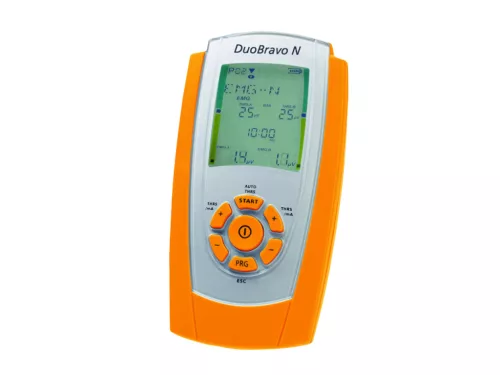 A two-channel neurorehabilitation device that combines three modes: EMG measurement (feedback on muscle activity), conventional muscle stimulation, and EMG-triggered stimulation (ETS), which responds to your own, still-weak attempts to move. It usually becomes relevant several months after a stroke, when at least some voluntary movement has returned. Leave the settings to a specialist.
OxyCycle 3 active-passive pedal exerciser
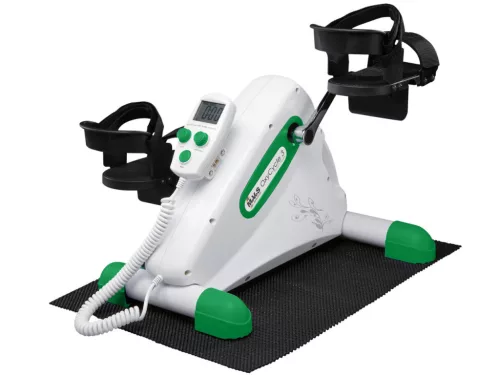 An ergometer for arm and leg exercise that you can use safely while seated. In passive mode, the motor moves your limb, so you can use it in the early stages too. As you get stronger, you can gradually take over the work. It is a step towards walking, without the risk of falling. More models: Ergometers category →
Moves Flex-Ion finger and hand strengthener
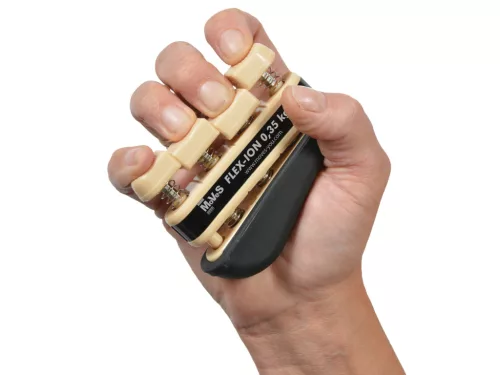 A trainer designed specifically to rebuild isolated finger movement and hand strength. Its six colour-coded resistance levels let you start at the gentlest setting (0.35 kg per finger) and progress step by step. Hand function is the slowest area of rehabilitation — this device is for short, frequent daily sets.
 Before you start treatment at home
There are situations in which electrotherapy devices cannot be used, or can only be used with medical approval. Check whether any of these apply to you:
- Implanted active electronic device – home electrotherapy is generally not recommended if you have a pacemaker, defibrillator (ICD), neurostimulator or insulin pump.
- Unstable heart or circulatory condition – uncontrolled high blood pressure, a recent cardiac event or unexplained chest symptoms require medical assessment first.
- Epilepsy – only after consulting a specialist.
- Active or unexplained tumour in the treatment area – stimulation should be avoided.
- Recent deep vein thrombosis or acute vascular inflammation – stimulation and intensive movement of the affected limb are prohibited.
- Damaged or inflamed skin at the electrode site – do not place electrodes over an open wound, eczema or a recent surgical scar.
- Fever or acute infection – suspend exercise and treatment until you have recovered.
- Carotid artery area – never place electrodes on the front or side of the neck, over the carotid artery.
Recognise the signs of another stroke
Anyone who has had a stroke is at higher risk. If you suddenly notice facial drooping on one side, new weakness in an arm, halting or nonsensical speech, sudden loss of vision, or an inability to walk with dizziness: do not wait or see if it passes — call 112.
Important information
Home therapy devices are intended to complement rehabilitation guided by a specialist — they do not replace your physiotherapist or doctor. Keeping your blood pressure and blood sugar under control and taking anticoagulant treatment as prescribed are just as much a part of recovery as exercise.
 What does the research say?
“Does it really matter how many times I do the same exercise?”
Yes — and this is the most important, yet least often stated, message in rehabilitation. According to comprehensive analyses, targeted practice that repeatedly imitates real everyday movements may improve walking, standing up, walking distance and self-care. The researchers themselves say that future assessments should measure not the minutes spent in therapy, but the number of repetitions actually completed — because that is what the effect is linked to.1,8
“Is it too late if my stroke was six months ago?”
It is not too late, but timing matters. In a carefully designed study, patients received the same additional amount of practice at different times: the greatest gains came in the second or third month after the stroke, slightly smaller gains in the first month, and after six months there was no measurable difference compared with usual care.2 The lesson is not that there is nothing to do after six months — but that the same effort achieves much more when started early. Later on, more persistent practice is needed to achieve the same results.
“Is pedalling worthwhile if I can barely move my leg?”
Yes. Ergometer training is one of the most studied forms of exercise after a stroke: it may have a positive effect on walking ability, lower limb muscle strength, balance and cardiorespiratory endurance.3 In the acute phase, physiotherapy combined with an arm ergometer improved muscle strength, trunk control and independence more than physiotherapy alone.4,5 If your leg is not working yet, several studies have found pedalling supported by electrical stimulation promising for improving motor function.9
“Why is ETS better than standard muscle stimulation?”
Because it links the stimulus to your own intention. Comparative analyses suggest that stimulation methods triggered by the patient’s own attempt to move (or movement on the unaffected side) produced better results in several areas than stimulation delivered at a preset rate — including upper limb movement and everyday activities.6 At that point, the brain receives feedback: the command arrived and it worked.
“Is a resistance band enough, or do I need more intensive exercise?”
Resistance training — even with a simple band — may have a positive effect on muscle strength and motor function. And here is an important result that will reassure many people: analyses did not confirm the old fear that strength training increases spasticity.7 The key is to progress gradually: start with the lightest band and move up only when the movement remains smooth and controlled throughout.
“What can I do about a painful shoulder after a stroke?”
According to a review of the studies, electrical stimulation of the shoulder muscles may measurably reduce partial shoulder dislocation (subluxation) when used in the early months — this effect was not seen in the chronic phase.10 So the message is the same as in rehabilitation as a whole: do not wait. Properly supporting the arm and protecting the muscles early on work best together.
 Practical advice for everyday life
Several short sessions are better than one long one. Four or five sessions a day, each lasting 10–15 minutes, mean more repetitions and less fatigue than a single one-hour session. Practising until you are exhausted makes the movement less effective — and a poor pattern may become ingrained.
Keep a diary. Write down what you did and how much each day. Your therapist can use this to adjust the programme, and you can look back and see progress that you might not notice from one day to the next. Losing motivation is one of rehabilitation’s biggest enemies — a diary is the cheapest weapon against it.
Build movement into your day. The most useful repetitions do not happen during “exercise time”, but when you try to pick up a glass, open a door or stir your tea with the affected hand. Your brain regards what you use in everyday life as important. Automatically favouring the unaffected side is one of the worst habits you can develop.
An honest word about expectations
I do not want to sugar-coat it: without regular practice, meaningful improvement “just happening on its own” is almost certain not to occur. At the same time, persistence does not mean that every lost ability will return completely — this is also affected by the location and extent of the damage, your age and other health conditions, some of which no one can change. What is in your hands is whether you start in time, find a good specialist, and do the exercises even on days when you do not feel like it. This is no guarantee — but it is the chance you can give yourself.
Frequently asked questions
There is no finish date. The fastest improvement happens in the first few months, but you need to continue practising afterwards too — many people work for years to regain particular functions. Rehabilitation is more of a way of life than a course of treatment: if you stop, the abilities you have regained may also decline.
Your physiotherapist’s role is to teach and monitor: they assess your condition, correct your technique and adjust the programme. You need to do the actual repetitions on the days in between. Results do not depend on how often your therapist visits, but on how often you repeat the exercises between sessions. You will need their support more often at first, then less often as time goes on.
EMS/NMES contracts the muscle at a preset rate — even if you do nothing. This is useful when there is no movement at all. ETS detects the muscle’s electrical signal and only switches on when you try to make the movement — it boosts your own, still-weak attempt. This is used when at least a little voluntary movement has returned.
When you can turn the pedals or hand grips by yourself, without assistance. The transition does not happen overnight: with combined active-passive devices, you can gradually reduce the machine’s input and increase your own. Your therapist will set the device according to your current condition.
Your therapist should decide this. According to research, resistance training generally does not increase spasticity, but poor technique may make things worse. The rule is: always start with the lightest band, and only move to a stronger one if the movement remains smooth and controlled throughout.
Review the programme with your therapist: are you doing enough repetitions, is the difficulty appropriate, and has an incorrect movement pattern become ingrained? It is important to know that at a later stage, progress often shows not in muscle strength, but in the accuracy or speed of movement, or in reduced fatigue — changes that are hard to notice from one day to the next. This is another reason to keep a diary: look back and you will see the real progress you have made.
 Summary – At a glance
Sources
- French B, Thomas LH, Coupe J, et al. (2016). Repetitive task training for improving functional ability after stroke. Cochrane Database of Systematic Reviews. PubMed: 27841442
- Dromerick AW, Geed S, Barth J, et al. (2021). Critical Period After Stroke Study (CPASS): A phase II clinical trial testing an optimal time for motor recovery after stroke in humans. Proceedings of the National Academy of Sciences. PubMed: 34544853
- Veldema J, Jansen P. (2020). Ergometer training in stroke rehabilitation: systematic review and meta-analysis. Archives of Physical Medicine and Rehabilitation. PubMed: 31689416
- da Rosa Pinheiro DR, Cabeleira MEP, da Campo LA, et al. (2021). Upper limbs cycle ergometer increases muscle strength, trunk control and independence of acute stroke subjects: a randomized clinical trial. NeuroRehabilitation. PubMed: 33998550
- da Rosa Pinheiro DR, Cabeleira MEP, da Campo LA, et al. (2021). Effects of aerobic cycling training on mobility and functionality of acute stroke subjects: a randomized clinical trial. NeuroRehabilitation. PubMed: 33386826
- Halawani A, Aljabri A, Bahathiq DM, et al. (2024). The efficacy of contralaterally controlled functional electrical stimulation compared to conventional neuromuscular electrical stimulation for recovery of limb function following a stroke: a systematic review and meta-analysis. Frontiers in Neurology. DOI: 10.3389/fneur.2024.1340248
- Veldema J, Jansen P. (2020). Resistance training in stroke rehabilitation: systematic review and meta-analysis. Clinical Rehabilitation. PubMed: 32527148
- Sabbahi A, et al. (2025). Intensity of task-specific training for functional ability post-stroke: systematic review and meta-analysis. Clinical Rehabilitation. PubMed: 40576954
- Ferreira LGLM, et al. (2023). Cycling using functional electrical stimulation therapy to improve motor function and activity in post-stroke individuals in early subacute phase: a systematic review with meta-analysis. BioMedical Engineering OnLine. DOI: 10.1186/s12938-023-01195-8
- Lee JH, Baker LL, Johnson RE, Tilson JK. (2017). Effectiveness of neuromuscular electrical stimulation for management of shoulder subluxation post-stroke: a systematic review with meta-analysis. Clinical Rehabilitation. PubMed: 28343442