
 What does peripheral neuropathy mean?
Peripheral neuropathy is a form of damage to the peripheral nervous system. It affects the nerves that transmit information from the brain and spinal cord (the central nervous system) to the rest of the body and back.
Neuropathy most commonly results from diabetes, autoimmune disease or alcoholism. It can also be a frequent side effect of chemotherapy and radiation therapy. Some forms are hereditary, while others develop due to injury.
There are more than 100 types of peripheral neuropathy, each with its own symptoms and prognosis. They are classified into the following categories:
- Motor neuropathy: Damage to the nerves that control muscles and movement — for example, affecting hand and arm movements or speech.
- Sensory neuropathy: Sensory nerves that transmit signals for pain, temperature or touch.
- Autonomic neuropathy: Nerves that control functions you cannot voluntarily influence, such as breathing and heartbeat.
- Combined neuropathies: Two or three of the above types can be present simultaneously. An example is sensorimotor neuropathy.
 Key point
Peripheral neuropathy is not currently curable, but symptoms — especially pain — can be substantially relieved. In this article we present six scientifically investigated methods that can be used safely at home: TENS, microcurrent, softlaser, magnetic field therapy (PEMF), BEMER and muscle stimulator therapy.
Symptoms of peripheral neuropathy
Symptoms depend on which type you have and which part of the body is affected. They can range from tingling and numbness to burning pain or even paralysis:
- Burning, tingling pain, numbness, a "stinging" sensation
- Muscle weakness, cramps, muscle twitching, muscle mass loss (atrophy)
- Loss of bone mass
- Changes in the skin, hair or nails
- Loss of balance
- Emotional disturbances, sleep disorders
- Loss of pain sensation (dangerous — you may not notice injuries)
- Inability to sweat, causing sensitivity to heat
- Bladder control problems
- Dizziness from loss of blood pressure regulation
- Diarrhea, constipation
- Eating or swallowing difficulties
- In severe cases, breathing difficulty or irregular heartbeat
Diagnosis of neuropathy
The symptoms of peripheral neuropathy can resemble other conditions. Therefore, an accurate diagnosis is extremely important. If you suspect neuropathy, consult a neurologist! In many cases neuropathy is related to an underlying disease, so the physician may already expect its occurrence.
Prevention: the most effective approach
Lifestyle choices play a role in preventing peripheral neuropathy. You can reduce the risk by:
- Avoiding alcohol consumption
- Correcting vitamin deficiencies
- Eating a healthy diet
- Losing weight
- Avoiding toxins
- Exercising regularly
If you have kidney disease, diabetes or other chronic problems, lifestyle changes can delay or even prevent the development of neuropathy.
Treatment options — what you can do at home
Peripheral neuropathy is generally not curable, but its progression can be slowed and symptoms can be meaningfully alleviated. Drug treatments sometimes help and sometimes do not — this can require trial and error. The sections below review home physiotherapy methods that have scientific evidence.
We discuss six methods: TENS, microcurrent, softlaser, magnetic field therapy (PEMF), BEMER and muscle stimulators — all of which can be used safely at home.
 TENS treatment and neuropathy
What is TENS?
TENS (transcutaneous electrical nerve stimulation) is a pain-relieving procedure. It is important to emphasize: it provides symptomatic treatment — it does not repair damaged nerves, but helps reduce pain. It delivers small electrical impulses through the skin to the painful area, thereby "blocking" pain signals from reaching the brain.
What do the studies show?
“Can TENS really ease the burning pain in diabetic feet?”
According to international professional guideline reviews, yes — TENS is recognized as a effective method to reduce pain from diabetic neuropathy. This conclusion is supported by the American Academy of Neurology.1
“How much better is it than placebo?”
A summary study found that patients receiving TENS had significantly greater pain reduction than those receiving sham treatment — and this difference remained at 4–6 weeks follow-up.2
“Does it help chemotherapy-induced neuropathy?”
A recent 142-participant study (2023) reported that daily home TENS use produced promising relief of chemotherapy-induced neuropathy symptoms. The researchers recommend further confirmatory studies.3
“What does the independent Cochrane review say?”
The Cochrane Collaboration — one of the world’s most rigorous independent medical review bodies — concluded that TENS provides a meaningful short-term pain reduction compared with placebo in neuropathic pain.4
How to apply TENS treatment?
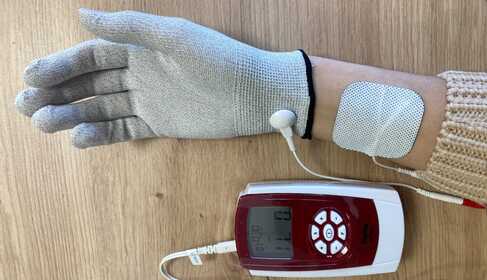
For neuropathy treatment, put on the glove or sock electrode on your hand or foot. You can use it dry, but the treatment may be more effective if you moisten it — dip it in lukewarm water, squeeze out the excess and put it on while still damp.
Stick an adhesive electrode above your wrist or ankle, 3–5 cm away from the edge of the glove/sock.
Connect the cable to the TENS device:
- Positive (red) cable end → glove/sock electrode
- Negative (black) → adhesive electrode
Start program 1 and increase the intensity gradually.
 Important safety warning
In severe neuropathy, due to damaged sensory nerve endings, you may not feel the electric prick of the current!
Safe intensity: Generally 8–18 mA is sufficient. Currents above 50 mA can cause skin burns — which you might not feel because of the neuropathy! Never increase treatment intensity unnecessarily.
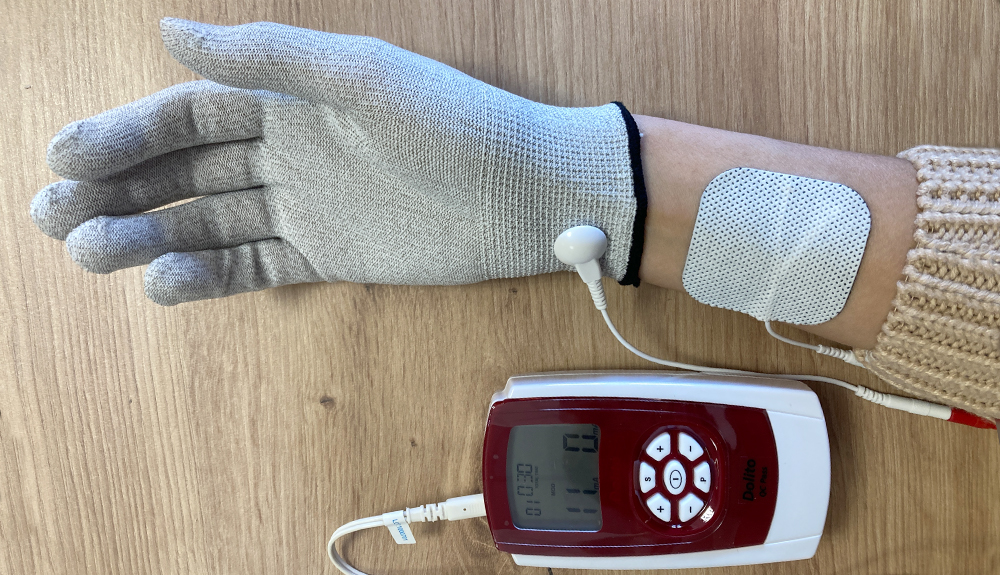
The same application method can also help reduce pain from rheumatoid small joint inflammation.
Which TENS devices are suitable?
For relieving neuropathic pain, the simplest TENS devices are also suitable. There is no need for expensive, high-priced machines.
Dolito TENS device
Simple, reliable entry-level model — the most common choice for home neuropathy treatment.
Myolito TENS/EMS device
TENS + muscle stimulation (EMS) function in one device — useful if muscle weakness is a concern.
Required accessories:
Microcurrent therapy — the gentler sibling of TENS
What is microcurrent?
Microcurrent therapy (MET) uses electrical current like TENS — but a million times more gently. It works with such tiny currents (measured in millionths of an ampere) that you do not feel the treatment. This makes it attractive for neuropathy patients: the tingling sensation of TENS can be too strong for some, or conversely — due to damaged nerve endings — they may not feel the effect of TENS properly, which can lead to overadjustment of the device.
Microcurrent does not work by overriding pain signals; it supports regeneration at the cellular level. Research suggests it may aid ATP production (the cell's energy source) and favorably influence the biochemical processes of nerve regeneration.
What do the studies show?
“Can it help if I can't feel anything?”
Yes — microcurrent is often a better choice in severe neuropathy precisely because it does not aim to rewrite pain perception. Clinical trials in diabetic neuropathy patients have observed pain reduction and improved sensation without side effects.
“When should I choose microcurrent over TENS?”
Choose it if TENS feels too strong (the tingling bothers you), or if you do not feel TENS due to nerve damage and fear setting the device too high. Microcurrent is safer for those with reduced sensation.
How to apply?
Microcurrent devices use adhesive electrodes. Glove and sock electrodes cannot be used for this type of treatment. Treatment duration is usually 20–40 minutes, once or twice daily.
Softlaser therapy and neuropathy
What is softlaser (photobiomodulation)?
Softlaser therapy — scientifically called photobiomodulation — uses low-energy red or near-infrared light to stimulate tissues. The light penetrates the skin and is absorbed in the cell's small "power plants" (mitochondria). Here it can increase ATP production (cellular energy), reduce inflammation, and support nerve regeneration processes.
What do the studies show?
“Can light help the tingling in your foot?”
A summary of several trials in diabetic neuropathy patients found that softlaser can reduce pain, improve sensory recovery and enhance daily quality of life. The effect is not immediate — many experience benefits after 4–8 weeks of regular treatment.5
“What are researchers investigating now?”
A planned comprehensive 2022 review is collecting data from 8 international scientific databases on the effectiveness and safety of laser/photobiomodulation in diabetic peripheral neuropathy — indicating substantial scientific interest.6
“Can it help older patients?”
A 2025 case report described an 81-year-old diabetic man who experienced significant pain reduction and improved sensation after softlaser treatment. Although a single case, it suggests older patients may also respond well.7
Overall: The current scientific picture is promising, although researchers emphasize the need for larger trials to define optimal protocols.
How to apply softlaser treatment?
Laser treatment should be performed on the painful area, proceeding point by point. Treatment time depends on device power, laser beam diameter and the size of the treated area. Perform the treatment once daily.
Recommended softlaser devices
Personal Laser L400
Ideal for home use — compact, easy-to-use entry model.
Energy Laser L500
Higher power, faster treatment times — for more intensive use.
PEMF (pulsed electromagnetic field) therapy and neuropathy
What is PEMF?
PEMF therapy creates a pulsed electromagnetic field that penetrates skin, muscle and bone. At the cellular level it supports restoration of electrical potential, can reduce inflammation, and improve microcirculation (blood flow in the smallest vessels).
What do the studies show?
“How much can pain decrease with magnetic therapy?”
A rigorous study of 182 participants showed that diabetic patients receiving magnetic field therapy had their leg pain reduced by about a third compared with those receiving sham treatment. This is not dramatic, but a tangible everyday difference.8
“Do the nerve fibers heal with treatment?”
An earlier 225-participant trial did not find a clear difference in pain perception, but measurements of nerve fiber density showed promising signs — indicating effects at the tissue level. Researchers suggested higher intensity and longer treatment might yield better results.9
“Does nerve conduction improve with treatment?”
In a clinical trial with 121 diabetic polyneuropathy patients, PEMF treatment improved nerve conduction and reduced main clinical symptoms.10
“What does the 2025 review conclude?”
The latest comprehensive review reports that clinical trials consistently show PEMF therapy has anti-inflammatory and edema-reducing effects, improves microcirculation, and can reduce neuropathic pain.11
How does PEMF work in neuropathy?
- Restoration of cellular electrical balance: supports healthy cell function and regenerative capacity
- Inflammation reduction: lowers pain related to inflammation
- Microcirculation improvement: more oxygen and nutrients reach the tissues
Recommended PEMF devices
For neuropathy treatment, a PEMF device with general tissue regeneration or anti-inflammatory programs is suitable:
Magnum 2500
2-channel, 320 Gauss, 52 programs.
Magnum XL Pro
2-channel, 400 Gauss.
Magnum 3000 Pro
2-channel, 400 Gauss, 70 programs.
BEMER therapy and neuropathy
What is BEMER?
BEMER is a specific PEMF technology that primarily focuses on improving microcirculation. One of the main causes of neuropathy is slowed blood flow in the smallest vessels (capillaries), so nerves do not receive enough oxygen and nutrients. BEMER helps the rhythmic pumping movement of vessels at this level.
What do the studies show?
“Do I really sleep better because of it?”
A study of 658 patients found that after 6 weeks of BEMER use there was meaningful improvement in sleep quality, pain level and overall quality of life — including patients with various conditions.12
“Can it help complex regional pain syndrome?”
In a randomized, double-blind controlled pilot trial, BEMER therapy combined with rehabilitation produced better pain reduction and functional improvement for painful regional pain syndrome in both upper and lower limbs.13
How can BEMER help in neuropathy?
As microcirculation improves:
- More oxygen and nutrients reach damaged nerves
- Harmful breakdown products are removed faster
- It may support regeneration of nerve tissues
 Consideration
The BEMER device is not a cheap investment. However, those who can afford it may not only reduce neuropathy symptoms but also support any condition caused or worsened by reduced circulation.
Muscle stimulation (EMS/NMES) — against muscle loss
Why is it important to address muscle mass?
One serious complication of peripheral neuropathy is muscle wasting (atrophy): muscles lose mass and strength. Impaired proprioception can also lead to an unstable, stumbling gait — which can cause falls and fractures.
What do the studies show?
“Can a muscle stimulator prevent muscle loss?”
Several independent systematic reviews indicate that neuromuscular electrical stimulation (NMES) effectively prevents muscle mass and strength loss during immobilization.14
“What does a specific experiment show?”
In a study with 24 healthy young men, during 5 days of forced immobility the control group experienced a 3.5% muscle loss — while the group using muscle stimulation virtually did not lose muscle mass.15
“What does this mean for those who cannot move?”
A 2024 review concluded that NMES is particularly valuable for those who cannot perform regular exercise because of their illness. It can preserve muscle mass, prevent atrophy, and to some extent improve gene expression.16
Practical advice
The most effective prevention of muscle strength loss remains regular exercise: at least 30–40 minutes of walking or cycling daily. If you cannot do this for some reason, use a muscle stimulator.
Muscle stimulation does not replace movement, but it helps:
- Slow down or stop muscle strength loss
- With appropriate frequency, aid in regaining muscle strength
You can find muscle stimulators here.
In my article on strengthening the thigh muscles I present a program and suitable devices.
Vibration therapy — for balance
One of the most frightening symptoms of neuropathy is not the pain but the loss of balance. Many patients "do not feel" the position of their feet, so they often stumble, fear stairs, or are afraid to go out alone. Falls can cause hip fractures — which are life-threatening in older age.
What is vibration therapy?
You stand (or sit) on a special platform that produces gentle, rapid vibrations. The vibration stimulates sensory nerve endings in the sole, lower leg and knee — thereby retraining the body to sense correct position.
What do the studies show?
“Does it really improve balance?”
Research in diabetic neuropathy patients found that 8 weeks of regular vibration therapy measurably improved balance metrics. Other studies also reported pain reduction.
“Who benefits most?”
Those who not only have pain but also a reduced sense of safety — people who are afraid to go outside because they might fall. For them, vibration therapy offers a new option.
Vibration therapy is a complementary method — it can be used alongside TENS, PEMF and laser, not instead of them.
Other supportive methods
Relaxation, meditation, yoga
Relaxation techniques can help alleviate emotional and physical symptoms. For people living with chronic pain, stress management is an important part of comprehensive therapy.
Infrared heat therapy
Poor circulation in the lower limbs is often associated with neuropathy. Infrared heat therapy (e.g., infrared lamp, infrared sauna) creates deep tissue warming, which can improve peripheral blood flow and relieve the sensation of cold feet. It can be used as a complementary method alongside the therapies described above.
 Before you start treatment
To ensure safe use, it is important to know the contraindications. In the following conditions none of the presented methods should be used without consulting your physician.
Contraindications applicable to everyone
- Implanted pacemaker or defibrillator — TENS, PEMF, BEMER and muscle stimulators are all prohibited
- Insulin pump or other active electrical implant
- Pregnancy (especially over the abdominal area)
- Active bleeding or severe clotting disorder
- Active malignant disease in the treatment area
- Severe cardiac arrhythmia
- Active thrombosis
- Acute febrile infection
- Epilepsy
Modality-specific additional warnings
| Method | Additional warning |
|---|---|
| TENS, muscle stimulator | Never place electrodes on the head, the front of the neck (carotid) or directly over the heart |
| Softlaser | Direct irradiation into the eyes is prohibited — eye protection is required |
| PEMF / BEMER | For old (more than 10 years) ferromagnetic metal implants consult your physician |
| Microcurrent | Same contraindications as for TENS |
| Vibration therapy | Avoid after fresh bone fracture or recent surgical wound |
Detailed information on softlaser contraindications: Softlaser therapy contraindications
Possible side effects
The therapies listed are generally safe and well tolerated. Rare side effects may include:
- TENS: Skin irritation under electrodes, muscle fatigue
- Microcurrent: Typically no perceptible side effects (this is one of its major advantages)
- Softlaser: Mild warming sensation, temporary skin redness
- PEMF/BEMER: Rarely mild headache, dizziness
- Muscle stimulator: Muscle fatigue, soreness-like sensation
- Vibration therapy: Temporary numbness sensation in the sole
If you experience persistent or unusual symptoms, stop the treatment and consult your physician!
Further reading
Softlaser therapy can support the treatment of many other diseases and complaints. For an overview of all home application areas, read the Softlaser therapy at home — Treating diseases article.
If you are not familiar with the basics of softlaser therapy, start with the Comprehensive guide to softlaser therapy article.
 Summary — Quick overview
- TENS: pain relief with tingling electrical impulses
- Microcurrent: imperceptible cellular-level regeneration support
- Softlaser: red light–assisted nerve regeneration
- PEMF / BEMER magnetic therapy: microcirculation and inflammation reduction
- Muscle stimulator: prevention of muscle loss
- Vibration therapy: regaining balance
Frequently asked questions
TENS usually has the fastest effect (can be felt within minutes). Softlaser, PEMF and BEMER effects emerge gradually and become tangible after 4–8 weeks of regular treatment. Microcurrent also produces longer-term effects — but is safer than TENS in severe neuropathy.
Yes — in fact, the most effective approach is often a combination. For example: TENS during the day for pain, softlaser in the evening for the affected area, overnight PEMF/BEMER for the whole body. Do not use multiple devices at exactly the same time — leave 1–2 hours between them.
TENS effects are almost immediate but symptomatic — pain may return some time after treatment. Other methods (laser, PEMF, BEMER, microcurrent, vibration) tend to produce gradual and more lasting effects, usually after 4–8 weeks of regular use. Be patient — neuropathic regeneration is a slow process.
Yes. These physiotherapy methods are intended to complement pharmacological treatment, not replace it. Monitor blood glucose regularly — in some cases physiotherapy can improve insulin sensitivity.
Unfortunately TENS, muscle stimulators, PEMF and BEMER are all contraindicated with a pacemaker. One safe home option that remains is softlaser. Vibration therapy and infrared heat may also be safe, but consult your cardiologist first.
Current medical opinion is that neuropathy is not fully reversible — but progression can be slowed, symptoms can be substantially alleviated, and in some cases (e.g., neuropathy due to vitamin deficiency or alcohol) partial improvement can be expected after treating the underlying cause.
Sources
- Assessment: Efficacy of TENS in neurologic disorders. Neurology (2010). PubMed: 20018714
- TENS for symptomatic diabetic peripheral neuropathy: meta-analysis (2010). PubMed: 20510476
- Wireless TENS for chemotherapy-induced peripheral neuropathy: randomized controlled trial (2023/2024). PubMed: 37993030
- Cochrane Review: TENS for neuropathic pain in adults (2017). PubMed: 28944453
- Low-level laser therapy for painful diabetic neuropathy: systematic review. Diabetes & Metabolic Syndrome (2019). PubMed: 31405692
- LLLT for diabetic peripheral neuropathy: protocol for systematic review and meta-analysis. BMJ Open (2022). PubMed: 36104132
- Low-level laser therapy case report in an 81-year-old male with diabetic neuropathy (2025). Parker Journal
- PEMF for painful diabetic symmetric peripheral neuropathy: double-blind RCT. Journal of Diabetes Science and Technology (2023). PubMed: 37542366
- PEMF for diabetic neuropathic pain: 225-patient randomized trial (2009). PubMed: 19577022
- PEMF in management of diabetic polyneuropathy (Musaev et al.). PMC2812751
- PEMF and LIPUS in peripheral nerve regeneration — review. MDPI (2025). MDPI 26/19/9311
- BEMER therapy effects on sleep, pain and quality of life. Journal of Complementary and Integrative Medicine (2013). PubMed: 23940071
- BEMER for CRPS-I: randomized controlled pilot trial (2018). PubMed: 29985719
- NMES for muscle impairment: critical review (2017). PMC5683854
- NMES prevents muscle disuse atrophy. Acta Physiologica (2014). PubMed: 24251881
- NMES for physical activity benefits. Frontiers in Sports and Active Living (2024). Frontiers 2024