

Stagnating sports results… what could be the cause?
The stagnation of Hungarian sports results did not begin recently, but it has become truly noticeable over the past few years. For decades our athletes were among the world elite in canoe-kayak, swimming, fencing, gymnastics, modern pentathlon, wrestling, football, handball, water polo, sport shooting, and even athletics. Today — with one or two exceptional stars aside — victories have become rarer.

Nothing illustrates this better than the Olympic results. In Helsinki (1952) we won gold medals in 10 sports and collected 42 podium finishes across 16 sports. In Rio (2016) Hungarian golds came from only 3 sports. We won 15 medals in total, but from just 4 sports. If we add that Katinka Hosszú alone won 3 golds and 1 silver, and Danuta Kozák won 3 golds, the scale of the problem becomes clear.
Hungarian sport is currently being 'carried on the back' of Katinka Hosszú and a few other determined individuals. Their sensational performances at the Olympics and other competitions mask the fact that without them there would be a loud silence. Everyone hides behind their results, because this makes the drift away from the leading nations less visible.
Clinging to the past
When it comes to recreational sport it doesn't matter whether someone jogs, swims, cycles, plays football, wrestles or plays tennis — the important thing is movement, which is clearly the most effective long-term way to maintain health and even the best medicine for many diseases!
In elite sport, however, it seems we have fallen behind. We cling to selection and training methods that produced results in the middle of the last century, while the international field has long since taken a different path. Here are just a few examples of approaches that are rarely or scarcely used at home.
- Anthropometric selection based on a series of measurements. Clearly, not everyone can become a top-level long-distance runner or a top sprinter — these innate qualities can only be developed within certain limits. For example, someone born with a predominance of slow-twitch muscle fibers cannot become a world-class sprinter. With a lot of work they may reach the mid-field, but not the front. Does that sound harsh? Yes. Anthropometric assessments performed according to international standards protect the child (and the parents) from later disappointment. I have known many athletes whose parents pushed them into trendy sports; the wrong choice only caused frustration for both the child and the parents. Leave selection to the professionals!
- Individual training programs based on repeated tests of the cardio-respiratory and metabolic systems. Exercise testing systems provide excellent feedback on an individual's fitness. Based on these data the optimal training load can be planned. The idea that everyone should do the same training is wrong. Even in team sports this does not apply to physical preparation (I am not referring to tactical drills here).
- Use of motion analysis software. This is as important as using wind tunnels in car design. To achieve optimal progress and low energy consumption you need the right shape. In sport, posture, correct joint positions and movement analysis ensure technique can be honed to perfection. Incidentally, a correct movement pattern is also one of the most effective ways to prevent sports injuries.
- Application of the most modern training technology. The future of training is eccentric training, yet there is not a single such device in Hungary. I write about eccentric training in more detail below.
- maximizing regeneration. International practice widely uses cooling, muscle stimulation, compression therapy, ice massage or combinations of these for regeneration, because more effective muscle recovery allows for more intense training. More intense training leads to faster progress.
- Muscle stimulation effectively helps prevent tendon and muscle injuries and aids recovery and rehabilitation. Used after training it removes 30–50% of metabolites, thereby accelerating recovery. It can be deployed to shape lagging muscles that are hard and slow to correct with conventional training.
Regular use can 'reach into' muscle-fiber-specific capacities (endurance, stamina, strength, explosiveness) and optimize and fine-tune them. Our capacities, which are encoded in the red-white muscle fiber ratio, can only be developed by conventional training within certain limits. Muscle stimulation provides an extra that can be measured in seconds, centimeters and performance improvements compared to yourself. - Use of modern medical technology. Effective recovery from injuries can begin immediately with modern rehabilitation tools (muscle stimulation, softlaser, therapeutic ultrasound, eccentric training, etc.). You don't have to wait for wound healing, or to ditch the crutches.
Of course, you must know exactly what, with what and how you do things, but under professional guidance this is not a problem. In the West every club employs movement and physical therapists! Their role is not only to treat injuries but also to prevent recurrent injuries by setting the correct movement patterns. If someone repeatedly injures the same body part, it indicates a weak point that must be strengthened and focused on. - Scientifically planned nutrition, supplements and hydration. One could say a lot about this. A state of ignorance prevails. Most sports diets are built on meat-meat foundations… meanwhile the World Health Organization has put processed meat on the list of the most dangerous carcinogenic substances… alongside asbestos and plutonium… Food for thought.
Note: In this article I talk about elite sport and exclusively about those legally applicable methods and devices that are widely used to improve performance. Unfortunately, most coaches and athletes at home have not even heard of many of these and even fewer use them consciously.
I'll run one more lap! I'll pedal a few more kilometers! I'll swim a few more lengths!
I have spoken with many coaches who insist on the sentence above — sadly this includes members of the younger generation as well. They use the best mobile phones, wear the trendiest running shoes, yet they remain stuck somewhere in the past. They copied what their predecessors did and apply the same methods. But these clearly no longer work, as the elite field is quickly moving away from us in almost every sport. You can no longer train with the hope of success using Alfred Hajós' preparation methods.
Today it's not enough to run one more lap, pedal a few more kilometers or swim a few more lengths! EVERYONE DOES THAT! Success requires more.
New methods must be integrated, applied and further developed
Katinka Hosszú became outstanding precisely because she abandoned the old mentality of training and, together with her coach, found a more modern and effective approach. I remember her exchange of messages with leaders of the swimming federation. Most of the 'experts' there didn't even understand what it was about, which illustrated the state of knowledge in the profession.
She had two essential requests. She asked for an underwater motion analysis system in the pool (available to every competitor) — such systems have been used for years in medicine, movement rehabilitation and, of course, in perfecting athletes' movements worldwide (but not here).
Her other request was to create conditions in the pool for post-training rest — in reality for a muscle recovery protocol. Few people understood this request, although the Ironlady often posted about her post-training 'cooling in icy water'. Even though she smiles in the pictures, this is not idle splashing or mere showmanship — it is much more. Ten to fifteen minutes of cooling provides huge help for muscles to recover after training. Katinka was often seen in a bin or a plastic barrel. In proper facilities there are special ice baths for athletes so that this muscle recovery treatment can be done as soon as possible after training. The pool where the multiple Olympic champion and her teammates train does not have such equipment — nor is there a Hungarian gym that does. Undignified conditions.
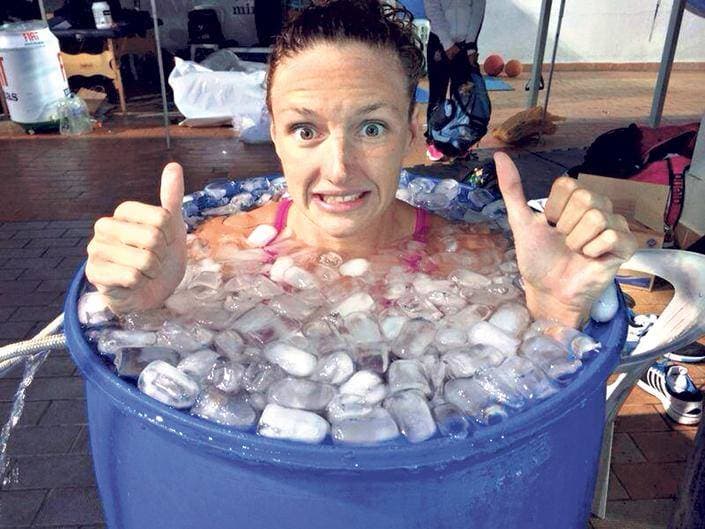
Not more training, but training more effectively!
The more time we spend training, the more serious the consequences for our bodies. Muscle work requires energy, which the body produces by breaking down various substrates. This process generates a significant amount of metabolites (metabolic waste products, such as lactic acid), which accumulate in the muscle. The longer we train, the more accumulates. The more there is, the more it impairs muscle performance and the efficiency of training. In other words, we can force long, 'lactate-rich' sessions, but our muscles' performance weakens during the workout. Efficiency decreases and injury risk rises. Low-intensity training improves endurance, but only to a limited extent (see also the Hennemann principle).
For effective muscle performance the metabolites must be removed from the muscles. The usual method is rest. The faster a muscle rests — i.e. the faster it regenerates — the sooner it is ready for another intense session.
It follows that one of the most important intervention areas for improving performance is helping, improving and accelerating muscle recovery.
If you've seen footage inside a cycling team's bus after a Tour de France stage, you may have noticed every athlete has their own recovery seat where the recovery protocol starts immediately. Some have masseurs working on their muscles; if no hands are available, they use a muscle stimulator or a compression device or ice massage. They cool the muscles, promote the clearance of metabolites and reduce the inflammatory processes triggered by the load.
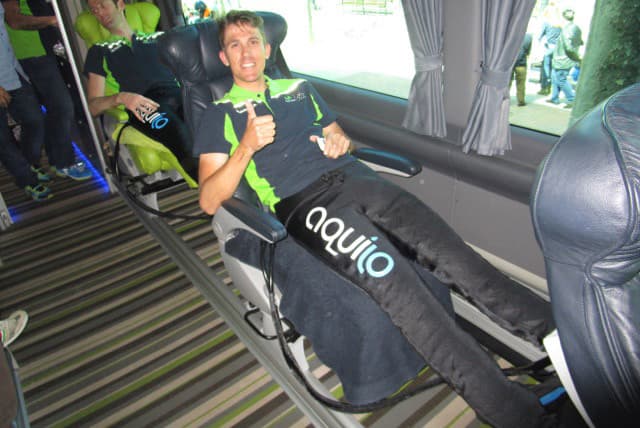
During intense training other things also happen to the muscles. Effort causes many muscle fibers to tear and creatine kinase is released; its accumulation also harms muscle efficiency. The muscle becomes stiff and fatigued. The fiber tears are, however, very important because they signal the body to build stronger, thicker, more resilient fibers. This is a cornerstone of muscle growth and strength gain.
The healing of torn fibers begins with an inflammatory process during the first 2–3 days. Only after this does actual repair begin. Cooling followed by rewarming (and thus increased circulation) very effectively reduces the amount of stiffness-causing creatine kinase and moderates/shortens the inflammatory process. Recovery accelerates, stiffness decreases and injury risk falls.
Recovery practices should be applied within a maximum of 2 hours after physical exertion — that is, it is worth starting immediately after training or competition.
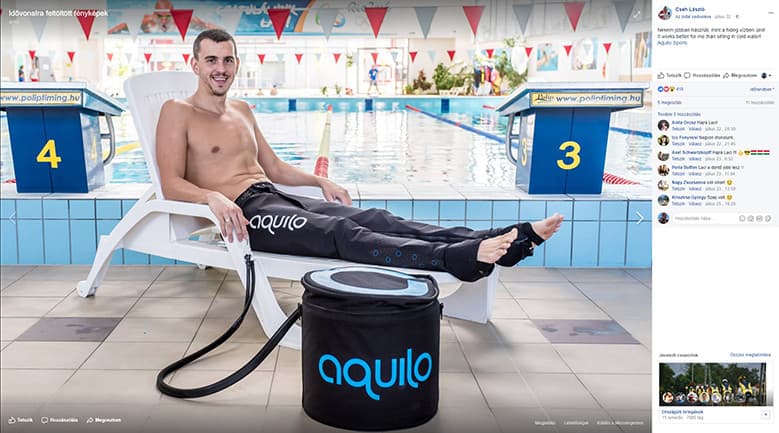
Eccentric training – the future of training
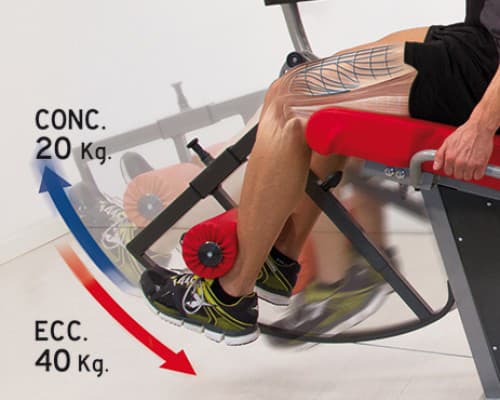
The Kineo training robot lets you use different loads in the concentric and eccentric phases of a movement
Already in the mid-1800s it was observed that during the eccentric phase almost twice the load can be handled than during the concentric phase. To make it clear: a concentric movement is when, for example, you lift a weight with the quadriceps. Eccentric is when you lower it. If you can concentrically lift 20 kg with the quadriceps, you can often lower 35–40 kg comfortably. That means with traditional (fixed) weight machines we actually use only a small fraction of our real muscular capacity.
It is known that with conventional weight training it takes about 6–8 months to achieve a 10% increase in strength. With eccentric training you can reach this in 5–6 sessions (!!!). Another great advantage of eccentric training is that its effects are long-lasting. You have surely experienced that if you miss training for 2–3 months due to injury or illness, much of the hard-won strength gains disappear and you have to start over. With eccentric training, however, more than 50% of the gain remains even after a six-month break!
That is an enormous difference.
What is the problem? With traditional free weights you cannot execute sufficiently effective eccentric loading. You would need, for example, to bench-press 120 kg, then have two assistants quickly add another 80 kg for the lowering phase — and then remove it again for the press.
Of course that method belongs to the past, because many major training centers around the world already use devices such as the Kineo training robot. These do not use simple weights; electric motors regulate the load in any phase of the movement. For example, you can set different loads for squatting down and standing up. You can even change the load during certain phases of the movement. Such devices are used in the training centers of Barça, Internazionale, Boca Juniors, for example.
The Kineo training robot lets you use different loads in the concentric and eccentric phases of a movement
Naturally, these devices also require knowledgeable operators. It is not enough to just switch on the computer-controlled Kineo. You must know what you are doing and why. It's not enough if Old Uncle Pinyó drags a ball-filled sack out onto the field from the equipment shed.
Sport muscle stimulator. An effective training partner with many functions.
Muscle stimulation has been used for decades in medicine to strengthen muscles (it even helps maintain tone and mass in spinal injury patients) and to make rehabilitation of sports injuries more effective. Increasing knowledge is accumulating about the method's application in sport. It's time Hungarian athletes took it seriously.
I am not referring to speed fitness suits here — although I consider them excellent for general fitness — but because of their general-purpose nature they are not suitable for the subtleties of improving muscle-group-specific endurance, stamina, strength, speed or explosiveness (which may be needed depending on muscle-fiber ratio and chosen sport).
Physiotherapy lab in your pocket
An individual sports muscle stimulator is a 'physiotherapy lab'. Muscle stimulators do not replace training but add new value — I believe considerably more than what a half-kilo lighter (but half-a-million more expensive) bike would improve your time, or what shaving chest and leg hair would do for your performance.
For the professional athlete, muscle stimulators can help most by improving muscle recovery. Moreover, the effect is noticeable after the first use and convinces you to take the application more seriously.
If you are short on time (no time to train twice a day), you can give the most important muscles for your sport a second, stimulator-based session. For swimming you can develop the endurance, stamina or strength-speed of the back and arm muscles that provide propulsion, depending on the distance. For running or cycling you can influence the strength or endurance of the leg muscles — and in ways that conventional training cannot.
With proper settings, muscle stimulation yields performance improvements even for regularly training athletes. For someone training 4–5 times a week, stimulation can provide a 15–20% strength gain.
Read my write-up on my 'self-experiment' demonstrating the performance-enhancing effects of muscle stimulation!
Finally, in case of injury or pain the rehabilitation functions help achieve effective recovery. Anywhere, anytime. The most thorough athletes (for example Lionel Messi after his 2018 injury) even begin pre-training warm-up with muscle stimulation to avoid injuries to cold and still-stiff muscles and ligaments.
Technology helps achieve better sports results
It is obvious to most that quality sportswear, better and lighter running shoes, a quality bicycle, etc., provide clear advantages in comfort and performance and also help prevent injuries. Think, for example, of the performance improvements caused by the shark-skin swimsuits.
It is hard for me to understand that while athletes widely adopt advanced sportswear and better bikes, they cling to old and outdated 'stone-age' methods when it comes to shaping their own bodies and improving their capabilities.
I mentioned Katinka Hosszú earlier, who revolutionized her own training. There are many components to her success, but one thing is certain: by increasing the effectiveness of regeneration she can undertake more intensive training than others, and her results speak for themselves.
The power of change and the fear of the unknown
It is an old truth that continuous change drives the world forward. If it were otherwise, Katinka Hosszú would be just another moderately successful swimmer. But that didn't happen. She changed and achieved success.
Fear of the unknown is natural. New things were always greeted with skepticism in the past. The first automobile was ridiculed by high society and was overtaken by their horses. Twenty years ago the first mobile phone came with a backpack to carry its multi-kilogram battery. We could list examples, but what's the point? Cars and mobile phones have become indispensable tools, their capabilities far exceed those of the first generations. The same applies to technologies that help sport.
History has shown that good methods should not be denied or rejected but adopted and applied. It is never too late to take the first step.
Our elite athletes' declining results show that the time has come…

