
 What is lipedema and why does the stage matter?
Lipedema is a chronic, symmetric, abnormal accumulation of subcutaneous adipose tissue that typically affects the hips, thighs, calves and upper arms. It almost exclusively affects women and often begins in connection with hormonal life stages (puberty, pregnancy, menopause). Lipedema is NOT caused by classic obesity, and diet alone does not reduce limb size.
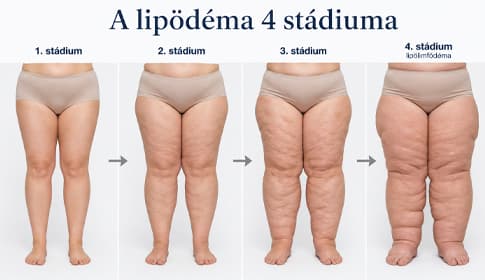
In clinical practice lipedema is divided into four stages, and this classification determines the treatment strategy. Stage is not simply limb size, but differs based on the skin surface and tissue firmness. A low-stage lipedema can be associated with considerable mass, and a high-stage can be slimmer – disease progression is a tissue change, not just an increase in size.
 Key point
Stage of lipedema is determined by the skin surface and the palpatory quality of the tissue, not limb size. Stage is essential to define the exact treatment package – for each stage different tools, pressures, protocols and professional background are recommended.
The detailed clinical background and symptom recognition of lipedema are discussed in the Lipedema (fat edema) symptoms and treatment pillar article. This article focuses on stage-level differences and how to recognise your own stage.
Comparative overview of the 4 stages
The table below summarizes the main differences between the 4 stages on one page. Detailed symptom and treatment descriptions for the individual phases follow.
| Stage | Skin surface | Palpable tissue | Mobility | Home treatment |
|---|---|---|---|---|
| 1. | Smooth, intact | Soft, painful, tender | Preserved | Compression + IPC + exercise (basic) |
| 2. | “Mattress-like", fine unevenness | Small to medium nodules | Slightly reduced | Compression + IPC + physiotherapy (advanced) |
| 3. | Coarse waviness, folds | Large adipose folds, fibrosis | Significantly reduced | CDT + 6/12-chamber IPC + specialist supervision |
| 4. (lipolymphedema) | Features of lipedema + lymphedema | Mixed: fat + fluid stasis | Severely limited | CDT + low-pressure IPC + surgical consultation |
Stage 1 – Smooth skin, soft sensitive tissue
Stage 1 lipedema is the initial phase when the change most often appears cosmetic. The skin surface is smooth and intact, but on palpation soft, enlarged adipose tissue can be felt on the hips, thighs or upper arms. The skin is more sensitive than normal, and small bruises may appear for weeks after minor bumps or pressure (easy bruising tendency).
Typical symptoms in stage 1:
- Disproportionate fat accumulation on hips, thighs, upper arms – waist and abdominal region remain relatively slim,
- Free ankle and dorsum of the hand ("cuff sign"),
- Skin sensitivity, pain with light pressure,
- Fatigue, heavy-leg sensation at the end of the day,
- Diet resistance – dieting reduces size at the waist and abdomen but has little effect on the hip, thigh and calf regions.
Home treatment in stage 1: compression garment + daily pneumatic compression + exercise in compression garment are the basics. 4-chamber home devices (Power Q-1000 Plus, Q-2200, Q-1000 Premium) are effective at this phase, at 30–50 mmHg pressure, with daily 30–60 minute sessions.
Stage 2 – Mattress-like skin, palpable nodules
In stage 2 the skin surface changes: it becomes slightly uneven, often taking on a "mattress-like" pattern, especially on the inner thigh and the lower part of the upper arm. Small to medium nodules can be felt in the tissue, which are the result of an irregular arrangement of connective tissue fibres and adipose tissue.
Typical symptoms in stage 2:
- "Mattress-like" surface irregularity,
- Palpable adipose nodules along the thigh and upper arm,
- Increased pain and pressure sensitivity,
- Mobility slightly reduced – for example climbing stairs or standing for long periods becomes more tiring,
- Bruising tendency,
- Reduced quality of life (appearance, clothing, sports) – this often triggers psychological burden.
Home treatment in stage 2: elements of CDT (complex decongestive therapy) are essential. A 4-chamber IPC (especially the program-save capable Power Q-1000 Premium) with daily 30–60 minute sessions + daily compression garment + 1–2 weekly manual lymphatic drainage (MLD) by a lymphedema therapist form the most effective package. Lifestyle pillars (anti-inflammatory diet, exercise, stress management) play an even more decisive role at this stage. In the upper range of stage 2 a 6-chamber Power Q-8060 may already be considered.
Stage 3 – Coarse waviness, significant tissue mass
In stage 3 the change becomes visible: the skin shows coarse waviness and significant adipose tissue folds develop, especially on the inner thigh and above the knee joint. Fibrotic (connective tissue-fixed) areas form in the tissue, which are palpably firmer. Mobility is significantly reduced: climbing stairs, running, and often even longer walking becomes difficult.
Typical symptoms in stage 3:
- Coarse skin waviness, large adipose folds (especially around the knee),
- Palpable, fibrotic, firmer tissue areas,
- Reduced mobility – climbing stairs, longer walks, running are difficult,
- Chronic pain in the affected area,
- Poor sleep due to pain,
- Chronic psychological burden, depression, anxiety,
- Muscle strength reduction due to decreased physical activity,
- Joint overload – risk of early cartilage wear (gonarthrosis).
Home treatment in stage 3: at this point a finer sequential pattern offered by a 6-chamber Power Q-8060 or a 12-chamber Q-8120 is recommended. Clinical studies indicate that an intensive introductory phase of CDT of 2–4 weeks with 3–5 professional sessions per week + daily home machine lymphatic massage is indispensable. The clinical-level treatment package includes physiotherapy, exercise therapy and psychological support. Surgical options (lipedema-oriented liposuction) may be considered; details are in the Lymphatic reconstruction surgery guide.
Stage 4 (lipolymphedema) – Lipedema + secondary lymphedema
Stage 4 is the most severe degree, where lipedema is accompanied by secondary lymphedema (lipolymphedema). Cause of development: the large tissue mass formed in stage 3 mechanically compresses the lymphatic vessels and lymph nodes, which gradually leads to lymphatic insufficiency. The increased tissue mass is aggravated by fluid stasis, and skin changes (thickening, waviness, hyperkeratosis) become persistent and deforming.
Typical symptoms in stage 4 (lipolymphedema):
- Combined features of lipedema + lymphedema,
- Soft swelling appears on the foot as well (Stemmer sign becomes positive – which would be negative in classic lipedema),
- Severe, deforming skin changes, hyperkeratosis,
- Recurrent skin infections (erysipelas, cellulitis),
- Severe mobility limitation,
- Chronic pain, sleep disturbance,
- Severe psychological burden, often complete inability to work.
Home treatment in stage 4: clinical-level complex decongestive therapy (CDT) is primary, and surgical consultation (LVA, VLNT, debulking) should be considered. Home IPC can be used at low pressure (30–40 mmHg) under treating physician supervision – the finer sequential pattern of the Power Q-8060 or Q-8120 is best at this stage. In complex anatomical cases low pressure is particularly important because high pressure may worsen venous or arterial complications.
How to determine your own stage? – Self-assessment guide
The responsibility for staging lies with the treating physician or a lymphology specialist. The guide below is only for preliminary orientation – a meaningful treatment plan always requires specialist consultation.
Try this 5-step self-assessment in the bathroom under good lighting:
- Skin surface check: looking in the mirror check the inner thigh and the lower part of the upper arm. Is the surface intact and smooth? (stage 1) Irregular, "mattress-like"? (stage 2) Coarsely wavy, folded? (stage 3)
- Palpation test: gently press the inner thigh. Do you feel a larger mass under smooth, soft tissue? (stage 1) Do you feel small to medium nodules? (stage 2) Large folds, hard areas? (stage 3)
- Foot observation: is the foot swollen or free? If the foot is also swollen and the Stemmer sign is positive (the skin at the base of the second toe cannot be lifted into a fold), it is likely stage 4 lipolymphedema or another lymphedema is present.
- Mobility test: can you climb stairs without getting tired? Does a one-kilometre walk strain you? If yes, you are likely already in stage 2–3.
- Pain scale: how painful is your thigh to pressure? Mild tenderness (stage 1), definite pain (stage 2), constant pain (stage 3–4)?
Discuss this self-assessment with your treating physician. Clinical diagnosis requires examination, measurements (tape measure, bioimpedance) and precise evaluation of the symptom picture. Relevant specialists include: lymphologist, vascular surgeon, plastic surgeon with lipedema practice.
 Stage-level home device selection
Based on clinical practice a different pneumatic lymphatic massage device is the most effective home choice for each stage. The nav-box below gives stage-by-stage recommendations – always consult your treating physician before making the final choice.
- Stage 1: Power Q-1000 Plus – simple home entry or Power Q-2200 – best value home. 4-chamber technology, classic protocol.
- Stage 2 (lower): Power Q-1000 Premium – advanced home. Program save for long-term protocols.
- Stage 2 (upper) – Stage 3: Power Q-8060 – 6-chamber professional. Finer inflation pattern for thicker tissue accumulation.
- Stage 3 (upper) – Stage 4: Power Q-8120 – 12-chamber top professional. Clinical-level precision and multi-protocol.
For the full selection logic and technical aspects see the Pneumatic compression device – what it is for, how to choose? guide, and the multi-indication hub is in the Pneumatic compression device category.
When should you see a specialist?
Treatment of lipedema is multimodal and requires specialist consultation at every stage. It is particularly important to seek a specialist in the following situations:
- Uncertain diagnosis: if you are not sure whether lipedema or another condition (eg lymphedema, classic obesity, hypothyroidism, venous insufficiency) is causing the complaints.
- Stage progression: if despite home treatment you feel the condition is worsening – for example the skin becomes more uneven, pain increases, mobility deteriorates.
- Specialist certification: if you need a prescription for compression, manufacturer-grade compression garments or health insurance support.
- Surgical consultation: if you are stage 3–4 and considering liposuction or other surgical options. Details in the Lymphatic reconstruction surgery guide.
- Professional experience exchange: the interview with Dr. Balázs Mohos in this interview provides clinical practice insight into surgical options.
In Hungary there are several lipedema specialists and patient organisations. Patient organisations (Hungarian Lipedema Association, online communities) also help find the right specialist by sharing patients' experiences.
 Clinical evidence for stage-level treatment
Clinical trials on stage-level treatment of lipedema have expanded significantly in recent years. The evidences below are stage-sensitive – for each stage consider the population and protocol studied in the given trial.
Atan and Bahar-Özdemir (2020) – RCT, 33 women, severe (stage 3) lipedema
In severe stage 3 lipedema the combination of complex decongestive therapy (CDT) + exercise produced the greatest reduction in limb volume, pain and physical function. IPC + exercise also yielded significantly better results than exercise alone. This confirms that in more severe stages IPC + therapist-performed MLD + lifestyle combination is most effective.1
Wright et al. (2022) – PCD + conservative care RCT
In women with lipedema the pneumatic compression device + conservative care (PCD+CC) led to greater improvements in leg circumference, bioimpedance and pain scores than conservative care alone. The trial provides an evidence base for primary cases of stage 1–2 lipedema.2
Herbst et al. (2025) – APCD lipedema RCT, 46 women
30 days of home APCD use (advanced pneumatic compression device) significantly reduced leg volume, extracellular and intracellular fluid, and subcutaneous adipose tissue thickness verified by ultrasound. Quality of life improved in 87.5% of women studied. Higher chamber-count APCDs proved particularly effective in stage 2–3 lipedema.3
Esmer and Schingale (2024) – CDT + IPC slowing progression
After one month of CDT + IPC treatment in 22 women with lipedema both intracellular and extracellular fluid volumes decreased. The authors suggest combined therapy may slow stage progression, which can be particularly decisive long-term in stage 1–2 patients.4
The consistent message of the four trials: choosing the appropriate device and protocol for the stage yields clinically proven results. In lower stages a 4-chamber IPC is most effective, while in higher stages 6–12-chamber professional devices are best – always alongside compression garments and lifestyle measures.
Related guides in the cluster
Stage-level treatment of lipedema is part of the whole cluster. Related guides:
- Lipedema (fat edema) symptoms and treatment – pillar guide
- Lipedema-fat edema category – stage-level product recommendations
- Lymphedema – types and causes – differential diagnosis in the context of lipolymphedema
- Lymphatic reconstruction surgery – surgical options in stages 3–4
- Interview with Dr. Balázs Mohos – clinical practice viewpoint
- Manual lymphatic drainage – manual and mechanical lymphatic massage – physical treatment methods
- Pneumatic compression device – multi-indication hub – device selection
- Pneumatic compression device – what it is for, how to choose? – technical guide
Guides coming soon:
- Lipedema vs lymphedema – differential diagnosis (in preparation)
- Lipedema diet – anti-inflammatory approach (in preparation)
- Lipedema physiotherapy – home protocol (in preparation)
 What to watch for in home treatment of lipedema?
Home treatment of lipedema is a safe procedure, but there are some conditions when you should definitely consult a physician before use.
When be cautious?
- Acute deep vein thrombosis or suspected DVT – treatment only with medical approval and monitoring.
- Severe heart failure – increased venous return may cause decompensation.
- Active skin infection (erysipelas, cellulitis) – not recommended until the infection has healed.
- Severe peripheral arterial disease – individual assessment and low pressure indicated.
- Untreated high blood pressure – stabilise first, use on physician's recommendation.
- Active malignant tumour in the treated region – only with oncologist approval.
 Important note
Pneumatic compression and compression garments are elements of complex lipedema treatment and do not replace medical or physiotherapy care. Consult your treating physician if new complaints, increasing swelling, pain or skin changes occur.
Frequently asked questions
In clinical practice stage regression is rarely achievable with conservative treatment alone. Complex decongestive therapy, compression and lifestyle can SLOW the progression, and in some cases (especially with surgical liposuction) it is possible to step back one stage. Early recognition and consistent treatment are key – the sooner you start multimodal treatment, the greater the chance of a stable, even decade-long state.
Progression of lipedema varies widely between individuals. Some patients remain stable in stage 1 for 10–20 years, while others progress to stage 2 within 5 years due to hormonal events or lifestyle changes. Starting treatment significantly slows progression. Regular specialist follow-up (at least once a year) helps detect changes in time.
Stage 4 lipolymphedema develops from lipedema: the tissue mass accumulated in stage 3 mechanically obstructs the lymphatic system, causing secondary lymphedema. Its clinical appearance partly resembles classic lymphedema (soft swelling, foot involvement, positive Stemmer sign), but it is always preceded by a history of lipedema. Classic (primary or secondary) lymphedema, by contrast, arises from surgical/radiation or congenital causes, not from tissue mass.
Preliminarily yes – based on the self-assessment guide above. However, precise clinical diagnosis and staging can only be performed by a specialist (lymphologist, vascular surgeon, plastic surgeon with lipedema practice). Accurate staging is particularly important for the treatment plan, because each stage requires different devices, pressures and professional background.
No. In stages 1–2 a 4-chamber home IPC is generally sufficient and clinical trials show significant effectiveness. In stage 3 a 6-chamber Q-8060 or 12-chamber Q-8120 with finer pattern delivers noticeably better results. In stage 4 (lipolymphedema) clinical-level CDT under specialist supervision is primary, and surgical options should be considered – home IPC is recommended only at low pressure and with treating physician supervision.
Lipedema-oriented liposuction (water-assisted WAL or tumescent technique) is typically considered in stages 3–4 where conservative treatment no longer yields adequate results. Clinical trials with 5–10 year follow-up show good outcomes: pain may decrease by 70–90% and limb volume can be 30–50% smaller. Surgery does not replace conservative treatment – postoperative maintenance protocol (compression + IPC + exercise + lifestyle) is essential. Details in the Lymphatic reconstruction surgery guide.
 Summary – The key of the 4 stages
Sources
- Atan T, Bahar-Özdemir Y (2020). The Effects of Complete Decongestive Therapy or Intermittent Pneumatic Compression Therapy or Exercise Only in the Treatment of Severe Lipedema: A Randomized Controlled Trial. Lymphatic Research and Biology. DOI: 10.1089/lrb.2020.0019
- Wright T, Scarfino CD, O'Malley EM (2022). Effect of pneumatic compression device and stocking use on symptoms and quality of life in women with lipedema: A proof-in-principle randomized trial. Phlebology. DOI: 10.1177/02683555221145779
- Herbst KL, Zelaya C, Sommerville M, Zimmerman T, McHutchison L (2025). An Advanced Pneumatic Compression Therapy System Improves Leg Volume and Fluid, Adipose Tissue Thickness, Symptoms, and Quality of Life and Reduces Risk of Lymphedema in Women with Lipedema. Life (Basel). DOI: 10.3390/life15050725
- Esmer M, Schingale FJ (2024). Can Physical Therapy Techniques Slow Down the Progression of Lipedema?. Lymphatic Research and Biology. DOI: 10.1089/lrb.2024.0065