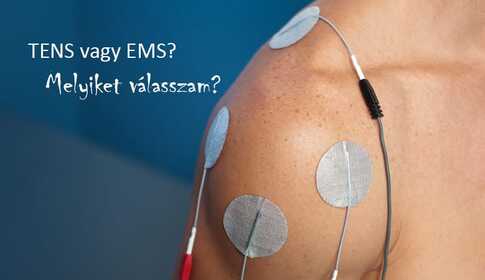

In this article we review the three methods: how each works, in which frequency ranges they operate, in which indications they are documented, and when it is worth choosing one – or their combination.
 Key takeaway
A simple reminder: TENS = pain relief acting on sensory nerves, EMS = muscle strengthening via motor nerves by inducing muscle contractions, MENS = support of cellular-level regeneration with low-intensity current. Multifunction devices can provide all three, so combined application is possible.
 How do the three methods work?
Each technology acts at a different physiological level. Let's look at them in order:
TENS (transcutaneous electrical nerve stimulation) acts on sensory nerves in a frequency range of 2–150 Hz. High-frequency modes can help reduce pain signals based on gate-control theory, while low-frequency modes may promote the release of endogenous opioids (endorphin, enkephalin).
Current: ~10–80 mA, pulse: 50–400 μs. Produces a mild tingling under the skin. Details: TENS cornerstone article.
EMS (electrical muscle stimulation) stimulates motor nerve fibers in a frequency range of 20–100 Hz, eliciting true muscle contractions. NMES (neuromuscular electrical stimulation) is the medical term for the same approach. Regular use can support muscle strength, coordination and local blood circulation.
Current: ~20–120 mA, pulse: 200–500 μs. Produces visible muscle contractions. Details: EMS cornerstone.
MENS (microcurrent therapy) uses currents that are thousands of times smaller than TENS or EMS. This range, which is close to physiological cell currents, may support ATP production and cell membrane transport processes. Its main applications are wound-regeneration support and anti-inflammatory effects.
Current: 100–1000 μA (microamperes, NOT milliamperes!), frequency: 0.5–100 Hz. Usually not felt by the patient, only a subtle tingling. Details: microcurrent cornerstone.
 Comparison of the three methods
| Parameter | TENS | EMS / NMES | MENS (microcurrent) |
|---|---|---|---|
| Target tissue | Sensory nerves | Motor nerves + muscle | Cells (cell membrane) |
| Frequency | 2–150 Hz | 20–100 Hz | 0.5–100 Hz |
| Current intensity | 10–80 mA | 20–120 mA | 100–1000 μA (~thousands of times smaller) |
| Sensation | Tingling | Muscle contraction | Generally not felt |
| Main goal | Pain relief | Muscle strengthening, rehabilitation | Cell-level regeneration, wound closure |
| Typical indications | Chronic low back/neck pain, labor pain, neuropathy | Postoperative muscle strength, sports rehab, body shaping | Chronic wound, inflammation, cosmetic applications |
| Treatment time / session | 20–45 minutes | 20–30 minutes | 20–60 minutes |
| User experience | "Tingling in the painful area" | "My muscles twitch rhythmically" | "I barely feel anything, just a subtle tingle" |
 When to choose which? – By complaint
Low back, neck, shoulder pain, headache, pain from arthritis, neuropathic pain, labor pain – these are classic indications for TENS. The electrical signal acting on sensory nerves can contribute to pain relief. According to Gibson's 2019 Cochrane overview, TENS is a documented adjunct method for treating chronic pain.
Postoperative rehabilitation, age-related muscle loss (sarcopenia), athlete training supplementation, body shaping, rehabilitation programs for disc herniation – these are indications for EMS/NMES. The 2018 review by Sluka (Phys Ther) reviews stimulation mechanisms related to pain management, including motor stimulation effects. Details: regaining muscle strength.
Chronic wounds (leg ulcers), hard-to-close injuries, joint inflammation, cosmetic microcurrent treatments (G-Pulse, facial rejuvenation). Microcurrent works in a physiological range, so it is suitable for more sensitive areas as well. The 2019 RCT by Maul et al. examined the clinical effectiveness of microcurrent. Details: microcurrent and joint inflammation.
After knee surgery or for disc herniation rehab when pain and muscle weakness coexist: combined application of TENS and EMS may be ideal. Typically 15–20 minutes of TENS for pain relief, then 15–20 minutes of EMS for muscle strengthening. Multifunction devices (Globus Elite SII, Genesy SII or Premium 400) solve this in one unit.
Pain from leg ulcers, chronic inflammatory pain – the combined MENS + TENS protocol can support regeneration while also treating pain. Multifunction devices (Globus Genesy 1500/3000, TensCare UniPro) can flexibly switch modes during a treatment cycle.
 Multifunction devices – all 3 methods in one
If you want to use all three methods, it is worth choosing a device that includes TENS, EMS and MENS functions.
Globus Genesy 3000 (PRO multifunctional)
The complete electrotherapy portfolio: TENS, EMS, NMES, MENS, IF, Kotz, iontophoresis. Ideal for clinical or professional environments. Chosen by professional rehabilitation centers.
Globus Genesy 1500 (PRO mid)
TENS, EMS, NMES, MENS, IF, Kotz – the most common methods in one device. PRO for home or professional use.
TensCare UniPro (4-in-1, mid category)
TENS, EMS, MENS and IF in one device at a more affordable price. An excellent entry point to multifunction electrotherapy.
Globus Elite SII (TENS + EMS entry)
The two most common methods (TENS and EMS) in an economical device. Recommended as a first step for home pain relief and muscle strengthening.
Want just one method? The Dolito is pure TENS, the Myolito is pure EMS entry-level. Detailed buying guide: Choosing a TENS device.
 How to decide? – Simple questionnaire
Ask yourself these 4 questions:
- What is your main complaint?
- Pain (chronic or acute) → TENS
- Muscle weakness, muscle rehabilitation → EMS
- Chronic wound, inflammation, regeneration → MENS
- Pain + muscle weakness → TENS + EMS
- How sensitive are you to the sensation of current?
- Rather sensitive → MENS (barely perceptible) or low-intensity TENS
- Tolerant → any method
- How much time will you spend on treatment?
- 20–30 minutes daily → all three methods are suitable
- Longer (45–60 minutes) → MENS with certain protocols
- Is one method enough, or will you need more?
- Only one → focused entry device (Dolito / Myolito)
- Multiple methods → multifunction device (Genesy / TensCare UniPro)
If you are still uncertain: the "Which electrotherapy is good for what?" decision-support article gives recommendations by complaint.
 Contraindications valid for all three
TENS, EMS and MENS cannot be used in certain conditions. The following contraindications apply to all three methods. Details: general contraindications.
- Pacemaker, ICD or other active electronic implant (see: implants)
- Malignancy in the treated area (see: cancer and electrotherapy)
- Pregnancy (treatment over the lower abdomen/lumbar area is contraindicated)
- Acute deep vein thrombosis (within 3 months)
- Acute fever, infection, open wound in the treated area
- Application over the carotid sinus / anterior triangle of the neck
- Active epilepsy (especially near the skull)
Frequently asked questions
Yes, with multifunction devices. The Globus Genesy 1500 and 3000, and the TensCare UniPro include TENS, EMS and MENS. At entry level, the Globus Elite SII offers a TENS+EMS combination without microcurrent. The professional Genesy 3000 adds further technologies (Kotz, IF, iontophoresis).
MENS current intensity (100–1000 μA) is close to physiological cell currents, so it is usually not felt or gives only a faint tingle. This is normal and not a sign that the device is not working. The effect is indirect at the cellular level – visible as wound reduction, decreased inflammation, or pain relief. The display and programming controls indicate that the device is delivering current.
Typically they do not run in parallel in the same device – the choice is program-level (TENS program or EMS program). However, they can be applied sequentially in one treatment session: e.g. first 15–20 minutes of TENS for pain relief, then 15–20 minutes of EMS for muscle strengthening. This is a standard approach in many rehabilitation protocols.
The operating principle is the same (low-intensity current, cellular-level effect), but pulse parameters differ. Cosmetic devices also use special applicators designed for facial areas. If it's a CE-marked medical device, it basically works on the same principle. Details on G-Pulse: G-Pulse cosmetics.
This is a classic rehabilitation case where combining TENS and EMS is recommended: TENS can help reduce pain, EMS helps regain muscle strength and thereby stabilize the joint (quadriceps, calf). The Globus Elite SII or the Premium 400 are ideal choices for this. If you have or will have knee surgery: muscle stimulation after surgery.
All three are considered safe as CE-marked home devices when contraindications are respected. MENS, due to its low current, carries the lowest risk of skin irritation and uncomfortable sensation, so it is often recommended for sensitive areas (face, children, elderly). EMS uses the highest current intensities, so beginners should increase intensity gradually. TENS is generally well tolerated.
 Summary
A guide to the differences between TENS, EMS and MENS (microcurrent) electrotherapy methods, their indications and how to choose the right device.
For those planning home electrotherapy who are unsure which method suits their complaint; and for sports physiotherapists and physical therapists.
TENS = pain relief, EMS = muscle strengthening, MENS = cell-level regeneration. Multifunction devices (Globus Genesy, TensCare UniPro) offer all three, so treatment can be switched depending on the complaint.
Read the detailed cornerstone articles: TENS, EMS, microcurrent. Or the decision-support: "Which electrotherapy is good for what?".
Scientific references
- Gibson W, et al. Transcutaneous electrical nerve stimulation (TENS) for chronic pain in adults: an overview of Cochrane Reviews – Cochrane Database of Systematic Reviews, 2019. PubMed: 30941745
- Kroeling P, et al. Electrotherapy for neck pain – Cochrane Database of Systematic Reviews, 2013. PubMed: 23979926
- Maul XA, et al. A randomized clinical trial evaluating microcurrent therapy – International Forum of Allergy & Rhinology, 2019. PubMed: 30667597
- Chimenti RL, Frey-Law LA, Sluka KA. A mechanism-based approach to physical therapist management of pain – Physical Therapy, 2018. PubMed: 29669091
- Sato KL, et al. Transcutaneous electrical nerve stimulation, acupuncture, and spinal cord stimulation – Korean Journal of Pain, 2020. PubMed: 32235012