
 What is a lymphedema stage and why is it important?
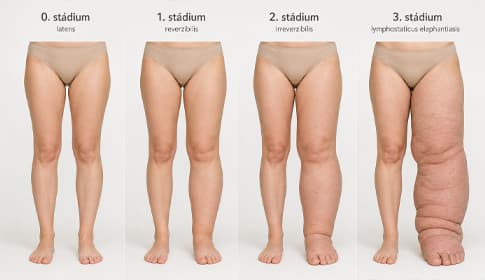
The staging system consists of 4 grades: 0 (latent), 1 (reversible), 2 (irreversible) and 3 (lymphostatic elephantiasis). Transition between stages is not inevitable — well managed stage 1 lymphedema can remain stable for decades. Likewise, stages 2–3 can develop within a few years without treatment. Early detection and consistent treatment are therefore decisive.
 Key point
Stage is not determined by the size of the swelling, but by skin condition, tissue firmness (fibrosis) and symptomatic reversibility. In stage 0 the disease already exists but there are no visible symptoms; in stage 3 the tissue has undergone dramatic and partly irreversible change.
The general clinical background of lymphedema and a detailed discussion of primary/secondary forms are covered in the Lymphedema – forms, causes and stages guide. This article specifically focuses on stage-level clinical approach.
Classification of lymphedema (per ISL)
The table below summarizes the main features of the 4 stages. Detailed descriptions by stage follow in the next sections.
| Stage | Clinical picture | Reversibility | Stemmer sign | Home treatment |
|---|---|---|---|---|
| 0 (latent) | Asymptomatic, only BIS abnormality | Fully reversible | Negative | Prophylactic IPC + monitoring |
| 1 (reversible) | Soft, pitting swelling | Resolves when elevated | Negative | Compression + IPC + lifestyle |
| 2 (irreversible) | Persistent swelling, partly fibrotic | Partly irreversible | May be positive | CDT + finer sequential IPC + MLD |
| 3 (elephantiasis) | Severe deforming swelling, hyperkeratosis | Irreversible (surgery indicated) | Positive | Clinical-level CDT + surgical consultation |
Stage 0 – Latent lymphedema
Stage 0 is the “hidden” phase: the lymphatic system is already damaged (e.g. after breast cancer surgery or radiotherapy), but there is no visible swelling yet. The lymphatic system "compensates" — alternative drainage pathways still provide sufficient capacity. Clinical signs:
- Bioimpedance spectroscopy (BIS) shows an abnormality (increased extracellular fluid),
- Early difference may appear on tape-measure limb assessment (1–2 cm),
- Subjective symptoms: heaviness in the arm/leg at the end of the day, tight ring/watch, fatigue sensation,
- Stemmer sign still negative, pitting test negative as well.
Home treatment in stage 0: prophylactic (preventive) pneumatic compression (i.e. machine lymphatic massage, IPC) is recommended. Clinical studies (Su 2025 meta-analysis) indicate that ≤40 mmHg, >2 weeks prophylactic IPC significantly reduces the risk of breast cancer-related arm lymphedema (BCRL) after breast cancer treatment (RR=0.36). A 4-chamber home device (Power Q-1000 Plus, Q-2200) is ideal in this phase. Daily use of a prophylactic compression garment (stocking, glove, class II) is also important. The detailed BCRL prevention protocol is in the Breast cancer–related arm swelling (BCRL) guide.
For most patients identified in stage 0, development of chronic lymphedema can be prevented. Therefore regular specialist follow-up and bioimpedance monitoring are especially important in high-risk groups (extensive oncologic surgery, post-radiotherapy phase).
Stage 1 – Reversible lymphedema
In stage 1 visible swelling appears, but it is still reversible: it partially subsides with rest, elevation and compression, and is reduced by morning. Typical clinical signs:
- Soft, pitting swelling: pressure with a finger leaves a noticeable indentation that returns within minutes.
- Partial resolution when elevated: if you lie down with your legs elevated, the swelling decreases.
- Smaller in the morning, larger in the evening: daily activity (upright posture) increases swelling.
- Stemmer sign negative: the skin at the base of the second toe can still be lifted into a fold.
- Skin still intact and flexible: no fibrotic changes, skin unaffected.
- Function preserved: movement of the arm or leg is not limited.
Home treatment in stage 1: the classical four elements of complex decongestive therapy (CDT) should be started — daily wear of compression garment, manual or machine lymphatic drainage, skin care, and exercise. 4-chamber home devices (Power Q-1000 Plus, Q-2200, Q-1000 Premium) are effective at this stage: 30–50 mmHg pressure, 30–60 minutes daily. Compression garment in class II–III (23–46 mmHg), custom-fitted.
Lymphedema detected and treated consistently in stage 1 can remain stable for decades. Early initiation is key to treatment success.
Stage 2 – Irreversible lymphedema
In stage 2 the swelling becomes persistent and connective tissue scarring (fibrosis) begins to form in the tissues. This fibrosis is partly irreversible — it does not fully resolve even in an elevated position. Typical clinical signs:
- Persistent swelling: present both morning and evening, not completely relieved by elevation.
- Pitting test negative or slight: due to fibrotic tissue, a finger press no longer leaves a long-lasting indentation.
- Skin firmer and thicker: skin feels noticeably harder on palpation.
- Stemmer sign may become positive: the skin at the base of the second toe is harder to lift into a fold.
- Function slightly reduced: the limb is heavier, movement more restricted.
- Recurrent skin irritation or mild infection tendency.
Home treatment in stage 2: an intensive introductory phase of CDT is recommended — MLD by a specialist 3–5 times weekly, multilayer compression bandaging, then maintenance with compression garment + daily home IPC. Home device selection already moves toward finer sequential patterns: the 4-chamber Q-1000 Premium with program-save function, or the 6-chamber professional Q-8060 with finer efficacy. Detailed clinical protocol is in the Lymphedema treatment at home guide.
In stage 2 surgical options (microsurgical LVA, VLNT) can also be considered — details in the Lymphatic reconstruction surgery guide. With modern techniques stage reduction by one stage is partially achievable.
Stage 3 – Lymphostatic elephantiasis
Stage 3 is the most severe grade — rare in clinical practice but dramatic in appearance. The term lymphostatic elephantiasis originates from the classic “elephant limb”: the limb becomes deformingly enlarged, the skin is thick, wrinkled and hyperkeratotic. Typical clinical signs:
- Severe, deforming swelling: limb size and shape change dramatically.
- Hyperkeratotic skin: the skin becomes coarsely thickened, wrinkled, nodular with hard areas.
- Stemmer sign positive: the skin cannot be lifted into a fold at all.
- Pitting test negative: no indentation due to fibrotic tissue.
- Recurrent skin infections: episodes of erysipelas and cellulitis are common.
- Severe mobility limitation: walking, stair climbing and daily activities are markedly impaired.
- Psychological burden: chronic pain, sleep disturbance, depression, social isolation.
Home treatment in stage 3: clinical-level CDT under specialist supervision is primary. The intensive introductory phase (2–4 weeks, inpatient or outpatient) aims at volume reduction, maintenance phase aims for stability. Home pneumatic lymphatic massage at this point requires the fine treatment patterns of the 12-chamber Q-8120 flagship model — 4- or 6-chamber devices have less effect on the thick, fibrotic tissue accumulation and are only a compromise. Performed at low pressure (30–40 mmHg) under physician supervision.
In stage 3 surgical options (LVA, VLNT, debulking) are often necessary. Modern techniques can achieve stage reduction but do not eliminate the nature of the disease. A detailed surgical review is available in the interview with Dr. Balázs Mohos in the interview.
How do you determine your own stage? – Self-assessment guide
Accurate staging is determined by the treating physician or lymphologist. However, the following 5-step self-assessment can help with preliminary orientation — it can be done in the bathroom under good lighting.
- Pitting test: press the swollen area with your finger for 5–10 seconds. Does an indentation form that returns within minutes? (stage 1) No or minimal indentation? (stages 2–3) No swelling at all? (possibly stage 0)
- Elevation test: lie down for 30 minutes with the limb elevated. Does the swelling decrease? (stage 1) No change? (stages 2–3)
- Stemmer sign: try to lift the skin at the base of the second toe (or second finger on the dorsum of the hand) into a fold. Easily lifted? (stages 0–1) Difficult or not liftable? (stages 2–3)
- Skin inspection: smooth, intact skin? (stages 0–1) Thick, hard, nodular? (stages 2–3)
- Measurement with tape: measure circumference of the limb at the same point on both sides. 1–2 cm difference (stages 0–1), 3–5 cm (stage 2), 5+ cm (stage 3).
Discuss this self-assessment with your treating physician or lymphologist. In Hungary lymphological specialist care is unfortunately insufficient but expanding. Apart from larger oncologic centers, private-practice lymphologists are also available. For clinical diagnosis, bioimpedance spectroscopy and, in more complex cases, lymphoscintigraphy or MR lymphangiography may be required.
 Stage-level home device selection
Based on clinical practice, different lymphatic massage machines are most effective at home for each stage. Final selection logic should be confirmed with your treating physician or lymphotherapist.
- Stage 0 (prophylaxis): Power Q-1000 Plus simple home entry or Power Q-2200 value option. 4 chambers, ≤40 mmHg, prophylactic protocol.
- Stage 1: Power Q-1000 Plus, Q-2200 or Q-1000 Premium with program-save. 4 chambers, 30–50 mmHg.
- Stage 2: Power Q-1000 Premium advanced home or Q-8060 6-chamber professional with finer sequential pattern.
- Stage 3: Power Q-8120 12-chamber top professional for clinical-level precision, at low pressure under physician supervision.
The complete selection logic is in the Lymphatic massage machine – what it does, how to choose? guide, and the multi-indication hub is in the Lymphatic massage machine category.
When should you consult a specialist?
Lymphedema requires specialist consultation at every stage. The following situations particularly call for prompt consultation:
- New swelling after oncologic surgery: even years after surgery or radiotherapy. Early detection is key to treatment success.
- Suspected stage transition: if home measurements show an increasing trend or symptoms worsen.
- Uncertain diagnosis: especially if signs of lipo-lymphedema (combination of lipedema + lymphedema) appear. Details in the Lipedema or lymphedema? guide.
- Considering surgical options: for patients in stages 2–3 to consider microsurgical or volume-reducing options. The Lymphatic reconstruction surgery guide and the interview with Dr. Balázs Mohos (interview) provide detailed clinical presentation.
- Acute skin infection (erysipelas, cellulitis): urgent antibiotic treatment — seek emergency care.
- Specialist certification or insurance support: prescription-style recommendation for compression garment, IPC device.
In Hungary the National Institute of Oncology, county oncology departments and private-practice lymphologists are available. The Hungarian Lymphedema Association and online patient communities also help patients find appropriate specialists through shared experiences.
 Clinical evidence for stage-level treatment
Clinical evidence for stage-level treatment of lymphedema is strong and has expanded markedly in the 2020s. The following studies provided stage-sensitive results.
Su et al. (2025) – BCRL prevention meta-analysis
Based on 14 randomized clinical trials with data from 1,397 patients: prophylactic pneumatic compression in stage 0 (latent) and stage 1 BCRL significantly reduces stage progression (RR=0.36; 95% CI 0.22–0.58). Optimal protocol: ≤40 mmHg, >2 weeks, ≤24 months after surgery. This clearly demonstrates the effectiveness of treating stages 0–1.1
Kulchitskaya et al. (2024) – IPC microcirculation RCT, lower-limb lymphedema
In 60 patients with lower-limb lymphedema (stages I–III) IPC + baseline therapy significantly improved endothelial function, reduced arteriolar spasm and increased capillary perfusion. The effect was detectable in all stages — therefore IPC is not only effective in stages 0–1.2
Pajero Otero et al. (2022) – CPT+IPC vs Kinesio tape RCT
In 43 women with BCRL stages 1–2, intensive complex physical therapy combined with intermittent pneumatic compression produced significantly greater volume reduction (-2.2%) than Kinesio taping (-0.9%, p=0.002). IPC is therefore a validated component of treatment protocols, especially in stages 1–2.3
Donahue et al. (2023) – BCRL review, stage-level recommendations
Modern BCRL care integrates stage-level approaches: stage 0 — prophylaxis and bioimpedance monitoring; stages 1–2 — CDT + IPC + lifestyle; stages 2–3 — microsurgical options (LVA, VLNT) may be considered. Patient education is key at every stage.4
The clinical message is clear: stage-level, evidence-based approach yields lasting results. Patients identified in stages 0–1 are well controllable; in stages 2–3 multimodal (combined surgical and conservative) treatment is most effective.
Further guides on the topic
-
 Lymphedema – forms, causes and stages →
-
Lymphedema treatment at home →
-
 Lymphatic drainage – manual and machine lymphatic massage →
-
 Lymphatic reconstruction surgery →
-
 Interview with Dr. Balázs Mohos →
-
 Radiotherapy and lymphedema →
-
Breast cancer–related arm swelling (BCRL) →
-
 Lipedema or lymphedema? →
-
Lipedema stages 1–4 →
-
 Lymphatic massage machine – multi-indication hub →
-
 Lymphatic massage machine – what it does, how to choose? →
 What to watch for in home lymphedema treatment?
Pneumatic compression is a safe procedure, but there are some conditions when consultation with a physician is definitely required before use.
Contraindications
- Acute deep vein thrombosis or suspicion thereof – treatment only with medical approval and under supervision.
- Severe heart failure – increased venous return can cause decompensation.
- Active skin infection (erysipelas, cellulitis) in the treated area – urgent antibiotic treatment required; IPC should be paused until the infection heals.
- Severe peripheral arterial disease – individual assessment and low pressure indicated.
- Untreated high blood pressure – treat and stabilize first, use only on physician recommendation.
- Active malignant tumor in the treated region – only with oncologist approval.
- Immediate postoperative period – not recommended until wound healing, physician permission required.
 Important to know
Treatment of lymphedema at every stage requires specialist consultation (lymphologist, oncologist). Home pneumatic lymphatic massage (IPC), compression garments and lifestyle elements complement medical and physiotherapy care and do not replace them. Consult your treating physician if you have new complaints, increasing swelling, pain or skin changes.
Frequently asked questions
Partly, yes. Stages 0–1 are fully reversible: with appropriate treatment the swelling may disappear and the patient can remain stable for a long time. Stage 2 is partially reversible — some fibrotic tissue does not return to normal, but symptoms can be significantly alleviated. Stage 3 is generally irreversible with conservative treatment, but modern microsurgical techniques (LVA, VLNT) can produce significant improvement. Early detection is key to treatment success.
Stage progression varies individually. If untreated, typical timelines are: stage 0 to stage 1 in 1–3 years, stage 1 to stage 2 in 2–5 years, and stage 2 to stage 3 in 5–10 years. Appropriate treatment (compression + IPC + lifestyle) can slow this significantly — many patients remain stable in stages 1–2 for decades. Regular specialist follow-up helps monitor stage.
Preliminarily, yes, using home Stemmer sign, pitting test and tape-measure measurements. However, an accurate clinical diagnosis and staging can only be made by a specialist (lymphologist, vascular surgeon). Precise staging is particularly important for creating the treatment plan because each stage requires different tools, pressures and specialist background.
In stage 0 the lymphatic system is already impaired, but compensatory mechanisms (alternative drainage pathways, reduced capacity demand) prevent visible swelling. Clinical signs: bioimpedance abnormality, possibly minimal (1–2 cm) arm/leg size difference, and subjective symptoms (heaviness). In a healthy state the lymphatic system operates at full capacity and there are no clinical signs. Patients identified in stage 0 can often avoid chronic, visible swelling with prophylactic treatment.
Stage 0: prophylactic IPC + monitoring. Stage 1: compression + IPC + lifestyle, 4-chamber home device, 30–50 mmHg. Stage 2: CDT + finer sequential IPC + MLD, 4- or 6-chamber device. Stage 3: clinical-level CDT + 12-chamber Q-8120 + surgical consultation. Treatment intensity and specialist supervision increase with stage.
If you are uncertain, the most effective step is a specialist lymphologist consultation. In Hungary the National Institute of Oncology, county oncology departments and private-practice lymphologists are available. During the assessment the specialist will use physical examination, measurements (tape, bioimpedance) and, if necessary, imaging (lymphoscintigraphy, MR) as well. Online patient communities can also help find the right specialist through experience sharing.
 Summary – the key of ISL stages
Sources
- Su L, Huang H, Tong Y, and colleagues (2025). Intermittent pneumatic compression devices for the prevention and treatment of breast cancer-related lymphedema – a systematic review and meta-analysis. Supportive Care in Cancer. DOI: 10.1007/s00520-025-10159-8
- Kulchitskaya DB, Fesyun AD, Konchugova TV, Apkhanova TV (2024). Influence of intermittent pneumatic compression on microvasculature condition in lymphedema – Prospective randomized clinical trial. Voprosy Kurortologii, Fizioterapii, i Lechebnoi Fizicheskoi Kultury. DOI: 10.17116/kurort202410106148
- Pajero Otero V, García Delgado E, Martín Cortijo C, and colleagues (2022). Intensive complex physical therapy combined with intermittent pneumatic compression versus Kinesio taping for treating breast cancer-related lymphedema of the upper limb: A randomised cross-over clinical trial. European Journal of Cancer Care. DOI: 10.1111/ecc.13625
- Donahue PMC, MacKenzie A, Filipovic A, Koelmeyer L (2023). Advances in the prevention and treatment of breast cancer-related lymphedema. Breast Cancer Research and Treatment. DOI: 10.1007/s10549-023-06947-7