
 Why is distinguishing between them important?
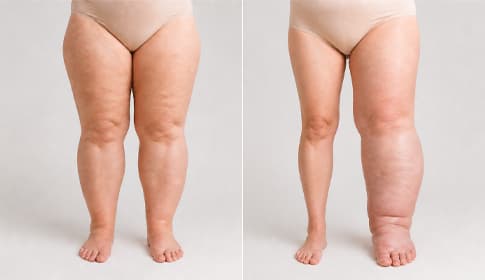
The aim of this article is to provide practical guidance on distinguishing between the two conditions – by comparing visual signs, clinical tests and treatment strategies. The exact diagnosis is always made by a specialist (lymphologist, vascular surgeon), but the information below will help you understand the situation and prepare for a well-informed consultation.
 Key idea
Lipoedema is a fat tissue disorder – treatment mainly targets tissue volume and inflammation. Lymphoedema is a fluid circulation disorder – treatment mainly supports fluid drainage. The two conditions can also occur together. This is called lipo-lymphoedema.
 Anatomical and pathological basis – what happens in the tissues?
The two conditions affect different tissue layers and cause swelling through different mechanisms.
In lipoedema, the subcutaneous fatty tissue accumulates abnormally and symmetrically. The cause is complex: a polygenic genetic predisposition, hormonal factors (oestrogen sensitivity) and chronic, low-grade inflammation. The increased fat mass is painful and tender and bruises easily. The lymphatic system is initially intact – it becomes secondarily affected only in stages 3–4 because of mechanical tissue pressure.
In lymphoedema, the capacity of the lymphatic system is reduced or obstructed. This may be congenital (primary lymphoedema – rare, a developmental disorder) or secondary, caused by an external event (surgery, radiotherapy, injury, infection or chronic venous congestion). The movement of protein-rich fluid between the tissues is impaired, increasing local inflammation and eventually causing connective-tissue scarring (fibrosis). The skin remains intact, but the tissue gradually becomes harder.
Because of these two fundamental differences, the treatment is also different:
- For lipoedema, the main aims are: controlling abnormal fatty tissue + reducing inflammation + stabilising quality of life.
- For lymphoedema, the main aims are: draining fluid + slowing tissue changes + preventing infection.
The detailed clinical background is available in the guides Lipoedema (fat oedema): symptoms and treatment and Lymphoedema – its forms, causes and stages.
Visual and symptom-based distinction
The detailed table below summarises the 8 main differences used in clinical practice. A person with no health problems can also work through it themselves:
| Feature | Lipoedema | Lymphoedema |
|---|---|---|
| Distribution | Symmetrical, bilateral (hips, thighs, calves, upper arms) | Typically unilateral (except congenital primary forms) |
| Foot / back of hand | Unaffected and remains slim – “cuff sign” | Usually affected and swollen |
| Stemmer sign | Negative (the skin fold can be lifted) | Positive (the skin fold cannot be lifted) |
| Skin sensitivity | Tender and bruises easily | Initially normal, later tight and indurated |
| Pitting (indentation on pressure) | Absent or minimal | Present, typical in the early stages |
| Pain | Typical, including on pressure | Minimal at first, chronic later |
| Sex distribution | Almost exclusively women | Both sexes (depending on the indication) |
| Typical triggering event | Hormonal change (puberty, pregnancy, menopause) | Surgery, radiotherapy, infection (secondary); congenital (primary) |
The key message from the table is that the two conditions have clear clinical features which, in most cases, already provide guidance before a specialist examination.
 Clinical tests and examinations
Four main clinical examination methods are used for an accurate differential diagnosis. Some can be performed at home, while others require consultation with a specialist.
1. Stemmer sign (can also be performed at home)
This is the classic clinical test for diagnosing lymphoedema. Try it: use your fingers to lift a fold of skin at the base of the second toe. If it can easily be lifted into a fold (negative Stemmer sign) → you probably have lipoedema. If the skin CANNOT be lifted (positive Stemmer sign) → you probably have lymphoedema. The test is not infallible, but in clinical practice it is a strong initial indication.
2. Pitting test (can also be performed at home)
Press the oedematous area with your fingers for 5–10 seconds, then remove your fingers. If a visible indentation remains and returns to normal within minutes → the result is pitting-positive (typical of stage 1 lymphoedema). If there is no visible indentation → it is probably lipoedema or lymphoedema at an advanced stage (above stage 2). This test detects the presence of fluid – lipoedema primarily involves tissue mass rather than fluid, so pitting is absent or minimal.
3. Limb measurement with a tape measure (at home or by a specialist)
Measuring the circumference of a limb at the same point each week with a tape measure helps assess trends (the direction of change). In lipoedema, the two sides are approximately symmetrical (the two thighs are the same size); in lymphoedema (especially secondary/BCRL), the affected side is significantly larger. A difference of more than 2 cm is an early indication.
4. Bioimpedance spectroscopy (BIS) – specialist examination
This is a modern, sensitive method that measures extracellular and intracellular fluid volume. It is very useful for the early detection of BCRL (before symptoms appear!). It may be available at the clinics of clinical lymph therapists and lymphology specialists.
5. Lymphoscintigraphy and MR lymphangiography – specialist hospital examination
These imaging procedures are used to establish the final diagnosis in more complex cases (e.g. congenital primary lymphoedema or lipo-lymphoedema). They show the function and anatomy of the lymphatic vessels accurately. The examination is performed in a specialist hospital.
Lipo-lymphoedema – when both conditions are present
Lipo-lymphoedema is the clinical situation in which lymphoedema develops secondarily in a patient with lipoedema, usually at stages 3–4. The typical progression is:
- Stage 1 lipoedema develops (smooth skin, tender tissue),
- over years or decades, it progresses to stages 2–3 (mattress-like skin, coarse rippling),
- the increased tissue mass mechanically compresses the lymphatic vessels and lymph nodes,
- the capacity of the lymphatic system decreases, and soft, fluid-like swelling appears in the limb, which was already enlarged,
- finally, the typical lipoedema features (bilateral, feet spared) and lymphoedema features (foot involvement, positive Stemmer sign) appear together.
Treatment of lipo-lymphoedema combines the treatment strategies for the two underlying conditions: the elements of complex decongestive therapy (CDT) (compression garment + manual or machine lymphatic drainage + skin care + exercise) are primary. Pneumatic compression is recommended at low pressure (30–40 mmHg) and under the supervision of the treating doctor. Surgical options (lipoedema-oriented liposuction +, in some cases, LVA or VLNT) may also be considered – details are available in the guide Lymphatic reconstruction surgery.
The stage-specific treatment strategies for lipoedema are described in detail in the cluster article Lipoedema stages 1–4.
What does the distinction mean for treatment?
Diagnostic accuracy also determines the treatment strategy. The table below summarises the most important differences:
| Treatment element | Lipoedema | Lymphoedema |
|---|---|---|
| Aim | Control of tissue mass, reduction of inflammation, pain relief | Fluid drainage, slowing tissue changes, infection prevention |
| Compression garment | Class II (23–32 mmHg) – worn daily | Class II–III (23–46 mmHg) – worn daily, individually fitted |
| Pneumatic compression pressure | 30–60 mmHg | 30–50 mmHg |
| Exercise | Emphasised – while wearing compression: swimming, walking, cycling | Emphasised – muscle pump function while wearing compression |
| Diet | Anti-inflammatory approach (Mediterranean, ketogenic) | Moderate sodium intake, hydration, weight control |
| Specific treatment | Liposuction in severe cases (stages 3–4) | Microsurgery in severe cases (LVA, VLNT) |
| Manual lymphatic drainage (MLD) | Useful adjunct | Primary treatment – one of the main pillars of CDT |
 Choosing a device according to the indication
The choice of pneumatic compression device differs both by stage and by indication. The most important difference is the pressure range:
- Lipoedema stages 1–2: 4-chamber home-use device at a pressure of 30–60 mmHg. Power Q-1000 Plus for entry-level use, Power Q-2200 for value for money, Power Q-1000 Premium for advanced use.
- Lipoedema stage 3: 6-chamber professional Power Q-8060 with a finer sequential pattern.
- Lipoedema stage 4 / lipo-lymphoedema: 12-chamber top professional Power Q-8120, at low pressure and under the supervision of the treating doctor.
- Lymphoedema stages 1–2: 4-chamber home-use device at a pressure of 30–50 mmHg. Q-1000 Plus, Q-2200 or Q-1000 Premium.
- Lymphoedema stage 3: 6- or 12-chamber professional device (Q-8060 or Q-8120) with a finer pattern.
- BCRL (arm swelling after breast cancer) prevention: 4-chamber IPC ≤40 mmHg, >2 weeks. Q-1000 Plus or Q-2200 is ideal.
The complete selection logic is explained in the guide Lymphatic massage machine – what is it for and how do you choose one?; the multi-indication hub is available in the Lymphatic massage machine category.
When should you see a specialist?
An accurate diagnosis – whether lipoedema or lymphoedema – is always the responsibility of a specialist (lymphologist, vascular surgeon or plastic surgeon with a lipoedema practice). Consultation is particularly important in the following situations:
- Persistent, unexplained swelling: whether symmetrical (suggestive of lipoedema) or unilateral (suggestive of lymphoedema), persistent swelling warrants consultation with a specialist.
- New swelling after cancer surgery: consult a lymphologist if arm or leg swelling develops after treatment for breast, cervical or prostate cancer – even years later.
- Uncertain clinical picture: if the home examination (Stemmer sign, pitting test) gives an uncertain result, or the symptoms do not clearly fit either condition.
- Recurrent skin infection (erysipelas, cellulitis): a typical complication of both conditions – recurrent episodes require a specialist treatment protocol.
- Considering a surgical option: liposuction or microsurgery (LVA, VLNT) may be considered for stage 3–4 lipoedema or severe lymphoedema. Details are available in the guide Lymphatic reconstruction surgery.
The specialist perspective from clinical practice is presented in the interview with surgeon Dr Balázs Mohos.
Clinical evidence in the treatment of the two conditions
The evidence base for the two conditions has developed differently over the past decade. The studies below support the development of indication-specific protocols.
Donahue et al. (2023) – review of BCRL prevention and treatment
Modern BCRL care is based on a multi-pillar approach: sentinel lymph node removal, early detection with tape measurement and bioimpedance, complex decongestive therapy (CDT), pneumatic compression and microsurgical techniques. The review summarises the key evidence supporting stage-specific lymphoedema treatment protocols.1
Su et al. (2025) – BCRL meta-analysis, 1,397 patients
Combined results from 14 randomised clinical trials: pneumatic compression significantly reduces the development of breast cancer-related lymphoedema (RR=0.36; 95% CI 0.22–0.58). The optimal protocol is: ≤40 mmHg, >2 weeks, ≤24 months after surgery. This is lymphoedema-specific evidence.2
Atan and Bahar-Özdemir (2021) – lipoedema RCT, revised Wold criteria
In 33 women with severe (stage 3) lipoedema, the combination of complex decongestive therapy (CDT) and exercise produced the greatest reductions in limb volume, pain and physical function. IPC plus exercise also showed significant improvement compared with the control group. This is lipoedema-specific evidence based on combined assessment of pain and volume.3
Herbst et al. (2025) – APCD lipoedema RCT
Thirty days of home APCD use significantly reduced leg volume, extracellular and intracellular fluid, and subcutaneous adipose tissue thickness, as confirmed by ultrasound measurement. In the lipoedema population, this study clearly supports a multimodal approach – it differs from the lymphoedema evidence precisely because it also measures changes in SAT (subcutaneous adipose tissue).4
The evidence base for the two conditions therefore has a different focus: in lymphoedema, fluid volume and prevention are the central topics; in lipoedema, the focus is tissue volume, pain and quality of life. This explains why an accurate diagnosis is needed when selecting the treatment protocol.
More in-depth guides in the cluster
Guides belonging to the two pillars:
- Lipoedema (fat oedema): symptoms and treatment – pillar guide
- Lipoedema stages 1–4 – stage-specific guide
- Lipoedema–fat oedema category – stage-specific product recommendations
- Lymphoedema – its forms, causes and stages – pillar guide
- Treating lymphoedema at home – conservative treatment protocol
- Lymphatic drainage – manual and machine lymphatic massage – physical methods
- Lymphatic reconstruction surgery – surgical options
- Radiotherapy and lymphoedema – BCRL context
- Lymphatic massage machine – multi-indication hub – device selection
- Lymphatic massage machine – what is it for and how do you choose one? – technical guide
 What should you watch out for if you have either lipoedema or lymphoedema?
When treating either condition at home, there are some situations in which you must consult a doctor before use. These are general contraindications to pneumatic compression and compression garments.
Contraindications
- Acute deep vein thrombosis or suspected deep vein thrombosis – treatment only with medical authorisation and supervision.
- Severe heart failure – increased venous return may cause decompensation.
- Active skin infection (erysipelas, cellulitis) – not recommended until the infection has healed; it may be restarted after antibiotic treatment has been completed.
- Severe peripheral arterial disease – individual assessment and low pressure are required.
- Untreated high blood pressure – after stabilisation, on medical advice.
- Active malignancy in the treated area – only with the approval of an oncologist.
 Important information
An accurate diagnosis and treatment plan prepared with your doctor or lymphologist are essential. Home IPC and compression garments should always be used only as an adjunct to medical and physiotherapy treatment. New symptoms, increasing swelling, pain or skin changes require consultation with a specialist.
Frequently asked questions
Yes. This clinical situation is called lipo-lymphoedema and usually develops in stage 3–4 lipoedema. Mechanical compression from the increased tissue mass reduces the capacity of the lymphatic system, leading to secondary lymphoedema. Treatment then combines the protocols for the two underlying conditions and often takes place under specialist supervision.
As an initial indication, yes. The home Stemmer sign and pitting test can provide useful guidance. If the Stemmer sign is negative, the swelling is symmetrical and the foot is spared → lipoedema is more likely. If the Stemmer sign is positive, the swelling is unilateral and the foot is also affected → lymphoedema is more likely. However, an accurate clinical diagnosis can only be made by a specialist (lymphologist, vascular surgeon).
Yes. The central units in the Power Q range are suitable for multiple indications – the same compressor can be used for lipoedema and lymphoedema. The difference lies in the settings: pressure, treatment time and programme. It is always advisable to agree the indication-specific protocol with your treating doctor or lymph therapist. The Power Q-1000 Premium and higher models are suitable for both indications.
Yes. It is part of the basic treatment of both conditions. For lipoedema, compression class II (23–32 mmHg) is typical and is recommended for daily wear. Compression reduces pain, improves venous return and slows progression to a higher stage. In lymphoedema, compression garments are even more important (class II–III), because they stabilise the fluid that has been mobilised.
The Stemmer sign is a classic clinical examination method for diagnosing lymphoedema. Use your fingers to lift a fold of skin at the base of the second toe. If the skin can easily be lifted into a fold (negative Stemmer sign), lymphoedema is probably absent (or is at an early stage). If the skin CANNOT be lifted into a fold (positive Stemmer sign), lymphoedema is likely. The test is simple and can be performed at home, but a positive result requires consultation with a specialist.
Unfortunately, neither can be completely reversed. Lipoedema is a chronic fat tissue disorder, and it cannot currently be eliminated completely – but it can be well controlled with multimodal treatment, and in severe cases liposuction may reduce it by one stage. Lymphoedema is also a chronic, lifelong condition, but complex decongestive therapy and modern microsurgical techniques (LVA, VLNT) can bring significant improvement. For both conditions, early recognition and consistent treatment are key.
 Summary – Lipoedema or lymphoedema?
Sources
- Donahue PMC, MacKenzie A, Filipovic A, Koelmeyer L (2023). Advances in the prevention and treatment of breast cancer-related lymphedema. Breast Cancer Research and Treatment. DOI: 10.1007/s10549-023-06947-7
- Su L, Huang H, Tong Y, et al. (2025). Intermittent pneumatic compression devices for the prevention and treatment of breast cancer-related lymphedema – a systematic review and meta-analysis. Supportive Care in Cancer. DOI: 10.1007/s00520-025-10159-8
- Atan T, Bahar-Özdemir Y (2021). The Effects of Complete Decongestive Therapy or Intermittent Pneumatic Compression Therapy or Exercise Only in the Treatment of Severe Lipedema: A Randomized Controlled Trial. Lymphatic Research and Biology. DOI: 10.1089/lrb.2020.0019
- Herbst KL, Zelaya C, Sommerville M, Zimmerman T, McHutchison L (2025). An Advanced Pneumatic Compression Therapy System Improves Leg Volume and Fluid, Adipose Tissue Thickness, Symptoms, and Quality of Life and Reduces Risk of Lymphedema in Women with Lipedema. Life (Basel). DOI: 10.3390/life15050725