
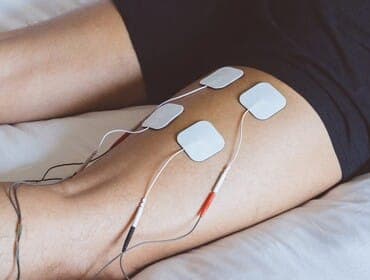

 Why do athletes use EMS?
If you are not yet familiar with the basics of how EMS works, it is worth first reading the EMS "main article" and the theoretical foundations of muscle stimulation. If, however, you are specifically interested in the sports context, you have found the right article.
 Key idea
Athletes can apply EMS in three main areas: strength development (50–80 Hz, targeting IIb fibers, 2–4 sessions/week), recovery (1–10 Hz, within 30–60 minutes after training, lactate clearance), and injury prevention / muscle maintenance (asymmetries, periods of inactivity). The 2022 systematic review by Borzuola (PMID 35856620) indicates that the most favorable strength gains are achieved by combining NMES with voluntary contractions (NMES+) – therefore EMS DOES NOT replace training but amplifies it.
The Medimarket sport‑dedicated EMS portfolio can be found in the sport‑stimulator category.
In the video I demonstrate how an athlete can use a muscle stimulator — for recovery, performance enhancement and injury prevention.
 Why does EMS work in the sports context?
During voluntary movement, according to Henneman's size principle, small slow motor units are activated first, and only when approaching maximal force (~75%) do the large fast (IIb) fibers come into play. Athletes chase these IIb fibers because they provide explosive power for maximal performance — reaching them requires fatiguing, heavy resistance work. EMS partially bypasses this: high frequency (50–80 Hz) directly stimulates IIa and IIb motor neurons, even when the athlete is not working at maximal effort.
This mechanism provides three concrete sport advantages:
- Time efficiency: passive stimulation provides an additional training stimulus, usable even during travel or sedentary work.
- Selectivity: a specific muscle group can be targeted — e.g., hamstrings for runners, quadriceps for cyclists.
- Faster recovery: at low frequency (1–10 Hz) the gentle rhythmic contractions can stimulate blood and lymphatic flow, aiding removal of metabolites.
The detailed mechanism (Henneman principle, motor units, fiber types) is described in the theoretical article on muscle stimulation. The 2022 Borzuola systematic review (PMID 35856620) also confirms that NMES combined with voluntary contractions produces stronger strength gains than purely passive EMS or purely conventional training.
 Five main benefits of EMS for the athlete
Sport‑oriented EMS use brings substantial value across five main dimensions:
Short (20–30 minute) low‑frequency stimulation (1–10 Hz) after training can aid blood and lymph flow and thereby accelerate lactate removal. The 2025 RCT by Zhou et al. (PMID 40321816, n=28 recreational rowers) showed that a 20‑minute TENS applied after a 2000 m ergometer effort significantly reduced blood lactate and sped quadriceps strength recovery compared with controls. The 2020 Barcala‑Furelos study (PMID 32806727) found the same after a lifesaving simulation: low‑frequency electrical stimulation produced lower lactate levels than passive rest.
In my experience the 30–60 minute post‑exercise window is the most useful time to apply recovery stimulation.
High‑frequency programs (50–80 Hz) target IIa and IIb fibers and complement traditional resistance training. The 2022 Borzuola systematic review (PMID 35856620) indicates that NMES combined with voluntary contractions (NMES+) most reliably increases muscle strength and mass — both in healthy athletes and in orthopedic rehabilitation. The 2024 Takeda RCT (PMID 38286427) measuring subthreshold NMES during sprint‑interval training reported increased blood lactate accumulation, a marker of higher anaerobic load — indicating that NMES adds extra metabolic stress to the same effort.
Many athletes have one side or one muscle group weaker than the other (e.g., after a previous injury). Traditional training struggles to load the weaker side unevenly because, following Henneman’s principle, the stronger side compensates. With EMS a given muscle group can be stimulated in isolation: placing electrodes only on the weaker side allows targeted reduction of asymmetry. Endurance, aerobic capacity, strength, explosiveness and muscle mass — all can be fine‑tuned and targeted by muscle group.
Ten days off after an ankle sprain, two weeks out for knee pain, or a 30+ hour transcontinental flight — each is enough for measurable strength loss. EMS is especially useful here: it does not move the joint but maintains action potentials and metabolism in the muscle. The 2020 Paradis‑Deschênes RCT (PMID 33239951) in endurance athletes confirmed that NMES during rest can effectively substitute for active recovery in terms of increased blood flow and lactate elimination when the athlete cannot move. Details of injury recovery are discussed in the EMS rehab article.
Serious injuries (Achilles rupture, ACL tear, rotator cuff tear) often result not from a single accident but from cumulative overload. With overtraining supercompensation cannot occur, progress stalls or reverses. A conscious training regime values recovery — sometimes supported by NMES — as much as the training itself. Professional athletes regularly integrate EMS into their weekly recovery blocks under sports‑medical supervision.
Pro vs. amateur athlete – what does EMS give to whom?
The time budget and training volume of professional and amateur athletes differ fundamentally — therefore the priorities for EMS benefits also differ.
| Aspect | Professional athlete (15–25 h/week) | Amateur / semi‑pro athlete (3–8 h/week) |
|---|---|---|
| Main benefit | Speeding recovery, avoiding overtraining | Compensating training time, correcting asymmetries |
| Weekly EMS volume | 4–6 sessions (recovery + specific strength blocks) | 2–3 sessions (supplement + asymmetry) |
| Typical protocol | 1–10 Hz recovery + 50–80 Hz strength block | 20–50 Hz general strengthening + 1–10 Hz |
| Risk | Too much stimulation = delayed recovery | Too little stimulation = no meaningful adaptation |
For both groups it remains true that EMS stimulation DOES NOT replace sleep, nutrition or physiotherapy. Aerobic base building, technical work and bodyweight motor control exercises form the foundation of performance in every sport — EMS is the fine tuning.
 Sport protocols – by goal and frequency
Practical protocols are tailored to the goal. The table below summarizes the most commonly used EMS program families:
| Goal | Frequency (Hz) | Pulse width (μs) | Session / frequency | Timing |
|---|---|---|---|---|
| Post‑training recovery | 1–10 Hz | 200–400 μs | 20–30 min / 3–5× week | Within 30–60 min after training |
| Aerobic endurance | 20–35 Hz | 200–400 μs | 25–35 min / 3–4× week | On aerobic days, independent of training |
| General muscle strengthening | 30–50 Hz | 200–400 μs | 15–25 min / 3× week | Within 24–48 h of strength training |
| Maximal strength development | 50–80 Hz | 200–400 μs | 15–20 min / 2–3× week | Within 60 min after resistance training |
| Explosiveness | 80–100 Hz | 200–400 μs | 10–15 min / 2× week | In cycles close to competition |
Exact program numbers and body‑part presets are available in Globus device built‑in protocols. International literature (Borzuola 2022, Takeda 2024) reinforces that EMS is most reliably used when combined with voluntary contraction — passive EMS alone yields only partial benefits.
How to place the electrodes?
Electrode placement is key to the effectiveness of sport EMS. The general principle: one electrode over the muscle belly (the most prominent point), the other close to the origin of the muscle, aligned with the direction of the fibers. Some sport‑specific examples:
- Running (m. quadriceps): one electrode in the middle of the thigh (toward vastus medialis and lateralis), the other on the upper third.
- Cycling (gluteus + quadriceps): with a 4‑channel device you can target gluteus and anterior thigh simultaneously.
- Swimming (m. latissimus dorsi): over the broad back muscle area, along the line below the scapula.
- Weightlifting (gluteus maximus, erector spinae): on the glute and paravertebral muscles (NOT on the spine!).
- Football (hamstring + quadriceps): for sprint preparation and injury prevention.
General rules: electrodes should not cross each other, should not be placed over joints or the spine, and MUST NOT be on the anterior neck carotid line. Details: polarity article and pad selection.
 Which EMS device to choose as an athlete?
The Medimarket sport‑targeted EMS portfolio is available in the sport‑stimulator category. This is the Globus Sport Pro line — designed specifically for athlete needs with sport‑specific built‑in protocols.
| Device | Positioning | Sport focus |
|---|---|---|
| Globus Runner Pro | Runner‑specific | Long and middle distance, sprint, hamstring + quadriceps protocols |
| Globus Cycling Pro | Cyclist‑specific | Quadriceps + gluteus + erector spinae, endurance and sprint |
| Globus Triathlon Pro | Multi‑sport | Combined swim + bike + run protocols |
| Globus Soccer Pro | Football‑specific | Sprint, change of direction, hamstring prevention |
| Globus The Champion | Multi‑sport premium | Several sports together, coach‑level program offering |
| Globus Activa 700 | HOME/SPORT transitional | Complex sport and rehab device in the mid‑range |
The broader EMS portfolio (Genesy, Elite line, the "Lito" family) is described in the EMS "main article". General EMS category: muscle stimulator category.
 When NOT to use EMS for sports?
EMS is generally well tolerated, but in some situations its application is not recommended or requires specialist supervision. The full list: electrotherapy contraindications.
- Implanted electronic device (pacemaker, ICD) – details: implant devices article
- Acute muscle, tendon or ligament injury in the fresh bleeding phase (a 3–4 day wait is recommended)
- Acute deep vein thrombosis, vascular inflammation
- Active or unknown tumor in the treatment area
- Acute fever, infectious condition
- Skin inflammation, wounds, fresh surgical wound in the treatment area
- Pregnancy (lower abdomen, lumbar area) – consult before use
- Doping rules: EMS is NOT on the doping list, but check sport‑specific rules with the respective federation
 Summary – what to take away?
- In the sports context EMS works in three main benefit directions: strength development, recovery, injury prevention.
- Recent 2020+ clinical evidence (Zhou 2025, Takeda 2024, Borzuola 2022, Paradis‑Deschênes 2020, Barcala‑Furelos 2020) confirms that TENS/NMES can aid blood‑lactate elimination and post‑exercise strength recovery.
- NMES combined with voluntary contraction produces stronger strength gains than purely passive stimulation — EMS DOES NOT replace training.
- Frequencies: 1–10 Hz recovery, 20–35 Hz aerobic, 30–50 Hz general strengthening, 50–80 Hz max strength, 80–100 Hz explosiveness.
- Pro: 4–6 sessions/week with recovery focus. Amateur: 2–3 sessions/week for asymmetry correction and training supplementation.
- Do NOT use at home in the presence of implanted devices, acute injury (allow 3–4 day window), pregnancy, or tumor without prior medical consultation.
Sport‑dedicated devices at Medimarket: sport‑stimulator category – the Globus Sport Pro line (Runner Pro, Cycling Pro, Triathlon Pro, Soccer Pro, The Champion) with sport‑specific protocols. Multi‑sport premium choice: Globus The Champion. Triathletes optimized: Globus Triathlon Pro. Mid‑range transitional: Globus Activa 700.
Frequently asked questions
No. The 2022 Borzuola systematic review (PMID 35856620) showed that the most reliable strength improvements occur with NMES combined with voluntary contractions. Passive EMS provides only partial benefits (recovery, asymmetry reduction), while cardiovascular load, coordination and sport‑specific movement patterns can only be developed through real training.
Both — but for different goals. Before training, a short (5–10 minute) medium‑frequency stimulation can serve as a warm‑up and activate target muscles. Within 30–60 minutes after training a low‑frequency (1–10 Hz) recovery program is recommended based on the 2025 Zhou study (PMID 40321816) — this is the most studied window for lactate elimination. Independent of training, on 24–48 hour recovery days you can perform longer (20–30 minute) protocols in calm conditions.
Globus Sport line devices (Runner, Cycling, Triathlon, Soccer Pro) include protocols optimized for the typical demands of each sport. This does not mean a runner cannot use Cycling Pro — rather, Runner Pro contains factory presets grouped for runners. Multi‑sport athletes may find Triathlon Pro or The Champion practical. The Globus Activa 700 or the Genesy line also include essential sport programs (without sport‑specific specialization).
No. EMS is not on the WADA (World Anti‑Doping Agency) list — stimulation does not introduce any foreign substance into the body. EMS is like a physiotherapy device or a weight. However, check competition‑specific regulations with the relevant federation.
For recovery use, effects can be perceived immediately after treatment (less muscle soreness, a quicker refreshed feeling). For strength development, meaningful gains typically require 4–8 weeks of regular application (Borzuola 2022, PMID 35856620). Muscle mass increases take longer (8–12 weeks). Exact results depend on the individual, sporting background and protocol.
Generally yes — but it depends on the current injury. After an acute muscle injury (strain, tear) wait 3–4 days until bleeding subsides. For joint injuries (ankle, knee, shoulder) EMS can be applied directly to the muscles around the joint because stimulation does not move the joint. Post‑operative use should be initiated in consultation with the treating physician or physiotherapist. Details: EMS rehab article.
Related articles
- EMS "main article" – electrical muscle stimulation
- Theoretical foundations of muscle stimulation – Henneman principle
- NMES rehab + sport
- WB‑EMS vs NMES
- EMS rehab – regaining muscle strength
- EMS body shaping programs
- EMS in practice
- Sport‑stimulator category (Globus Sport Pro)
- Electrode polarity
- Electrotherapy contraindications
 Scientific sources (2020+)
- Zhou Y, Mao X, Luo W, Qu K, Lu A, Zang J, Chen Y, Wu R, Wang D. The effect of transcutaneous electrical nerve stimulation on fatigue recovery in recreational rowers. PeerJ. 2025 Apr 29;13:e19388. DOI: 10.7717/peerj.19388 · PMID: 40321816
- Takeda R, Nojima H, Nishikawa T, Okudaira M, Hirono T, Watanabe K. Can Neuromuscular Electrical Stimulation Enhance the Effect of Sprint Interval Training? Int J Sports Med. 2024 Aug;45(9):672-677. DOI: 10.1055/a-2256-0285 · PMID: 38286427
- Borzuola R, Laudani L, Labanca L, Macaluso A. Superimposing neuromuscular electrical stimulation onto voluntary contractions to improve muscle strength and mass: A systematic review. Eur J Sport Sci. 2023;23(8):1547-1559. DOI: 10.1080/17461391.2022.2104656 · PMID: 35856620
- Paradis-Deschênes P, Lapointe J, Joanisse DR, Billaut F. Similar Recovery of Maximal Cycling Performance after Ischemic Preconditioning, Neuromuscular Electrical Stimulation or Active Recovery in Endurance Athletes. J Sports Sci Med. 2020 Nov 19;19(4):761-771. PMID: 33239951
- Barcala-Furelos R, González-Represas A, Rey E, Martínez-Rodríguez A, Kalén A, Marques O, Rama L. Is Low-Frequency Electrical Stimulation a Tool for Recovery after a Water Rescue? A Cross-Over Study with Lifeguards. Int J Environ Res Public Health. 2020 Aug 12;17(16):5854. DOI: 10.3390/ijerph17165854 · PMID: 32806727
This article provides general information and does not replace consultation with a sports physician, physiotherapist or coach. Home use of EMS is recommended with a CE/MDR‑certified medical device and according to the user manual. In the presence of implanted medical devices, acute injury, pregnancy or chronic disease, consult your treating physician before initiating treatment.

