
 What is the difference between WB-EMS and NMES?
I covered the basics of EMS technology in the EMS overview and the theoretical foundations of muscle stimulation articles. Sport applications are detailed in EMS for athletes, and rehab uses in NMES in rehabilitation and sport.
 Key idea
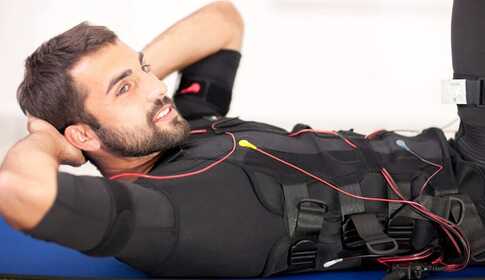
WB-EMS uses a specialized garment (including electrodes integrated into the suit) and stimulates 10–12 major muscle groups simultaneously—typically in supervised 20-minute studio sessions. NMES is a portable home device that targets one or a few muscle groups at a time using self-adhesive electrodes. The 2021 meta-analysis by Kemmler (PMID 33716787) found WB-EMS significantly increases muscle mass and strength, but does not reduce body fat by itself. The 2022 pilot by Bloeckl (PMID 35812334) found it safe in frail older adults. Both methods are complements to—not replacements for—conventional exercise programs.
 Precise definitions of the two methods
Although the basic electrical impulse is similar for both methods, their clinical positioning and modes of use differ fundamentally:
WB-EMS uses a specialized suit with wired electrode systems (vest, shorts, wrist and ankle straps) covering 10–12 major muscle groups simultaneously. The user receives stimulation through moist textile electrodes while performing light dynamic movements (squats, steps, trunk tensions). A "session" typically lasts 20 minutes in a supervised studio setting with an instructor, usually 1–2 times per week. The method saw strong growth in parts of Europe (Germany, Italy) during the 2010s and is available in fitness studios in Hungary as well.
NMES is a portable, home-usable device that stimulates target muscles or muscle groups via 2–4 channels with self-adhesive electrodes. Typical uses include sport-specific strength development (Globus Cycling Pro for cyclists, Runner Pro, etc.), post-operative rehabilitation (Rehalito, Myolito), and treatment of age-related muscle loss (sarcopenia). A session lasts 15–30 minutes per muscle group, typically 3–5 times per week. Only a limited area—usually one or two muscle groups—can be stimulated at a time.
Both WB-EMS and NMES operate with a biphasic square-wave electrical pulse. The polarity of the current reverses many times per second, which prevents subcutaneous electrochemical buildup and precisely targets the motor nerve fibers innervating the muscle. The biochemical process of muscle contraction is identical in both methods—the same ion channels open and calcium flows across the muscle fibers as when a command arrives from the brain. For details see the theoretical foundations article.
Detailed comparison – 10 dimensions
| Aspect | WB-EMS | NMES |
|---|---|---|
| Scope | 10–12 major muscle groups simultaneously | 1–2 muscle groups (2-channel), up to 4 (4-channel) |
| Treatment length | 20 minutes (typical) | 15–30 minutes per muscle group |
| Weekly frequency | 1–2 sessions (more is not recommended) | 3–5 sessions (depending on goal) |
| Location | Studio, supervised by an instructor | At home, independently or under physiotherapist supervision |
| Device acquisition | Subscription-based (studio service) | One-time purchase (own device) |
| Cost | ~12,000–40,000 HUF / 20 min; a 10-session package approaches an average monthly salary | ~50,000 HUF (entry) – ~200,000 HUF (PRO) one-time |
| Typical protocol | 85 Hz, 350 μs, 4s/4s stim/rest, medium-high intensity (Kemmler 2020) | Variable 1–80 Hz, 200–400 μs, targeted programs |
| Sport-specific protocol | General functional | Yes — Globus Cycling/Runner/Soccer/Triathlon Pro |
| Sarcopenia / older age | Yes, with instructor (Yang 2022, Bloeckl 2022) | Yes, at home (Xu 2025) |
| Safety profile | Requires greater attention (risk of rhabdomyolysis at extreme intensities) | Low — minimal side effects within approved parameter ranges |
 Safety – what you need to know about WB-EMS
WB-EMS is effective, but recent literature calls for increased attention to safety issues. The 2019 BMJ review by Stöllberger and Finsterer (PMID 31908835) listed seven documented cases of rhabdomyolysis following WB-EMS training—most were associated with unsupervised or excessively intense application. The underlying reason is that WB-EMS simultaneously elicits strong contractions across the entire musculature, which can produce substantial creatine kinase (CK) elevations even in healthy individuals. Recent clinical observations:
- Kemmler 2020 (PMID 32612355): in sarcopenic elderly men, combining WB-EMS with high protein intake produced a mild but significant CK increase (~140 U/L); no severe rhabdomyolysis occurred. Renal function (eGFR) did not worsen. Cardiac markers (hs-troponin T, CK-MB) showed slight increases but did not indicate increased heart failure risk.
- Bloeckl 2022 (PMID 35812334): an 8-week WB-EMS pilot in seven frail (mean 81 years) older adults—CK elevations were modest and transient; no participant reached the critical 5000 U/L threshold. No signs of rhabdomyolysis occurred. Significant improvements were observed in SPPB score, hand-grip strength and knee extensor strength.
- Stöllberger 2019: recommended screening protocol: medical consultation before starting WB-EMS to exclude rhabdomyolysis risk factors (statin therapy, malignant hyperthermia genetic predisposition, history of prior rhabdomyolysis, severe kidney disease).
Compared with NMES, WB-EMS uses a higher intensity threshold — which is why it can be effective in 20-minute sessions, but also why it is more sensitive to parameter settings. Basic rules for safe WB-EMS application:
- First session at a particularly low intensity (well below 30–40% of maximum).
- 48–72 hours of recovery between sessions.
- Gradual progression over several weeks—never jump large steps.
- Stay well hydrated after the session.
- Any new concerning symptoms (dark urine, severe muscle pain, muscle weakness) require immediate medical evaluation.
Home NMES devices operate within approved parameter ranges, so the risk of rhabdomyolysis is orders of magnitude lower. The 2024 evidence map by Beier (PMID 38339689) indicates that severe adverse events in WB-EMS trials are rare among the 86 trials reviewed—especially when training is conducted with a qualified instructor.
 For athletes – which is more practical?
Sports research supports a combined, selective approach. The 2022 systematic review by Borzuola (PMID 35856620) found that combining NMES with voluntary contractions (NMES+) produces greater strength gains than purely passive stimulation. The 2021 Kemmler meta-analysis (PMID 33716787) showed notable muscle mass increases with WB-EMS—although the participants were predominantly non-athletic adults.
When to choose WB-EMS?
- Recreational athletes short on time who want a whole-body training block in 20-minute sessions once or twice weekly.
- Older adults beginning strength training under professional supervision.
- Those who prefer to start in a studio setting before investing in their own device.
When NMES is more practical?
- When sport-specific protocols are required (Cycling Pro for cyclists, Runner Pro for runners, Triathlon Pro for triathletes—see the sport-stimulator category).
- When targeted strengthening of a specific muscle group (e.g. quadriceps, hamstrings) is needed.
- For asymmetry correction: only one side or muscle is weaker.
- For long-term use: a one-time investment in a personal device has good ROI over years.
- In rehab settings: after ACL or TKA surgery, premium PRO devices (Globus Genesy 600 or similar) offer targeted programs.
Modern literature emphasizes that the two methods are NOT competitors but serve different application contexts. The 2022 Qin RCT (PMID 36159315) found that WB-EMS’s effect on muscle strength is comparable to traditional resistance training—therefore no method universally "outperforms" the other; they simply operate within different logistical frameworks.
Rehabilitation: targeted NMES or whole-body WB-EMS?
After surgery or injury, targeted NMES is generally the more practical choice because:
- It can be precisely focused on the injured muscle group (e.g. quadriceps after ACL reconstruction)—there is no need to stimulate the whole body.
- The treating physician or physiotherapist can clearly set program parameters for the current rehabilitation phase.
- Home application on a daily basis is possible—no need to go to a studio every session.
- High intensity only affects the treated muscle, sparing surrounding tissues.
In rehab contexts WB-EMS may play a supplementary role, typically in the post-acute phase (6–12 weeks after surgery) and only under a qualified instructor. Details: EMS rehab article and muscle stimulation after surgery.
Older age and sarcopenia – both methods are effective
Recent meta-analyses support both methods for treating age-related muscle loss (sarcopenia) and sarcopenic obesity:
- The 2022 meta-analysis by Yang et al. (PMID 35798137) found that WB-EMS combined with protein supplementation reduces body fat percentage and waist circumference and increases appendicular skeletal muscle index in middle-aged and older individuals with sarcopenic obesity.
- The 2025 Xu meta-analysis (PMID 40362811) confirmed similar benefits with NMES combined with exercise and nutrition in complex programs.
- The 2022 Bloeckl pilot (PMID 35812334) showed WB-EMS can be applied safely in frail older adults with appropriate screening and instructor supervision.
Choice here depends on access and comfort: if there is a nearby WB-EMS studio and the patient is mobile, weekly whole-body sessions can be effective. If the patient is mobility-limited or prefers home care, an entry-level NMES device (e.g. Myolito or Rehalito) is more practical. In both cases regular exercise and adequate protein intake are required.
 Costs and accessibility
The cost structures of the two methods differ fundamentally—this is often decisive.
| Cost item | WB-EMS | NMES |
|---|---|---|
| Entry price | ~12,000–40,000 HUF / 20 min | ~50,000 HUF (Myolito) — one-time purchase |
| 10-session package | ~120,000–400,000 HUF | not applicable (own device) |
| Mid-range device | — | ~100,000–160,000 HUF (Globus Elite 150 / Cycling Pro / Runner Pro) |
| PRO device once | — | ~250,000–330,000 HUF (Globus Genesy 600 / 1500) |
| Ongoing cost | Monthly membership or per-session fee | Only electrode replacements (~10,000 HUF / 3–6 months) |
In my experience: a 10-session WB-EMS package costs about an average monthly salary in Hungary. Consider that a quality NMES device costs far less than an intensive WB-EMS package cycle and can be used for years. WB-EMS offers the studio experience and instructor feedback—NMES offers flexible, daily home availability.
If choosing NMES for home – which device to pick?
MediMarket’s NMES portfolio serves several target groups. Some orientation points:
| Device | Positioning | For whom? |
|---|---|---|
| Myolito | Entry-level EMS (HOME) | Beginners, focus on one muscle group |
| Globus Elite 150 | 4-channel mid-range | Regular home training + EMS |
| Globus Cycling Pro / Runner Pro / Soccer Pro / Triathlon Pro | Sport-specific 4-channel | Cyclists / runners / footballers / triathletes |
| Globus The Champion | Sport multifunctional premium | Athletes active in multiple sports |
| Globus Genesy 600 / Genesy 1500 | PRO multifunctional | For complex rehabilitation needs |
Devices dedicated to athletes: sport-stimulator category. Full EMS portfolio: muscle stimulator category.
 When should neither method be used?
Both methods are generally well tolerated, but in the following situations application is not recommended or requires increased medical supervision. Full list: electrotherapy contraindications. Applicable to both methods:
- An implanted electronic device (pacemaker, ICD, neurostimulator) — DO NOT use without specialist (cardiologist) approval!
- Acute vascular inflammation or deep vein thrombosis
- Active or unknown tumor in the treatment area
- Epilepsy, severe peripheral neuropathy (reduced sensation)
- Acute fever, infectious condition
- Dermatitis, wounds in the treatment area
- Pregnancy — especially avoid the lower abdomen and lumbar area
- Anterior triangle of the neck (carotid line) – electrode prohibition
- Severe kidney disease (particularly relevant for rhabdomyolysis risk with WB-EMS)
- On statin therapy or prior history of rhabdomyolysis — medical consultation before WB-EMS
In Hungary NMES devices and WB-EMS equipment are CE/MDR-certified medical devices, but NMES cannot be prescribed on a medical prescription.
 Summary – takeaways
- WB-EMS: 10–12 muscle groups simultaneously, 20-minute studio session with an instructor, 1–2 times weekly.
- NMES: Targeted stimulation of 1–2 muscle groups at home, 15–30 minutes per muscle group, 3–5 times weekly.
- Both methods use the same biphasic square-wave pulse—the application logistics differ.
- 2020+ clinical evidence: both methods can increase muscle mass and strength (Kemmler 2021, Borzuola 2022, Bloeckl 2022, Qin 2022, Yang 2022, Xu 2025).
- Neither method alone produces substantial body fat reduction—exercise plus nutrition is required.
- Safety: rhabdomyolysis screening is recommended for WB-EMS (Stöllberger 2019); home NMES within approved parameters carries minimal risk.
- Cost: WB-EMS is subscription-based (10 sessions ≈ average salary); NMES is a one-time purchase (50,000–330,000 HUF range).
Sport multifunctional pick: Globus The Champion. BEAUTY/HOME mid-range: Globus Activa 700. Entry-level home NMES: Myolito. Sport-specific: sport-stimulator category.
Frequently asked questions
This is often advertised in studio marketing. The current clinical evidence is more nuanced: the 2022 Qin RCT (PMID 36159315) found a 6-week WB-EMS program produced comparable gains in upper limb flexor strength to traditional resistance training—so the muscle load can be similar. However, WB-EMS DOES NOT replace cardiovascular training, coordination drills or sport-specific technical practice. Quantitative claims like "equal to 90 minutes" are unfounded—think of WB-EMS as complementary, not substitutive.
WB-EMS is safe with appropriate parameter selection and supervision, but the 2019 BMJ review by Stöllberger (PMID 31908835) reported seven documented cases of rhabdomyolysis following WB-EMS training. Rhabdomyolysis is significant muscle fiber breakdown that can impair kidney function (characterized by dark urine, muscle pain, muscle weakness). Because WB-EMS stimulates the whole body at once, muscle demand can be high even if the user feels little. Prevention: start at low intensity, progress gradually, allow 48–72 hours recovery, stay hydrated. Do not start WB-EMS without medical clearance if on statins, with prior rhabdomyolysis or severe kidney disease.
Yes, with qualified instructor supervision. The 2022 Bloeckl pilot (PMID 35812334) applied eight weeks of WB-EMS in seven frail older participants (mean age 81)—CK increases were modest and transient, no rhabdomyolysis occurred, and SPPB and grip strength improved significantly. The 2020 Kemmler study (PMID 32612355) also found WB-EMS + protein supplementation safe in sarcopenic elderly men. The key: medical consultation before starting and instructor supervision during sessions.
Not by itself. The 2021 Kemmler meta-analysis (PMID 33716787, 16 RCTs, n=897) found WB-EMS significantly increased muscle mass and strength but did not produce a significant change in body fat. In sarcopenic obesity, the 2022 Yang meta-analysis (PMID 35798137) showed WB-EMS combined with high protein supplementation reduced body fat percentage and waist circumference. Muscle stimulation is therefore an adjunct in a multimodal weight-loss program—calorie balance and nutrition remain dominant factors.
The choice depends on four factors: (1) access — is there a WB-EMS studio nearby? (2) budget — one-time NMES device vs recurring subscription; (3) goal — targeted single-muscle treatment (NMES) or general whole-body strength block (WB-EMS); (4) age/condition — frail or mobility-limited users may prefer home NMES. Many active athletes combine both: one WB-EMS whole-body block weekly + 3–4 NMES sessions per week using sport-specific protocols.
WB-EMS is NOT recommended with a pacemaker because electrodes around the chest directly affect the implanted device. For NMES, protocols applied to muscles distant from the pacemaker may be possible with cardiologist approval. The principle: with any implanted electronic device (pacemaker, ICD, neurostimulator) electrotherapy may only be started with the explicit permission of the specialist who manages the implant. Details: electrotherapy and implants article.
Related articles
- EMS overview
- Theoretical foundations of muscle stimulation – Henneman’s principle
- NMES rehab and sport
- EMS for athletes
- EMS rehab – regaining lost muscle strength
- Body shaping with EMS programs
- EMS in practice – electrodes, intensity, schedules
- Sport-stimulator category
- Electrotherapy contraindications
- Electrotherapy and implants
 Scientific sources (2020+, WB-EMS safety emphasized)
- Kemmler W, Shojaa M, Steele J, Berger J, Fröhlich M, Schoene D, von Stengel S, Kleinöder H, Kohl M. Efficacy of Whole-Body Electromyostimulation (WB-EMS) on Body Composition and Muscle Strength in Non-athletic Adults. A Systematic Review and Meta-Analysis. Front Physiol. 2021 Feb 26;12:640657. DOI: 10.3389/fphys.2021.640657 · PMID: 33716787
- Bloeckl J, Raps S, Weineck M, Kob R, Bertsch T, Kemmler W, Schoene D. Feasibility and Safety of Whole-Body Electromyostimulation in Frail Older People – A Pilot Trial. Front Physiol. 2022 Jun 24;13:856681. DOI: 10.3389/fphys.2022.856681 · PMID: 35812334
- Kemmler W, von Stengel S, Kohl M, Rohleder N, Bertsch T, Sieber CC, Freiberger E, Kob R. Safety of a Combined WB-EMS and High-Protein Diet Intervention in Sarcopenic Obese Elderly Men. Clin Interv Aging. 2020 Jun 24;15:953-967. DOI: 10.2147/CIA.S248868 · PMID: 32612355
- Stöllberger C, Finsterer J. Side effects of and contraindications for whole-body electro-myo-stimulation: a viewpoint. BMJ Open Sport Exerc Med. 2019 Dec 17;5(1):e000619. DOI: 10.1136/bmjsem-2019-000619 · PMID: 31908835
- Borzuola R, Laudani L, Labanca L, Macaluso A. Superimposing neuromuscular electrical stimulation onto voluntary contractions to improve muscle strength and mass: A systematic review. Eur J Sport Sci. 2023;23(8):1547-1559. DOI: 10.1080/17461391.2022.2104656 · PMID: 35856620
This article provides general information and does not replace specialist, physiotherapist or sports medicine consultation. Home or studio application of WB-EMS and NMES should be performed with CE/MDR-certified medical devices and according to the user manual. Before starting WB-EMS—especially in older age, with chronic disease, on statin therapy, or with a prior history of rhabdomyolysis—medical consultation is required. In the presence of an implanted medical device, electrotherapy may only be started with the permission of the implant-managing specialist.

