
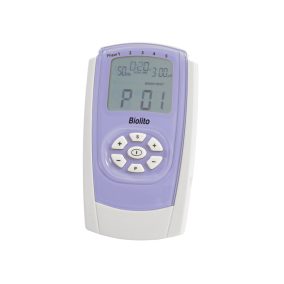
Electrotherapy device for treating stress, urge and mixed forms of incontinence, strengthening intimate (pelvic floor) muscles, postpartum rehabilitation, and home therapy for vaginal pain (vaginismus).
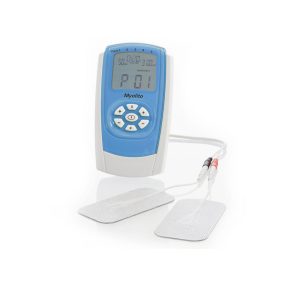
Myolito electrotherapy device with TENS, EMS and FES (incontinence) programs

The Prosecca band is a mechanical compression device for men: by applying gentle pressure to the urethra it prevents urine dribbling. Hygiene product.

The Fleur vaginal ball provides the simplest pelvic floor muscle training. Your muscles work involuntarily to keep the balls in place.

evoStim UG: 2-channel FES device / high-level incontinence treatment: stress, urge and mixed types / vaginismus treatment.

MyoBravo multifunctional electrotherapy device. TENS /EMS /FES. Programs supporting sports preparation.
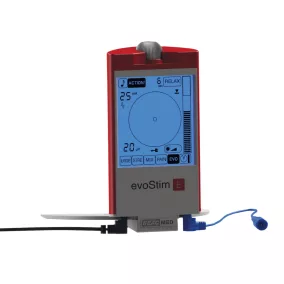
evoStim E stimulator with EMG-biofeedback / FES / ETS functions. Advanced incontinence therapy for stress, urge and mixed types. Vaginismus treatment.
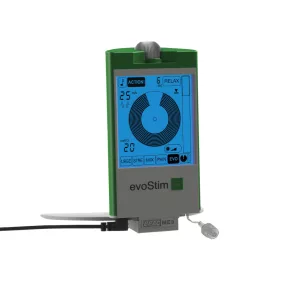
evoStim P: pressure-biofeedback / FES / ETS functions. Advanced incontinence treatment for stress, urge and mixed types. Vaginismus treatment.
Urine leakage is the difficulty of retaining urine and/or stool, resulting in the involuntary dribbling of stool and/or urine.
Our expert, Dr. Zátrok Zsolt, has compiled a free guide on incontinence and its treatment.
Different Forms of Urinary Leakage
Stress Urinary Leakage:
- Urine dribbles or leaks during simple actions such as laughing, sneezing, coughing, sitting up, and any other situation that puts pressure on the bladder.
- Excessive pressure causes the most common form of urinary leakage in women.
- During pregnancy or later around menopause, the tone of the pelvic floor muscles decreases, so they no longer properly support the bladder, which then descends somewhat into the vagina.
Urge Urinary Leakage:
- In this form of leakage, a sudden, intense urge to urinate occurs, which the patient is unable to suppress, resulting in uncontrollable urine release.
- There is usually very little time to reach the restroom before the “accident” occurs.
- In older age, bladder muscle overactivity increases and sphincter contraction deteriorates; together, these factors can lead to the development of urinary leakage.
Mixed Urinary Leakage:
- A mixed form of the above often occurs in women.
Treatment of Urine Leakage
In the treatment of urinary leakage, a gradual approach is recommended. It is advisable to start with the least risky treatment method and, if these prove ineffective, move on to more significant interventions such as surgery.
- Sphincter muscle strengthening
- Drug therapy
- Medical devices
- Surgery
Pelvic Floor Muscle Strengthening (Kegel exercises, perineal exercises, intimate exercises)
The exercises aim to strengthen the pelvic floor and bladder sphincter muscles. You should perform voluntary contractions at least 3–4 times a day. This is not easy because the muscles to be contracted are not easy to “find.” The advantage of intimate exercises is that they cost nothing. The drawback is that you must be very patient before seeing the first favorable effects—it can take months. If you stop, the effect disappears within a few weeks.
Muscle Training with Biofeedback
With a biofeedback device, you can take pelvic floor training to a higher level. The device provides feedback on muscle contractions and their quality, helping you perform the exercises correctly and “find” the right muscles.
Electrostimulation
During electrostimulation, mild electrical impulses are used to induce contractions of the pelvic floor muscles. A probe is placed in the vagina or rectum for the treatment. The impulse directly stimulates the bladder and pelvic floor sphincter muscles, producing a considerably stronger effect than intimate exercises alone. Electrostimulation is effective for stress, urge, and mixed forms of urinary leakage alike.
Advanced Biofeedback
Such devices combine a feedback sensor with an electrostimulator. When the device detects a voluntary muscle contraction, it applies a stimulation impulse to enhance the contraction, significantly improving the exercise’s efficiency. In this way, favorable effects can be noticed in just 2–3 weeks.

