
 What is 3S sequential stimulation, and who can benefit from it?
Home-use 2- or 4-channel muscle stimulators typically deliver the impulse on all channels at the same time – so the muscles also contract simultaneously. This is conventional NMES.
During natural movement, however, the muscles come into action one after another – this is what allows you to grasp a glass, lift it to your mouth, tilt it and take a sip. In certain situations, it is more beneficial if the stimulator operates not simultaneously, but with a programmed delay between the channels. This is sequential stimulation – the essence of the 3S system in Globus devices.
 Key point
3S sequential stimulation uses a 0.5-11 second delay between the channel pairs of Globus 4-channel devices. Channels 1-2 stimulate first, followed by channels 3-4 after a delay. This sequential “muscle pump” creates a mechanically upward-moving pressure wave in the limb – which is why it is particularly useful for reducing oedema, improving venous and lymphatic circulation, and regaining movement function after a stroke.
 How does the 3S sequential system work?
The 3S system follows three basic principles: activation of channel pairs, programmed delay and cycle completion. Let’s look at each one:
The four channels are divided into two pairs
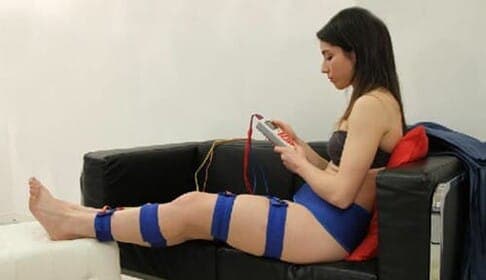
The 8 electrodes of a Globus 4-channel device (4 channels × 2 electrodes) are arranged in two pairs: channels 1-2 form one pair, and channels 3-4 the other. In 3S mode, the two pairs do not start simultaneously, but separately. A typical arrangement is channels 1-2 on the calf (or the affected distal muscles), and channels 3-4 on the thigh (proximal muscles).
Delay between 0.5 and 11 seconds
The delay between the two channel pairs depends on the selected programme. A short delay (<1 second) is particularly suitable for functional stimulation (e.g. stroke-gait FES), where the successive activation of agonist and antagonist muscles follows a movement pattern. A longer delay (2-11 seconds), on the other hand, is optimal for reducing oedema and improving venous circulation – here, the muscles “pump upwards” along the limb.
Work-rest cycles
In 3S, each channel pair follows a regular work-rest cycle – for example, 8 seconds of contraction + 5 seconds of active rest. The selected delay applies between the two pairs. The device repeats this cycle for the entire duration of the programme. The table below shows how it works using a 3-second delay as an example.
Example: 3S operation with a 3-second delay
| Channels 1-2 (e.g. calf) | Channels 3-4 (e.g. thigh) |
|---|---|
| Contraction 8 sec | Delay 3 sec |
| Delay 3 sec | Contraction 8 sec |
| Active rest 5 sec | Delay 3 sec |
| Delay 3 sec | Active rest 5 sec |
This cycle repeats throughout the entire programme. If the electrodes of channels 1-2 are on the calf and those of channels 3-4 are on the thigh, the oedema-reducing effect is directed from the bottom upwards – as if a “mechanical pump” were helping move fluid from the limb towards the heart.
3S programmes and delay times
You will find the 3S programmes in the device menu, within the PROGRAM LIST group. Their names refer to the delay time of channels 3-4:
| Programme name | Delay time | Typical application |
|---|---|---|
| SerSeqStim 0.5 s | 0.5 sec | Stroke FES, functional rehabilitation |
| SerSeqStim 1 s | 1 sec | Rehabilitation, agonist-antagonist coordination |
| SerSeqStim 2 s | 2 sec | Combined (rehabilitation + oedema) |
| SerSeqStim 3 s | 3 sec | Oedema reduction, improved venous circulation |
| SerSeqStim 4 s | 4 sec | Evening recovery, “flushing out” after muscle soreness |
| SerSeqStim serial | 11 sec | Deep oedema, complementary lymphatic therapy |

The most advanced devices also allow you to select the treatment area and frequency (Hz). For oedema and recovery treatments, it is advisable to choose a lower frequency.
 The key rule for electrode placement
For venous/lymphatic circulation treatment, the electrodes of channels 1-2 should always be placed on the part of the body farther from the heart (e.g. foot, calf, forearm), while channels 3-4 should be placed on the section closer to the heart (thigh, upper arm). This ensures that fluid is “pumped” towards the heart. If you place them the other way round, the effect will be reversed.
Where is 3S sequential stimulation useful?
Clinical studies indicate that sequential/multichannel NMES has several areas with demonstrated effectiveness. The 3S programme is designed to make these applications possible at home.
A 2025 systematic review (8 studies, 311 patients) confirmed that NMES improves oedema, leg pain, ulcer healing and quality of life in chronic venous disease by activating the calf muscle pump.3 The sequential protocol imitates the muscle-pump principle more directly than conventional simultaneous stimulation.
NMES has been shown to complement complex decongestive therapy in the treatment of lymphoedema following breast cancer treatment. In a 2022 clinical study (39 patients), electrotherapy added to CDT reduced lymphoedema volume, pain and functional disability more than CDT alone.1 A 2025 study also produced similar positive results for lymphoedema following surgery.2
NMES has a favourable effect in preventing venous thrombosis: according to a 2025 meta-analysis (14 RCTs), NMES applied to the calf muscle significantly increases peak femoral venous velocity and blood volume per unit of time.4 A 2022 RCT after hip surgery (64 patients) found that NMES increased femoral venous velocity by 43.2% and reduced calf diameter, thereby reducing DVT risk.5
Multichannel FES in patients with post-stroke hemiparesis – in which the peroneal, knee-extensor and knee-flexor muscles are stimulated sequentially according to a programmed timing pattern – is an increasingly studied area. A 2021 pilot RCT (40 patients) showed good feasibility (90% adherence). However, it did not provide a significant benefit over conventional gait training at follow-up. 6 Another study using a patient-specific profile produced a 23.4% improvement in the 10 m walking test and a 30% increase in walking speed.7 The evidence is therefore promising, but the precise application protocol is still developing.
Recovery use is based on the typical principle of “increased blood circulation”. The evidence is more nuanced than many people think: according to a 2025 systematic review and meta-analysis (19 RCTs), NMES does not significantly reduce post-exercise fatigue (DOMS, muscle soreness) immediately.8 Athletes should therefore not expect immediate relief from muscle soreness, but the circulation-enhancing effect may support longer-term recovery.
 What does research say about sequential stimulation?
“Is sequential NMES really better for chronic venous disease?”
Yes. A 2025 systematic review combined the results of 8 studies (311 patients): by activating the calf muscle pump, NMES clearly improves oedema, leg pain, ulcer healing and quality of life in chronic venous disease.3 The sequential pattern is the closest form of the muscle-pump principle that can be implemented at home.
“How much does it help with lymphoedema?”
A 2022 clinical study (39 patients) found that, in post-breast-cancer lymphoedema, electrotherapy added to complex decongestive therapy produced a significantly greater reduction in volume, less pain and better function than therapy alone.1 The 2025 study after surgery also showed similar positive results.2
“Does it really reduce the risk of venous thrombosis?”
According to a 2025 meta-analysis (14 randomised clinical trials), NMES significantly increases venous blood velocity (peak value: +1.18 m/s compared with control) and ejected blood volume in the leg veins.4 In a study after hip surgery (64 patients), NMES increased femoral venous velocity by 43.2%, compared with 16.3% in the control group.5
“Is it effective for gait rehabilitation after stroke?”
Multichannel, sequential FES (the hospital-clinical equivalent of the 3S principle) is a promising, developing area. A 2021 pilot RCT confirmed feasibility (90% adherence), but did not show significant superiority over conventional gait training.6 However, a study using a patient-specific profile measured a 23.4% improvement in the 10 m walking test and a 30% increase in walking speed.7
“How can it help with sports recovery?”
The circulation-enhancing effect is known, but the evidence for directly reducing muscle soreness is weak. According to a 2025 meta-analysis (19 RCTs), post-exercise NMES has no statistically significant effect on immediate relief of DOMS.8 So do not expect an “immediate miracle” – but the circulation-enhancing effect may support longer recovery.
The key point in brief
The best-documented areas for sequential NMES are venous disease, lymphoedema treatment and DVT prevention. The 3S sequential protocol imitates the muscle-pump principle more directly than conventional NMES. It is a promising but developing area in stroke rehabilitation. In sports recovery, the circulation-enhancing effect is realistic, while the claim of “immediate relief from muscle soreness” is less well supported.
 Which Globus devices include 3S?
3S sequential stimulation was specifically developed by Globus. The devices below include it – the number of programmes varies by device category:
| Number of 3S programmes | Device models |
|---|---|
| 12 types | Genesy 300 Pro, Genesy 600 |
| 18 types | Premium 400, Cycling Pro, Runner Pro, Soccer Pro |
| 36 types | Elite 150, Activa 700 |
| 54 types | Triathlon Pro, The Champion, Genesy 1500, Genesy 3000 |
Accessory: elastic strap electrode
The 3S programmes can also be performed using the standard self-adhesive electrodes supplied with the device. However, the separately available elastic strap electrode simplifies treatment:
- A much larger, circular stimulation area than with self-adhesive electrodes
- Can be reused many times – regular replacement is not necessary
- Quick to use – reusable after cleaning the strap
- Ideal for treating the upper and lower limbs because the current is distributed circularly around the entire circumference of the strap
- Especially useful for the thigh: the front and back of the thigh can be treated together
Note: the elastic straps are specifically suitable for improving muscle tone and for circulation-enhancing treatments. They are not suitable for specific strengthening programmes (motor-point-targeted NMES), because they do not concentrate the current on a particular motor point.
 Before you start 3S treatment
In the following situations, 3S sequential stimulation is contraindicated or requires consultation with a specialist:
- Active deep vein thrombosis (DVT) – the muscle pump may dislodge part of the thrombus – urgent medical care is required; do not start treatment at home.
- Severe heart failure, decompensated cardiac arrhythmia – increased venous return may cause unwanted additional strain.
- Implanted pacemaker, ICD or other active implant – the current may interfere with the device’s operation.
- Pregnancy – treatment of the abdomen and lower back is prohibited at every stage of pregnancy.
- Active malignant tumour in the treatment area – avoid the affected region.
- Epilepsy or another condition involving seizures – stimulation may act as a trigger.
- Dermatitis, eczema or wounds in the electrode area – the skin must be intact.
- Recently operated area – wait for the wound to heal and start only with medical approval.
- Severe kidney disease, dialysis – increased venous return may place additional strain on the body; obtain nephrology approval.
- Acute fever or infectious disease – wait until you have recovered.
Further reading
For the complete list of contraindications and technology-specific information, read our article on contraindications to electrotherapy.
Frequently asked questions
Conventional NMES activates all channels simultaneously – every muscle contracts at the same time. 3S sequential stimulation uses a 0.5-11 second delay between the channel pairs: channels 1-2 stimulate first, followed by channels 3-4 after a delay. This “muscle pump” principle is more similar to natural movement.
The best-documented areas are the treatment of venous disease and varicose-vein-related oedema,3 lymphoedema therapy,1, 2 and DVT prevention after hospitalisation.4, 5 Multichannel gait FES after stroke is also promising, although it remains a developing area.6, 7
The circulation-enhancing effect is documented. However, according to a 2025 meta-analysis (19 RCTs), post-exercise NMES does not significantly reduce muscle-soreness pain (DOMS) immediately.8 So do not expect an “immediate miracle” – 3S is more likely to support longer-term recovery through its circulation-enhancing effect.
The electrodes of channels 1-2 should always be placed on the part of the body farther from the heart (e.g. calf, foot, forearm). The electrodes of channels 3-4 should be placed on the section closer to the heart (thigh, upper arm). In this way, the 3S programme “pumps” fluid upwards. Reversing the arrangement pushes fluid in the opposite direction – do not place them the wrong way round!
The entry-level option is the Genesy 300 Pro or Genesy 600 (with 12 types of 3S programme). If you are an athlete and also want to focus on recovery: Premium 400 or the sports device range (with 18 types of programme). For clinical-level use: Genesy 1500 or 3000 (with 54 types of programme).
For oedema-reducing and circulation-enhancing use, 20-30 minutes once or twice daily is typical. Set the intensity so that you clearly feel the contraction, but the treatment is not painful. Improvement may be noticed after 2-4 weeks of regular use.
 Summary – Quick overview
Sources
- Hemmati M, Rojhani-Shirazi Z, Zakeri ZS, Akrami M, Salehi Dehno N. (2022). The effect of the combined use of complex decongestive therapy with electrotherapy modalities for the treatment of breast cancer-related lymphedema: a randomized clinical trial. BMC Musculoskeletal Disorders 23(1):837. PubMed: 36057658
- Wu Q, An L, Xu L, et al. (2025). Complex decongestive therapy combined with needle electrode stimulation facilitates postoperative rehabilitation of lymphedema. Journal of Vascular Surgery: Venous and Lymphatic Disorders 14(1):102337. PubMed: 41043548
- Santos M, Pires R, Ferreira J, Dias-Neto M. (2025). Effects of neuromuscular electrical stimulation on symptoms of chronic venous disease of the lower limbs: A systematic review. Vascular Medicine 31(1):114-123. PubMed: 41055697
- Xu Y, Li Y, Chai Z, Tao Y, Lin H, Zheng C. (2025). Effectiveness of neuromuscular electrical stimulation in preventing venous thromboembolism: A meta-analysis based on randomized controlled trials. Clinical and Applied Thrombosis/Hemostasis 31:10760296251366423. PubMed: 41105602
- Calbiyik M, Yılmaz S. (2022). Role of neuromuscular electrical stimulation in increasing femoral venous blood flow after total hip prosthesis. Cureus 14(9):e29255. PubMed: 36277586
- van Bloemendaal M, Bus SA, Nollet F, Geurts ACH, Beelen A. (2021). Feasibility and preliminary efficacy of gait training assisted by multichannel functional electrical stimulation in early stroke rehabilitation: A pilot randomized controlled trial. Neurorehabilitation and Neural Repair 35(2):131-144. PubMed: 33410388
- Lim J, Lim T, Lee J, Sim J, Chang H, Yoon B, Jung H. (2021). Patient-specific functional electrical stimulation strategy based on muscle synergy and walking posture analysis for gait rehabilitation of stroke patients. Journal of International Medical Research 49(5):3000605211016782. PubMed: 34038206
- Canez MS, da Silva LI, Ferreira GD, de Araújo FX, Luza LP. (2025). Effects of photobiomodulation, intermittent pneumatic compression and neuromuscular electrical stimulation on muscle recovery: Systematic review with meta-analysis. Journal of Bodywork and Movement Therapies 44:570-584. PubMed: 40954632